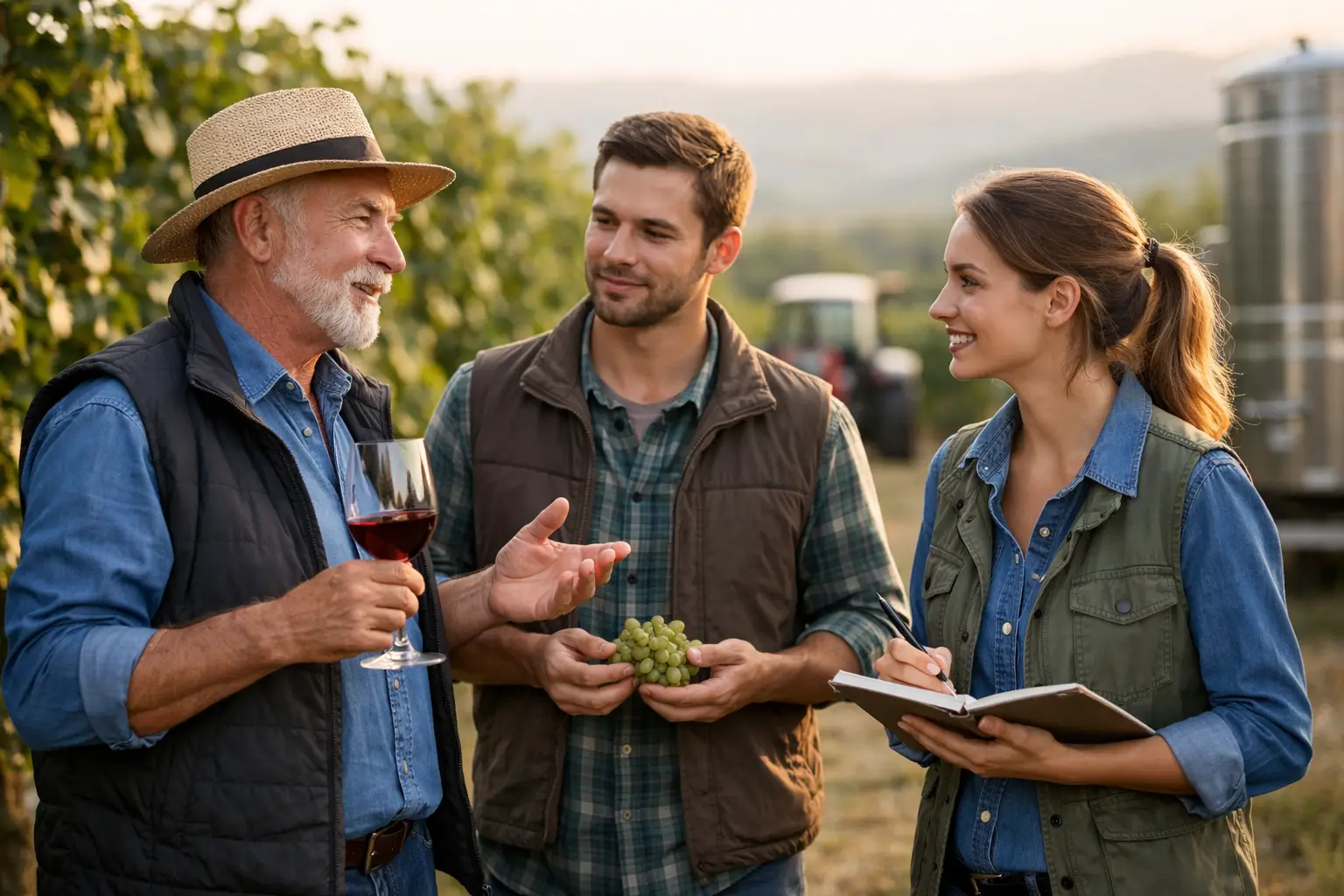
A cellar can be a laboratory, a workshop, and a courtroom of taste. A young winemaker may arrive with formal training, sharp instincts, and a notebook full of questions. But the lessons that endure are often delivered beside a fermenting tank, during a predawn vineyard walk, or over a sample that is almost right. That is how winemakers mentor future generations: not by handing down a fixed recipe, but by teaching people how to see, taste, question, and decide.
For California wine, no figure better embodies that tradition than Andre Tchelistcheff. Miraculously rescued from the upheaval of revolutionary Russia, trained in the sciences of fermentation in France, and drawn to Napa Valley in the late 1930s, he became a giant among his peers. His work at Beaulieu Vineyard helped reinvent American winemaking. Just as consequentially, his generosity with knowledge created a lineage that reached far beyond any one estate.
Mentorship Begins With Standards
A mentor does not merely reassure. The best winemakers establish a standard so exacting that it changes what their students believe is possible. Tchelistcheff brought European scientific discipline to a young California industry still defining its ambitions. He advocated meticulous sanitation, careful temperature control, sound barrel practices, and an unblinking respect for the fruit.
Those methods mattered because they made quality repeatable. A great vintage can flatter nearly anyone. A true professional learns to make intelligent choices when weather is difficult, fermentation turns volatile, or a promising lot loses its balance. The mentor’s task is to make judgment visible: why a barrel should be moved, why a wine needs time, why intervention may be necessary, and why restraint can sometimes be the most difficult choice of all.
For an apprentice, this can feel severe. Wine is deeply personal work, and criticism lands close to the heart. Yet a cellar culture that avoids honest critique does no one a favor. The mentor who says, “Taste again,” offers more than correction. They invite the next generation to develop the patience and humility on which serious craft depends.
How Winemakers Mentor Future Generations in the Cellar
The most durable wine education is sensory. Books can explain malolactic fermentation or the role of oak, but they cannot fully convey the scent of a ferment that is running too hot, the texture of tannin that has not yet settled, or the quiet moment when a blend finds its center. Those recognitions are earned through repetition, comparison, and conversation.
Experienced winemakers teach by bringing younger colleagues into the decision itself. They taste through lots together. They revisit samples over days and months. They ask an emerging winemaker to describe what they perceive before supplying an answer. This approach is slower than issuing instructions, but it creates independent thinkers rather than permanent assistants.
It also teaches that wine is a chain of consequences. A picking decision shapes acidity. A cap-management choice changes extraction. A barrel program influences aroma, texture, and longevity. The young winemaker begins to understand that technical knowledge and aesthetic judgment are not opponents. They are partners, each correcting the excesses of the other.
Tchelistcheff was revered not simply for being right, but for insisting on inquiry. His influence was felt in the careers of many California vintners who carried his lessons into their own wineries. They did not all make identical wines. That is the point. A meaningful mentor transmits principles, not replicas of himself.
The Vineyard Is Part of the Lesson
Mentorship that begins at the crush pad is already late. Great winemakers lead future generations back into the vineyard, where the story of a vintage first takes shape. They teach young colleagues to read soils, drainage, exposure, canopy growth, vine stress, and changing weather patterns. They show that a celebrated appellation is not a guarantee of excellence. It is a responsibility.
This is particularly urgent in Napa Valley, where land values, climate pressure, labor realities, and public expectations place extraordinary demands on every grower and producer. The next generation must honor the region’s hard-won reputation without treating its past as a museum piece. Some sites may require new farming practices. Some varieties may need reconsideration. The essential discipline is to adapt without losing the commitment to quality that made the valley matter.
A mentor can help distinguish innovation from novelty. New tools, data, and techniques can improve precision and sustainability. But technology cannot replace a winemaker’s attention to living vines, changing seasons, and the people whose labor brings fruit to the cellar.
A Legacy Is Carried Through Generosity
Wine history is often told through famous labels, landmark vintages, and decisive judgments. Those milestones deserve their place. Yet the industry’s most enduring achievements also emerge from acts of professional generosity: a veteran opening a cellar door, sharing a hard-won observation, recommending a young colleague for an opportunity, or allowing a protégé room to make and learn from a mistake.
This is especially meaningful in an industry shaped by migration. Tchelistcheff arrived in the United States carrying knowledge forged across continents and amid personal survival. He became one of the defining architects of modern California wine because he joined inherited European expertise to American possibility. His life reminds us that mentorship is never simply backward-looking. It transforms what has been preserved into something newly possible.
The mentor-protégé relationship also benefits the mentor. Younger winemakers bring unfamiliar references, new scientific tools, and a willingness to challenge assumptions that may have hardened into habit. The exchange works best when respect travels in both directions. Experience provides context; fresh perspective tests its limits.
Not every promising winemaker needs the same kind of guidance. Some need technical rigor. Others need help finding confidence in their palate or learning the business realities behind a bottle. A small family winery may offer intimate, hands-on instruction, while a larger producer can expose a trainee to specialized teams and complex operations. Neither path is automatically superior. What matters is access to serious work, candid feedback, and mentors who take another person’s potential seriously.
Preserving the Stories Behind the Wine
There is another form of mentorship that reaches beyond the vineyard and cellar: preserving memory. When the people who built an industry are reduced to a few dates on a tasting-room wall, future generations lose the human scale of the work. They lose the failures, risks, migrations, rivalries, and improbable meetings that explain how a region became great.
For wine lovers, these stories deepen the experience of the glass. For winery families and industry professionals, they create a clearer sense of stewardship. And for young people considering a life in wine, they reveal that the field has always been built by individuals willing to learn across boundaries of nationality, class, language, and custom.
Maestro Productions approaches the legacy of Andre Tchelistcheff in that spirit: as history with motion, stakes, and continuing consequence. His story belongs not only to Napa Valley but to the larger American story of resilience, scientific mastery, and cultural reinvention.
The Next Vintage of Leadership
The future of wine will not be secured by preserving every old practice unchanged. It will be secured by passing on the values beneath the practices: rigor, curiosity, patience, hospitality, and reverence for place. The finest mentors teach emerging winemakers to protect those values while meeting conditions their predecessors could not have imagined.
For anyone who cares about California wine, the invitation is clear. Ask who taught the people behind the bottle. Listen for the names that surface in cellar stories. Support the institutions, wineries, and storytellers preserving these histories. A mentor’s greatest vintage is not the wine left in the cellar, but the judgment, courage, and generosity that continue in the hands of someone else.