The Judgment of Paris 1976: How a Blind Tasting Changed Wine Forever—and Why André Tchelistcheff Deserves Part of the Credit
Every great wine region has a defining moment.
For Bordeaux, it was the 1855 Classification.
For Champagne, it was centuries of refinement.
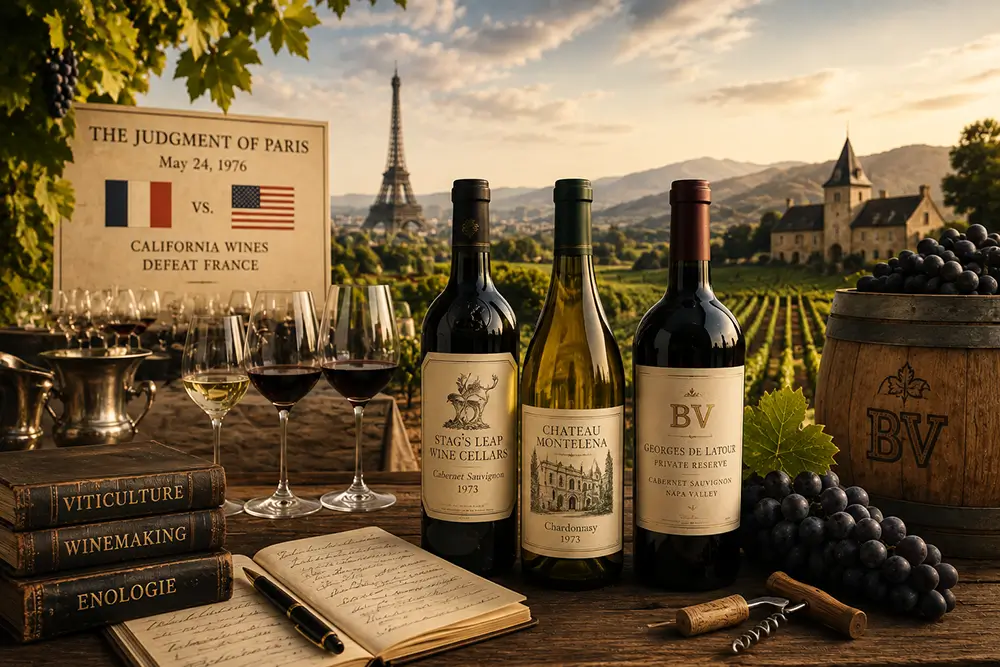
For Napa Valley, everything changed on May 24, 1976, during an event now known simply as The Judgment of Paris.
What began as a small blind tasting organized by a British wine merchant unexpectedly became one of the most influential moments in modern wine history. It shattered centuries of assumptions, elevated California onto the global stage, and permanently changed how the world judged fine wine.
But behind this historic victory stood a man who wasn’t even seated at the tasting table.
His name was André Tchelistcheff.
Long before Napa Valley defeated France, André Tchelistcheff had quietly spent decades laying the scientific and philosophical foundation that made this victory possible.
What Was the Judgment of Paris?
In 1976, British wine merchant Steven Spurrier, who owned a wine shop and wine school in Paris, organized a blind tasting to celebrate the United States Bicentennial.
The concept seemed simple.
Invite some of France’s most respected wine experts.
Pour elite French wines alongside a handful of California wines.
Ask the judges to score every wine without knowing its identity.
Almost everyone assumed the French wines would dominate.
After all, France had been producing world-class wines for centuries, while California was still considered an ambitious newcomer.
No one expected history to change that afternoon.
The Unexpected Results That Shocked the Wine World
When the scores were finally revealed, something extraordinary had happened.
A California Chardonnay ranked above Burgundy’s finest white wines.
Even more astonishing, a California Cabernet Sauvignon outperformed some of Bordeaux’s most prestigious estates.
The winning wines were:
- 1973 Chateau Montelena Chardonnay
- 1973 Stag’s Leap Wine Cellars Cabernet Sauvignon
The French judges themselves had unknowingly selected California wines as the best in the tasting.
The room fell silent.
Within days, newspapers around the world reported that California had defeated France on its own turf.
The event became known as The Judgment of Paris, borrowing its name from Greek mythology, where Paris was asked to judge the fairest goddess.
Why the Judgment of Paris Changed Wine Forever
The tasting proved something revolutionary.
Great wine was no longer defined solely by geography or centuries of tradition.
Excellence could emerge wherever passionate people combined exceptional vineyards with outstanding winemaking.
The event transformed global perceptions almost overnight.
Wine collectors began paying attention to California.
International critics started reviewing Napa Valley wines seriously.
Investment flowed into American wineries.
Young winemakers gained confidence to innovate instead of simply copying Europe.
For the first time, Napa Valley was viewed not as an imitation of Bordeaux—but as one of the world’s truly great wine regions.
André Tchelistcheff: The Architect Behind Napa’s Success
Although André Tchelistcheff did not compete in the Judgment of Paris, his influence was everywhere.
By 1976, he had already spent nearly four decades transforming California winemaking.
At Beaulieu Vineyard, he introduced scientific vineyard management, temperature-controlled fermentation, improved sanitation, careful barrel aging, and a deep respect for terroir.
More importantly, he mentored an entire generation of California winemakers.
Many of the people who built Napa Valley’s reputation learned directly from him or were influenced by his philosophy.
His belief was simple:
Great wine begins in the vineyard—but reaches its full potential only through precision, patience, and respect for the fruit.
Those principles became the blueprint for modern California wine.
The Invisible Hand Behind the Winners
The wineries that triumphed in Paris were different in style, ownership, and philosophy.
Yet they shared something important.
They belonged to a Napa Valley that had been reshaped by André Tchelistcheff.
His work helped establish:
- Scientific vineyard management.
- Lower-yield, higher-quality grape growing.
- Modern cellar hygiene.
- Better oak aging techniques.
- Long-term aging potential.
- Vineyard-focused winemaking instead of mass production.
These practices dramatically improved wine quality across the region.
While Tchelistcheff didn’t make the winning wines himself, many historians believe the victory would have been far less likely without the standards he introduced decades earlier.
Why Is Napa Valley Now One of the World’s Greatest Wine Regions?
The Judgment of Paris made headlines.
But headlines alone don’t create legendary wines.
Napa Valley earned its reputation through decades of continuous improvement.
Today, the region combines several unique advantages.
Its Mediterranean climate provides warm days and cool nights, allowing grapes to ripen slowly while preserving freshness and acidity.
The valley contains dozens of distinct soil types, volcanic hillsides, gravel benches, river sediments, and mountain vineyards, creating remarkable diversity within a relatively small area.
Generations of winemakers continue to experiment while respecting traditional craftsmanship.
Most importantly, Napa producers maintain an unwavering commitment to quality over quantity.
This philosophy reflects many of the values André Tchelistcheff championed throughout his career.
More Than a Victory Over France
Many people describe the Judgment of Paris as “America beating France.”
That interpretation misses the deeper story.
The event was never about proving France was no longer capable of producing extraordinary wine.
Instead, it demonstrated that greatness is earned—not inherited.
Exceptional vineyards, dedicated growers, scientific understanding, and relentless attention to detail can produce remarkable wines anywhere in the world.
That lesson continues to inspire wine regions across every continent.
André Tchelistcheff’s Legacy Lives On
Today, nearly every premium Napa Valley winery follows principles that André Tchelistcheff helped introduce.
His influence can be found in meticulous vineyard management, balanced Cabernet Sauvignon, elegant aging, and the pursuit of wines that improve over decades.
Modern Napa Valley is built upon the foundation he created.
Every collector who opens a great Napa Cabernet…
Every visitor who tours a world-class winery…
Every winemaker striving for excellence…
Benefits from a legacy that began long before the Judgment of Paris.
Discover the Story Behind Every Great Bottle
The Judgment of Paris was not an accident.
It was the result of vision, innovation, and decades of dedication from pioneers like André Tchelistcheff, whose work transformed California from an emerging wine region into one of the world’s most respected.
At Wine Elf, we believe every great bottle tells a story. Explore legendary wineries, discover iconic vintages, learn about the people who shaped modern winemaking, and experience the history behind the wines that changed the world.