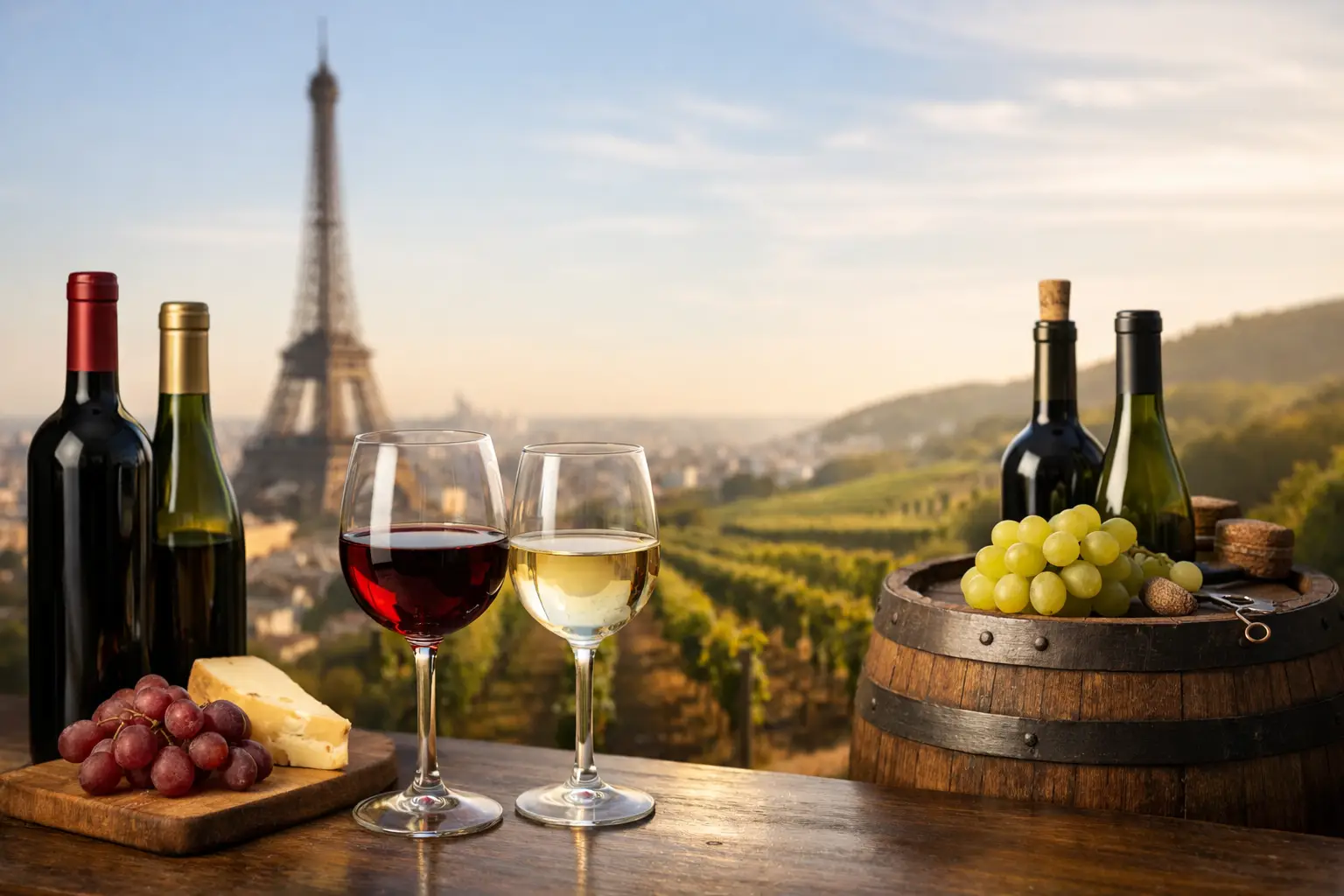
On May 24, 1976, a handful of California wines entered a Paris tasting with little expectation of glory. By the afternoon’s end, two had surpassed celebrated French wines in a blind judging. The Judgment of Paris wine history is often told as an upset, and it was. But its deeper meaning is more compelling: it marked the moment a region long dismissed by Europe proved that American wine could stand among the world’s finest.
The event did not create Napa Valley’s ambition. It revealed what years of risk, scientific discipline, immigrant expertise, and patient vineyard work had already begun to achieve. Its legacy belongs not only to the bottles poured in Paris, but to the people who made California believe it could build a lasting culture of great wine.
The Judgment of Paris wine history begins before 1976
The tasting was organized by Steven Spurrier, an English wine merchant living in Paris. To commemorate the American bicentennial, Spurrier and his colleague Patricia Gallagher arranged a blind tasting at the InterContinental Hotel in Paris. The premise was deceptively simple: French judges would assess California Chardonnay against white Burgundy, then California Cabernet Sauvignon against leading Bordeaux.
At the time, the proposition carried a faint air of theater. France was the accepted center of fine wine. Burgundy and Bordeaux represented centuries of accumulated knowledge, famous estates, established markets, and cultural authority. California, by contrast, was still fighting to be taken seriously beyond its own borders.
Yet Napa Valley had been changing rapidly. Prohibition had devastated many American wineries. The postwar years brought recovery, but also a more consequential shift: a new generation of vintners began treating winemaking as an exacting craft rather than a secondary agricultural enterprise. They planted better sites, studied European methods, refined cellar practices, and learned that California’s generous sunshine required restraint as much as confidence.
Among the towering figures shaping that transformation was André Tchelistcheff. A Russian-born enologist who survived revolution, exile, and war before reaching California, Tchelistcheff arrived at Beaulieu Vineyard in 1938 and helped reinvent American winemaking. His work advanced temperature-controlled fermentation, careful sanitation, oak aging, vineyard selection, and the belief that a California wine could express both place and elegance.
He was not the organizer of the Paris tasting, nor the maker of its two winning wines. That distinction matters. But his influence ran through the culture that made the result possible. As a teacher, mentor, and giant among his peers, Tchelistcheff helped establish the professional standards by which Napa’s next generation could compete.
The wines that stunned the judges
The white-wine winner was the 1973 Chateau Montelena Chardonnay, made by Mike Grgich for owner Jim Barrett. Grgich, a Croatian-born winemaker whose own journey reflected the immigrant energy of California wine, crafted a Chardonnay with balance, freshness, and structure. Against prestigious Burgundies, it finished first.
The red-wine result was equally dramatic. The 1973 Stag’s Leap Wine Cellars SLV Cabernet Sauvignon, made by Warren Winiarski, took the top position in the Cabernet tasting. Its success carried special resonance. Cabernet Sauvignon was Bordeaux’s great red grape, and Bordeaux was the standard against which serious Cabernet was measured. A young Napa winery had defeated that standard on French soil.
The judges did not know the wines’ identities when they scored them. That blind format gave the tasting its force, though it also deserves a measure of perspective. Wine evaluation is never a machine of perfect certainty. Palates differ. Bottle condition, serving order, mood, context, and individual preference can influence a result. One tasting cannot settle every argument about quality.
But this was never merely an argument about whether one California wine was “better” than one French wine on one day. The result shattered a much larger assumption: that California could not belong in the same conversation. The wines had earned their place at the table, and the world had watched it happen.
The story reached a far wider audience because journalist George Taber reported on the tasting for Time magazine. His article gave the event a name that endured: the Judgment of Paris. The phrase evoked classical competition and cultural consequence, turning an afternoon of blind judging into a defining chapter in American wine history.
Napa’s victory was not an overnight miracle
The popular version of the story can make it seem as though Paris transformed Napa overnight. In reality, recognition came through a longer and less glamorous process. Growers had to improve vineyard sites. Wineries had to finance barrels, equipment, and aging programs. Sales teams had to persuade skeptical restaurants, retailers, collectors, and consumers to give American fine wine a chance.
The Judgment of Paris accelerated that work by giving California a powerful symbol. It gave collectors permission to look beyond Europe. It gave journalists a clear narrative. It gave young winemakers a standard of possibility. And it gave Napa Valley an identity that could travel around the world.
That identity was not built on imitation alone. Early California winemakers drew deeply from European traditions, and wisely so. They learned from Bordeaux, Burgundy, Champagne, Germany, Italy, and elsewhere. But the most enduring success came when they adapted those lessons to California’s soils, climate, fruit, and growing conditions.
This is where the story becomes richer than a France-versus-California contest. Great wine regions do not mature by rejecting tradition. They mature by understanding it well enough to develop an authentic voice. Napa’s finest wines gained stature when they stopped asking whether they could copy Europe and began proving that they could express their own place with discipline and distinction.
The human legacy behind the bottles
The Judgment of Paris is also a story of migration. Tchelistcheff came from Russia. Grgich came from Croatia. Many of Napa’s most consequential figures arrived from elsewhere or were shaped by families who had. They brought technical knowledge, resilience, and a willingness to begin again in a landscape that had not yet achieved global prestige.
That pattern matters because Napa’s ascent was never inevitable. It depended on people who saw potential before the market rewarded it. It depended on proprietors willing to invest in vineyards and cellars, growers willing to experiment, and winemakers willing to accept that a difficult vintage or a costly decision might still be necessary in pursuit of quality.
The 1976 tasting also reminds us that wine is cultural memory in liquid form. A bottle can carry the weather of a season, the choices of a cellar, the character of a vineyard, and the values of a community. When Chateau Montelena and Stag’s Leap Wine Cellars were announced as winners, they represented far more than individual labels. They stood for a region that had learned to take its own potential seriously.
For institutions, wineries, and storytellers, that makes the Judgment of Paris an unusually fertile historical subject. It contains suspense, rivalry, craftsmanship, migration, commerce, and an unmistakable cinematic reveal. Yet its lasting power comes from the quieter scenes before Paris: the laboratory work, the pruning decisions, the harvest pressure, the mentoring conversations, and the conviction that California could make wine worthy of aging and attention.
Why the story still matters
Today, Napa Valley is recognized worldwide, but recognition brings its own responsibilities. Prestige can harden into complacency. Rising costs, changing climate conditions, shifting consumer habits, and consolidation continue to test the industry. The lesson of 1976 is not that one victory guarantees greatness. It is that excellence must be renewed through care, curiosity, and an uncompromising respect for craft.
The event’s legacy should also make room for humility. French wine did not lose its importance when California won a blind tasting. France remains foundational to the world’s wine heritage. What changed was the map of possibility. Great wine could emerge from more places, speak in more accents, and command serious attention beyond the old centers of authority.
For a visitor standing among Napa vines, a collector opening an older California Cabernet, or a young winemaker deciding how much risk to take, the most useful lesson is simple: history turns when preparation meets courage. The Judgment of Paris was one afternoon in a hotel dining room. Its real victory was the generation of masters who had prepared California for that moment – and the generations still called to carry the work forward.