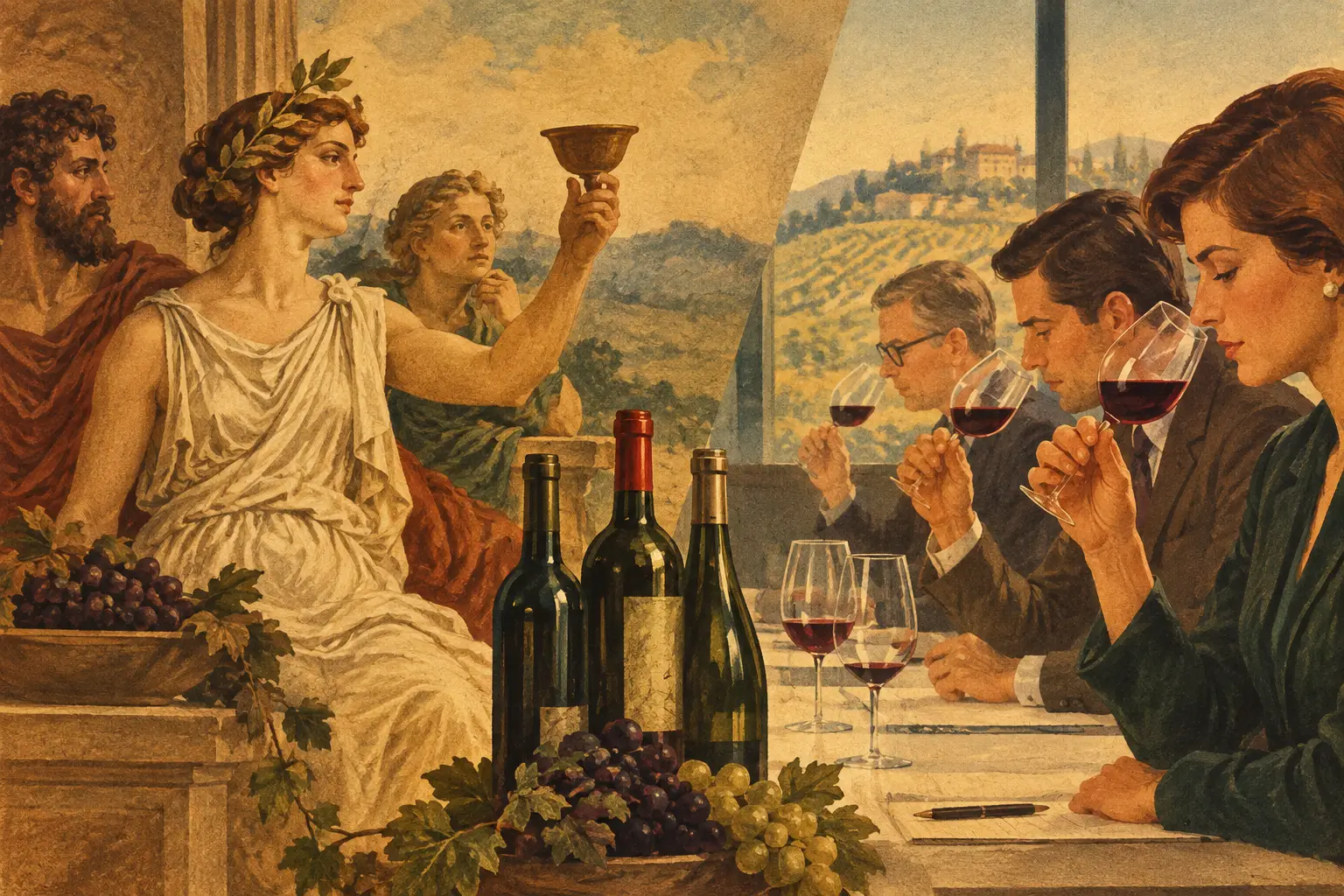
On May 24, 1976, a Paris tasting turned a handful of California bottles into international news. The story of the Judgment of Paris versus modern tastings is not simply a contest between an old shock and new procedures. It is a question of what happens when reputation leaves the room, a bottle is judged on its own terms, and an established cultural order is forced to listen.
At the InterContinental Hotel in Paris, British wine merchant Steven Spurrier assembled French judges and presented them with California Chardonnays and Cabernet Sauvignons alongside celebrated French wines. The wines were tasted blind. When Chateau Montelena’s 1973 Chardonnay and Stag’s Leap Wine Cellars’ 1973 Cabernet Sauvignon received the top scores in their categories, the result crossed an invisible border. California wine was no longer a regional aspiration. It had entered the world conversation.
Nearly fifty years later, tastings are more frequent, more visible, and more complicated. They can be conducted by critics, sommeliers, competition panels, collectors, winemakers, trade buyers, and thousands of consumers posting impressions in real time. Yet the central dramatic tension of Paris remains: can a tasting reveal greatness, and what does greatness mean when the label is covered?
The Judgment of Paris Was a Cultural Reckoning
The original tasting did not prove that California was categorically better than France. A single tasting could never bear that weight, and the wines have been revisited in later comparative events with varied results. What it did prove was more enduring: California belonged at the highest table, and conventional wisdom was not a reliable substitute for direct experience.
That distinction matters. Before Paris, many European gatekeepers saw fine wine as an inheritance guarded by geography, tradition, and long-established houses. Napa Valley had exceptional soil, ambitious growers, and a growing circle of determined vintners, but it did not yet possess the same cultural authority. The winning bottles made the case in the only language the room could not dismiss – performance in the glass.
Behind that performance stood decades of patient work. Andre Tchelistcheff, the Russian-born enologist who became known as the father of modern California winemaking, had helped establish the scientific and aesthetic discipline that made such a moment possible. At Beaulieu Vineyard and through a wide network of mentorship, he championed precision in the cellar, vineyard awareness, sanitation, careful aging, and the conviction that California could make wines of stature.
He was a giant among his peers not because he promised easy success, but because he insisted that excellence was built through judgment, training, and relentless attention. The Judgment of Paris became a headline. The deeper story was the generation of growers and winemakers who had prepared for that headline long before the bottles arrived in France.
How Modern Tastings Changed the Frame
Modern tastings inherited Paris’s appetite for surprise, but they operate in a much more crowded arena. A major critic’s score can move inventory within hours. A competition medal can appear on a shelf before a consumer has tasted the wine. A sommelier’s recommendation, a winemaker dinner, or a short video from a vineyard can give a bottle context that a blind score deliberately removes.
This abundance has created a useful tension. Blind tasting remains one of the fairest ways to reduce the influence of price, packaging, producer prestige, and regional mythology. When conducted carefully, it asks tasters to confront aroma, texture, balance, length, and age-worthiness without being guided by expectations.
But modern audiences also understand that wine is not consumed in a vacuum. Place matters. Vintage conditions matter. The people who farmed the vines and made decisions in the cellar matter. A wine from a family estate, a historic Napa property, or an immigrant-founded winery carries human meaning that cannot be measured by a scorecard alone.
The most thoughtful tastings recognize both truths. They use blind evaluation to test the liquid honestly, then restore the story afterward. That sequence protects judgment without pretending that wine’s cultural life is irrelevant.
The scale is larger, but the stakes are different
The Paris tasting was startling partly because it was rare. A small group of French experts rendered an opinion that challenged centuries of assumptions. Today, panels are everywhere. There are international competitions with hundreds or thousands of entries, trade tastings designed for buyers, consumer events built around discovery, and private comparative tastings among serious collectors.
Greater access is a genuine gain. More regions, styles, and producers can be heard. A small winery does not have to wait for approval from a narrow circle of institutions before finding an audience. This has been particularly meaningful for producers whose histories were once treated as peripheral: immigrant families, women-led estates, and vintners working outside the traditional centers of prestige.
Yet scale introduces trade-offs. Palate fatigue can flatten distinctions. Scoring systems may reward immediate impact over subtlety and longevity. A wine shown in a rushed flight, at the wrong temperature, or beside an overpowering neighbor can be misunderstood. A medal may be useful shorthand, but it cannot tell a drinker why a wine matters or whether it will move them at the table.
Experts are no longer the only witnesses
The authority of the modern taster is more distributed than it was in 1976. That does not mean expertise has disappeared. Trained palates still bring historical knowledge, technical fluency, and the discipline to distinguish a flaw from an unfamiliar style. A skilled evaluator can identify the difference between concentration and heaviness, oak influence and structural depth, a wine built for youth and one built for decades.
What has changed is the relationship between expert and audience. Consumers expect to participate. They want to compare notes, visit vineyards, meet makers, and understand how a vintage came to be. For wineries, this can be an opportunity rather than a threat. The strongest stories do not ask an audience to accept a verdict from above. They invite people to see the craft, taste with attention, and form a more informed connection.
That invitation is especially powerful in Napa Valley, where a glass can open onto a much larger American story. The valley’s rise involved agricultural risk, postwar scientific ambition, international migration, family enterprise, and the willingness to build a new standard rather than merely imitate an old one.
What Blind Tasting Can and Cannot Tell Us
Blind tasting is best understood as an instrument, not a final court of appeal. It can expose bias and puncture lazy assumptions. It can reveal that an unfamiliar producer has made an extraordinary wine. It can also remind a famous estate that pedigree does not exempt any vintage from scrutiny.
Still, it cannot answer every question a wine lover may reasonably ask. It cannot fully convey a vineyard’s history, the environmental choices behind a bottle, or the emotional force of opening a wine tied to a family milestone. Nor can it reliably settle whether one region is permanently superior to another. Wines evolve in bottle. Palates differ. Weather changes. A great bottle is a living record, not a static specimen.
The original Judgment of Paris has sometimes been reduced to a sports-style upset: California defeated France. That framing is memorable, but it is too small for the event’s real legacy. Paris expanded the map. It made room for the possibility that mastery could emerge from a younger wine culture, shaped by people who had crossed oceans, survived upheaval, studied hard, and devoted their lives to the vineyard.
The Modern Tasting Worth Remembering
A meaningful tasting today should be rigorous enough to respect the wines and generous enough to respect the people behind them. In a professional setting, that may mean calibrated service, appropriate glassware, carefully controlled temperature, clear criteria, and enough time for each wine to show itself. In a home cellar or tasting room, it may simply mean slowing down, recording impressions before looking at labels, and allowing disagreement to be part of the pleasure.
Then comes the reveal. This is where modern tasting can become more than an exercise in ranking. A name on a bottle may lead to a vineyard, a vintage, a mentor, a family, or a pivotal chapter in American wine. The story does not invalidate the palate. It gives the palate a horizon.
For Maestro Productions, that horizon is essential. Wine history is not static biography. It is cinematic human history: the escape and reinvention of Andre Tchelistcheff, the disciplined labor of Napa’s builders, and the moments when a single bottle can alter what the world believes is possible.
The next time a label is concealed, taste with the open-mindedness Paris demanded. When the label is revealed, stay for the story. The future of wine culture depends on both.

