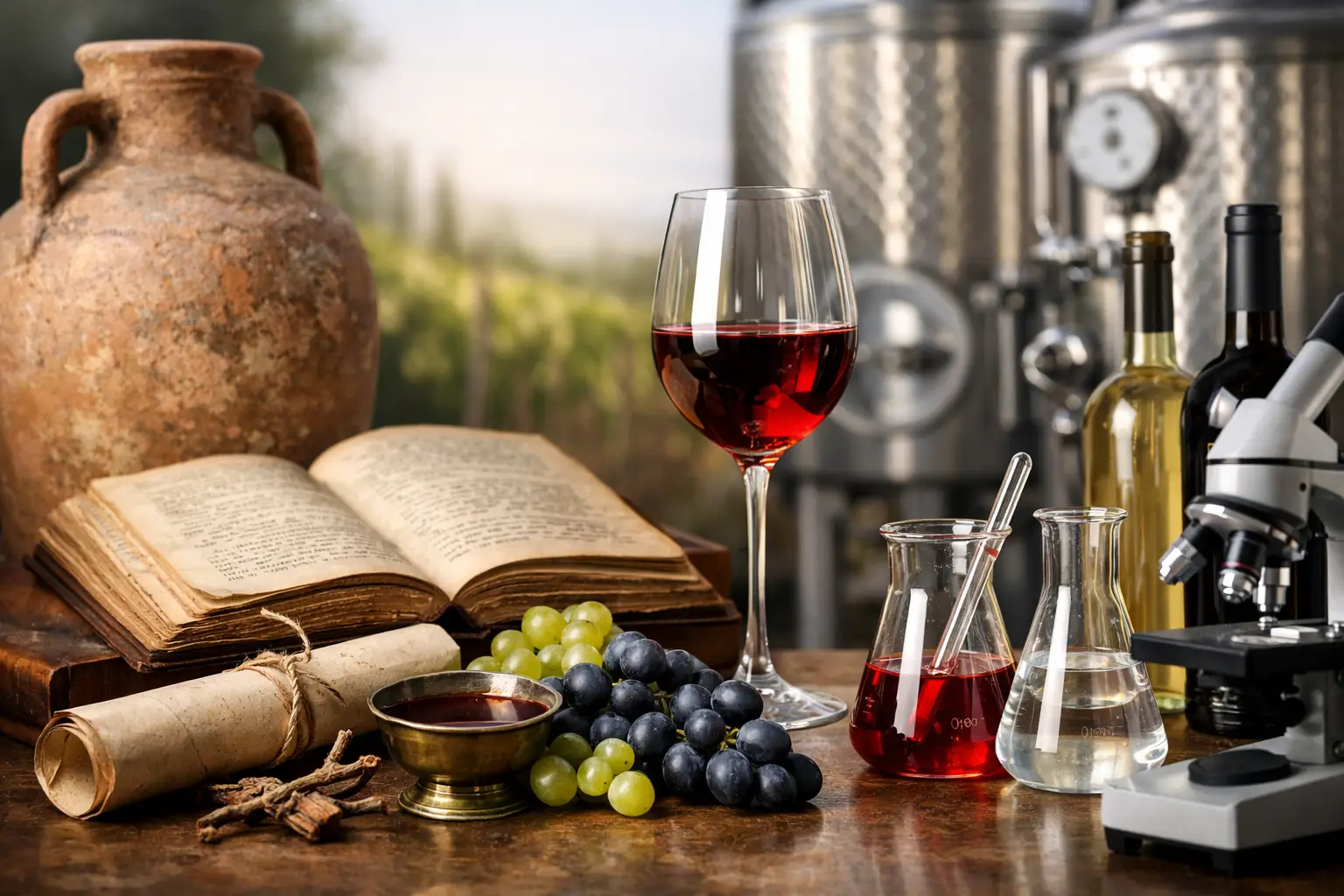
Wine was made for thousands of years before anyone could explain why a barrel turned fragrant, why a ferment stalled, or why one harvest endured while another became vinegar. The history of enology science is the story of humanity moving from inherited instinct to disciplined understanding – and, in California, of a few exceptional figures who used that understanding to reinvent American winemaking.
Enology is often described simply as the science of wine and winemaking. That definition is accurate, but too narrow to capture its drama. It brings together microbiology, chemistry, agriculture, sensory judgment, cellar design, and an almost theatrical sensitivity to time. The best winemakers have never treated science as the enemy of romance. They have used it to protect the romance contained in a vineyard, a season, and a bottle opened decades later.
Before Enology Had a Name
Ancient winemakers in Georgia, the Mediterranean, and the Near East possessed hard-won practical knowledge. They learned that vessels mattered, that excessive heat could ruin a ferment, that ripe fruit made stronger wine, and that cleanliness had consequences. Amphorae, clay qvevri, wooden casks, sulfur, and careful storage were not merely traditions. They were early answers to technical problems, even when the organisms and reactions at work remained unseen.
For centuries, wine knowledge traveled through households, monasteries, estates, and merchant networks. Roman writers recorded vineyard practices and cellar observations. Medieval religious communities preserved viticulture through political upheaval, refining methods because sacramental wine and estate income demanded reliability. Yet much of this knowledge was empirical. A master could recognize a sound fermentation by scent, taste, and motion, but could not identify the yeast transforming sugar into alcohol.
That distinction matters. Craft can produce greatness, but it can also leave a wine vulnerable to spoilage, instability, and mystery. The early history of wine is full of local genius. The history of enology science begins when observation became testable knowledge.
The Scientific Revolution Reaches the Cellar
The 19th century changed wine as decisively as it changed medicine and industry. As European vineyards faced disease, contamination, and the devastating phylloxera crisis, wine could no longer be treated only as an agricultural inheritance. It became an urgent scientific subject.
Louis Pasteur stood at the center of that transformation. In the 1850s and 1860s, his investigations showed that fermentation was not a spontaneous chemical event but the work of living microorganisms. He demonstrated that wine spoilage also had biological causes. Suddenly, a cloudy barrel or volatile aroma was not a curse of the season. It was a problem that could be studied, diagnosed, and, often, prevented.
Pasteur’s work elevated sanitation, temperature awareness, and microbial control from cellar folklore to essential practice. His influence helped establish enology as a serious field of study across France and beyond. Laboratories began to stand beside vineyards. Winemakers gained a new vocabulary for the forces shaping their wines.
Science did not make every wine identical, nor should it have. Its great contribution was control. By reducing preventable faults, it gave growers and winemakers a better chance to express the particular character of place. That balance remains central: intervention can preserve a wine’s identity, but excessive correction can flatten it.
Phylloxera and the Cost of Ignorance
No chapter better reveals the stakes of scientific exchange than phylloxera. The tiny insect, inadvertently carried from North America to Europe, ravaged vineyards during the late 19th century. Entire regions faced economic and cultural ruin. The eventual solution – grafting European Vitis vinifera vines onto resistant American rootstocks – emerged through research, experimentation, and international collaboration.
The remedy carried an enduring irony. American rootstock helped save Europe’s most celebrated wine regions, while European scientific traditions would later help transform American wine. Enology has always crossed borders because vines, pests, microbes, and ideas do not respect them.
How the History of Enology Science Came to California
California had vineyards long before it had a stable scientific wine culture. Missionaries planted grapes in the 18th century, and the Gold Rush era brought commercial ambition. But the state’s wine industry endured cycles of promise and collapse: pests, economic swings, and the long shadow of Prohibition. When repeal arrived in 1933, much of the industry needed more than capital. It needed trained leadership.
The University of California helped build the institutional foundation. Research at Davis and Berkeley connected viticulture and enology to American agriculture, while later generations of scientists, including Maynard Amerine, advanced serious study of wine composition, sensory evaluation, climate, and regional suitability. The work gave California a framework for moving beyond bulk production toward international standards of quality.
Still, institutions require interpreters – people capable of bringing laboratory discipline into the living unpredictability of a cellar. Napa Valley found one in Andre Tchelistcheff.
Andre Tchelistcheff and the Modern California Cellar
Tchelistcheff’s life carried the scale of a historical epic. Born in Russia in 1901, he survived revolution and displacement before continuing his scientific education in France, where wine was treated as both cultural inheritance and exacting discipline. When he arrived in the United States, he brought European technical rigor to a young California industry ready to be taken seriously.
In 1938, Georges de Latour recruited Tchelistcheff to lead winemaking at Beaulieu Vineyard in Napa Valley. The appointment would reshape the region. Tchelistcheff approached the cellar with a scientist’s precision and an artist’s conviction that great wine begins with respect for fruit. He championed sanitary practices, temperature-controlled fermentation, attentive barrel aging, and careful handling at every stage. He helped establish methods for making wines of greater balance, longevity, and consistency.
His impact was not confined to one estate or one label. Tchelistcheff became mentor, adviser, and standard-bearer for generations of California vintners. He understood that a region earns stature bottle by bottle, but also through the shared discipline of its people. His influence reached across Napa and beyond, helping turn California wine from a regional curiosity into a serious global presence.
His best-known wines, particularly Beaulieu Vineyard’s Georges de Latour Private Reserve Cabernet Sauvignon, demonstrated that California could make cellar-worthy Cabernet with depth, structure, and grace. These wines did not imitate Bordeaux. They showed what Napa Valley could become when scientific knowledge served a distinct place.
There is a temptation to tell this story as one man arriving with all the answers. The fuller truth is more compelling. Tchelistcheff entered a community of growers, owners, researchers, and workers, then raised its ambitions through uncommon standards. A giant among his peers, he made excellence feel possible and demanded that it be repeatable.
From Laboratory Certainty to Vineyard Character
By the late 20th century, enology had become far more sophisticated. Winemakers could measure acidity, sugar, sulfur dioxide, dissolved oxygen, tannin development, and microbial populations with growing accuracy. Refrigeration made cool fermentation more reliable. Selected yeast strains, cultured bacteria, filtration, and modern analytical tools reduced many of the risks that once defined a vintage.
These advances supported California’s rise, including the era symbolized by the 1976 Judgment of Paris. The tasting did not prove that science alone could create great wine. It proved that American producers, using rigorous vineyard and cellar practices, could stand beside the world’s established names.
Yet contemporary winemaking has also renewed respect for restraint. Many vintners now favor native yeast fermentations, lower-intervention methods, organic or regenerative farming, concrete vessels, and older traditions of skin contact. This is not a rejection of enology. It is a more mature use of it. A winemaker who chooses minimal intervention still needs to understand the risks: volatile acidity, microbial instability, oxidation, and the fine line between complexity and flaw.
The question is not whether wine should be scientific or natural. Every wine involves choices. The enduring question is whether those choices honor the vineyard, the vintage, and the people who will gather around the bottle.
Why This Legacy Still Matters
Wine’s future will test enology in new ways. Rising temperatures can accelerate ripening and shift acid balance. Water pressure, smoke exposure, new disease patterns, and changing consumer expectations are already remaking decisions in the vineyard and cellar. Scientific literacy will be indispensable, but so will memory.
The history preserved in old cellars, field notes, oral histories, and landmark bottles reminds us that progress is not simply a march toward more technology. It is the accumulation of hard lessons, shared freely by people who cared enough to make the next vintage better. Maestro Productions honors that inheritance because the human story behind a great wine deserves to be carried forward with the same care once reserved for the cellar.
The next time a Napa Cabernet is poured, consider the invisible company at the table: ancient growers reading the weather, Pasteur at his microscope, researchers at Davis, and Tchelistcheff walking a cellar with exacting eyes. Their work did more than improve wine. It gave future vintners the confidence to make history of their own.