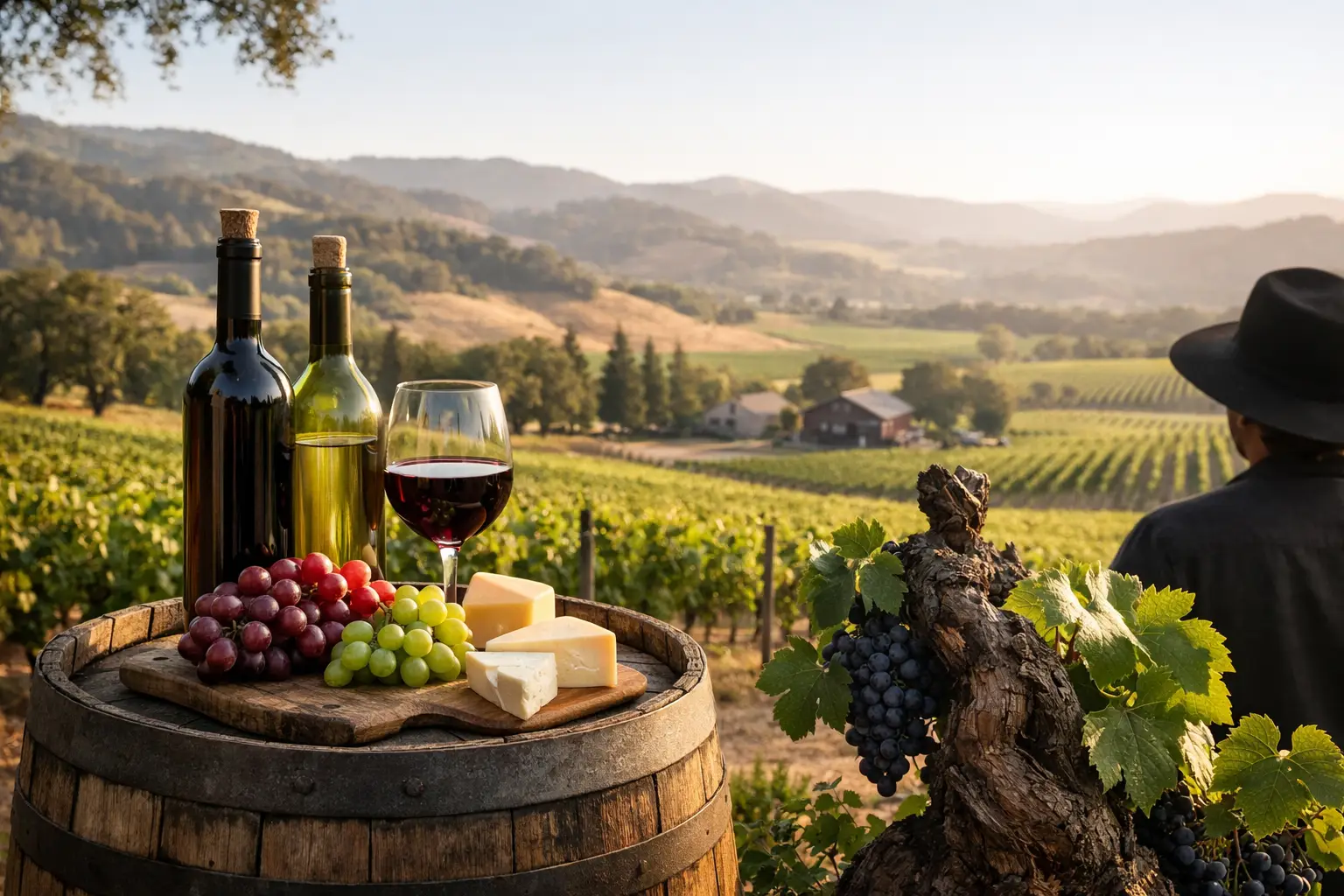
Napa Valley did not become a global wine capital through sunshine alone. This Napa Valley wine pioneers guide follows the people who saw possibility in a difficult agricultural frontier, endured disease and Prohibition, and eventually gave American wine a new standard of excellence. Their names belong not only on labels and tasting-room walls, but in the larger American story of migration, reinvention, and exacting craft.
The valley’s rise was never inevitable. It was built vineyard by vineyard, often by immigrants and outsiders who brought old-world knowledge to a young nation still deciding whether it could make wines of consequence. Some laid the physical foundations. Others saved historic estates from collapse. One Russian-born winemaker, miraculously rescued from war and revolution, gave Napa the scientific discipline that helped change its destiny.
The First Napa Valley Wine Pioneers
George C. Yount planted the original idea
Before Napa Valley was synonymous with Cabernet Sauvignon and cult bottlings, it was a remote and sparsely settled place. In the 1830s, George C. Yount received the land grant known as Rancho Caymus and became the first American settler in what is now Napa County. He planted some of the region’s earliest grapevines in the 1830s, establishing a simple but lasting proposition: this valley could grow wine grapes.
Yount was not responsible for Napa’s later reputation for fine wine, but he made the idea of viticulture tangible. Yountville bears his name, a reminder that geography and ambition often begin with a single person willing to test an unproven landscape.
Charles Krug made winemaking a serious enterprise
Charles Krug arrived in California from Prussia and made Napa’s first commercial wine in 1861. At a time when much of the state’s wine trade chased volume, Krug helped establish a model for an enduring winery business: vines, cellar work, salesmanship, and a recognizable estate identity.
His winery in St. Helena became one of Napa’s defining institutions. Just as importantly, Krug embodied a pattern that would shape the valley for generations. Napa was strengthened by people who arrived from elsewhere carrying knowledge, appetite, and a willingness to stake their future on a new American landscape.
H. W. Crabb proved Napa could aim higher
Hamilton Walker Crabb, a former sea captain and California political figure, purchased land near Oakville in 1868 and created the enormous To Kalon estate. His ambition was extraordinary for the era. By the late nineteenth century, To Kalon had become a celebrated vineyard property, with hundreds of acres planted and wines earning recognition beyond California.
Crabb’s legacy is complicated by the scale and commercial realities of his time, but his central insight remains vital. Not all Napa land was equal, and exceptional vineyards could produce wines with a distinctive character. The modern language of site, vineyard designation, and estate prestige has deeper roots than it may first appear.
Survival, Setback, and the Estates That Endured
Napa’s early promise met brutal resistance. Phylloxera damaged vineyards. Economic downturns narrowed markets. Then Prohibition, beginning nationally in 1920, nearly erased the commercial wine industry. A pioneers guide that skips these setbacks turns a hard-won story into a fairy tale.
Gustave Niebaum’s Inglenook estate illustrates both aspiration and fragility. A Finnish sea captain who built wealth in California, Niebaum established Inglenook in the 1870s near Rutherford. He imported vines, pursued European standards, and built an estate meant to produce wines with international standing. After his death, the property endured changing ownership and decline, but its name retained an aura that later generations would restore.
The point is not that Napa’s great estates moved in a straight line toward success. Many did not. Their histories contain interruptions, compromise, and rescue. That is why preservation matters. A vineyard may remain, while the story of the people who believed in it can disappear unless someone carries it forward.
André Tchelistcheff Reinvented American Winemaking
Among all the figures in this Napa Valley wine pioneers guide, André Tchelistcheff stands apart as the master technician and teacher whose influence reached far beyond one cellar. Born in Moscow, shaped by the upheaval of revolution and exile, and trained in France’s demanding scientific tradition, Tchelistcheff arrived in California in 1938 to become the winemaker at Beaulieu Vineyard.
He entered a region still recovering from Prohibition, where fine-wine ambitions were real but methods varied widely. At Beaulieu, working with owner Georges de Latour, Tchelistcheff brought precision to every stage of production. He emphasized hygiene in the winery, temperature-controlled fermentation, careful oak aging, vineyard management, and the belief that great wine begins with healthy, properly ripened grapes.
These may sound like accepted principles now. They were not universally practiced in California at the time. Tchelistcheff helped establish a culture of rigorous observation. Wine was not merely an agricultural product to be made by habit. It was the result of chemistry, weather, soil, timing, and disciplined judgment.
His most enduring work may have been mentorship. Tchelistcheff advised and inspired a generation of vintners, sharing knowledge freely while demanding seriousness from those around him. His influence touched legendary names across Napa and Sonoma, helping create the professional confidence that California wine would need to compete with Europe’s established regions.
At Beaulieu, the Private Reserve Cabernet Sauvignon became a statement of intent: California could make a wine built for age, elegance, and international respect. Tchelistcheff did not accomplish this alone. De Latour provided the estate, resources, and conviction. Yet the partnership showed what Napa could become when visionary ownership met scientific mastery.
For Wine Elf, his life carries an added resonance. It is a survival story, an immigrant story, and a story of a man who remade a place by insisting that excellence could be taught, measured, and pursued without apology.
The Generation That Carried Napa to the World
By the 1960s and 1970s, a new generation built on the groundwork of the valley’s earlier pioneers. Robert Mondavi, after leaving the family business, opened Robert Mondavi Winery in 1966 and gave Napa a bold public identity. His winery’s architecture, hospitality, marketing, and focus on varietal wines announced that California deserved to be discussed alongside the world’s great wine regions.
Mondavi’s gift was not only technical or commercial. He understood that wine requires a cultural setting. A great bottle gains meaning through food, art, landscape, conversation, and a sense of place. He made Napa feel like a destination with a point of view.
Then came the 1976 Judgment of Paris, the blind tasting that placed Napa wines beside revered French bottles and startled the wine establishment. Warren Winiarski’s 1973 Stag’s Leap Wine Cellars Cabernet Sauvignon won the red-wine tasting. Chateau Montelena’s 1973 Chardonnay, made by Mike Grgich, won the white-wine tasting.
The event did not suddenly make Napa great. The wines had been shaped by decades of vineyard development, experimentation, and increasingly sophisticated cellar practice. But the Judgment of Paris changed the public narrative. It gave international audiences a dramatic proof point and made clear that California’s finest producers belonged in the conversation.
How to Read Napa’s Pioneer Story Today
When you visit Napa Valley or choose a bottle with a storied name, resist the temptation to treat history as a decorative backdrop. Ask what came before the current vintage. Who planted the site? Who preserved it through lean years? Which winemaker changed the standards of the cellar? Which family, worker, or immigrant carried knowledge across an ocean?
There is also a useful caution in the word “pioneer.” It can suggest that land was empty before newcomers arrived, when it was not. Napa Valley is the ancestral homeland of Indigenous peoples, including the Wappo and Patwin. Any honest account of wine history should recognize that the modern wine industry was built on a landscape with far older human histories and ongoing cultural significance.
The best way to honor Napa’s pioneers is not to freeze them in amber. Their example asks something of the present: protect historic vineyards, preserve archives and oral histories, support craftsmanship, and leave room for the next generation of voices. Napa’s most compelling legacy is not simply that it achieved greatness. It is that, again and again, people chose to build greatness where others saw only risk.

