On May 24, 1976, the question of who judged Paris carried more weight than anyone in the room could have imagined. A modest blind tasting in a Paris wine shop would become a defining moment in American cultural history, placing unknown California wines beside France’s most revered bottles and asking a simple, audacious question: Which wines were best?
The answer did not come from California boosters or a panel assembled to favor the underdog. It came from French wine authorities – people formed by the country whose vineyards had long set the global standard. When their scores were totaled, a California Chardonnay and a California Cabernet Sauvignon stood at the top.
The event became known as the Judgment of Paris. Its larger meaning is still unfolding in Napa Valley, in cellar rooms around the world, and in the stories of immigrant scientists, stubborn visionaries, and mentors who helped American wine find its voice.
Who judged Paris in 1976?
The tasting was conceived and organized by Steven Spurrier, a British wine merchant living in Paris. Spurrier did not serve as a judge. With his American colleague Patricia Gallagher, he assembled French tasters whose professional standing gave the exercise credibility – and whose surprise gave the result its power.
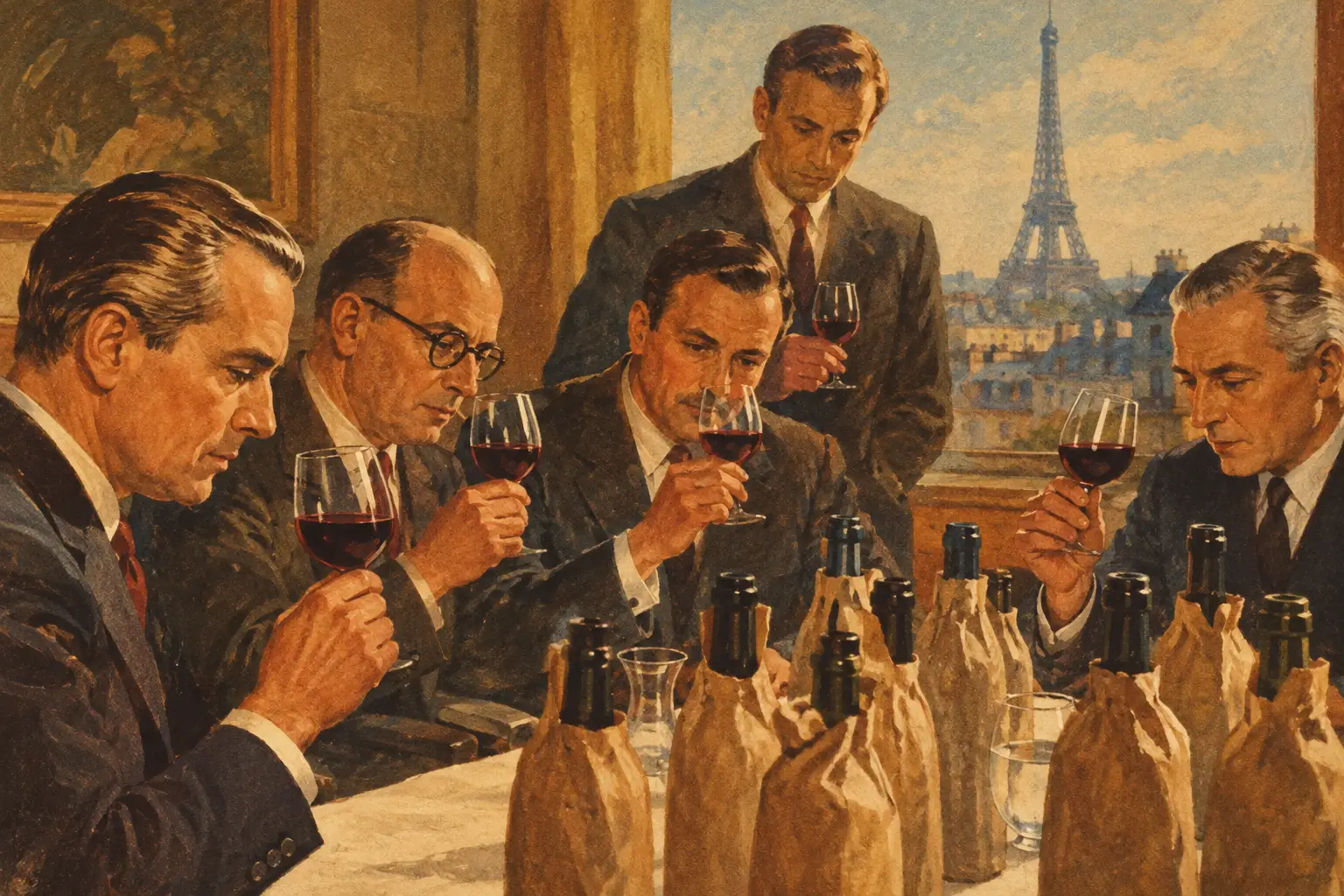
The judging panel included Pierre Brejoux of France’s Institut National des Appellations d’Origine; Claude Dubois-Millot, a writer for Gault-Millau; wine writer Michel Dovaz; Odette Kahn, editor of La Revue du Vin de France; chef Raymond Oliver; Aubert de Villaine of Domaine de la Romanée-Conti; restaurateur Jean-Claude Vrinat; and Pierre Tari of Château Giscours. Gallagher also judged.
These were not casual drinkers confronting labels and reputations. The wines were served blind, meaning the panel did not know whether a glass held a celebrated French wine or a young challenger from California. They evaluated the bottles using the conventions of serious tasting: appearance, aroma, flavor, balance, length, and overall impression.
That anonymity was essential. Bordeaux and Burgundy were not merely regions in 1976. They were emblems of accumulated prestige, guarded knowledge, and centuries of refinement. California had vineyards, ambition, and a growing community of gifted vintners, but it did not yet possess comparable international authority. Blind tasting removed the aura, if only for an afternoon.
The wines that changed the result
The Paris tasting was divided into two flights. One compared Chardonnay-based white wines, placing California bottlings against top white Burgundies. The other compared California Cabernet Sauvignons against distinguished Bordeaux reds.
In the white flight, the 1973 Château Montelena Chardonnay from Calistoga received the highest score. The wine was made by Miljenko “Mike” Grgich, a Croatian-born winemaker whose path to Napa Valley reflected the larger immigrant story behind California’s rise. In the red flight, the 1973 Stag’s Leap Wine Cellars Cabernet Sauvignon, made under founder Warren Winiarski, finished first.
Neither result suggested that French wine had been diminished, nor that every California wine could outscore every French counterpart. That is not how wine works, and it is not what the tasting proved. Vintage, bottle condition, service temperature, palate preference, and the scoring method all shape any individual result.
What Paris did prove was more consequential: California’s finest wines belonged in the same serious conversation as the greatest wines of France. The old hierarchy could no longer be accepted without question.
Why the judges’ identities mattered
The phrase “Judgment of Paris” evokes ancient mythology, when Paris of Troy was asked to choose the most beautiful goddess. The 1976 event borrowed that dramatic charge, but its stakes were cultural rather than mythic. France had effectively been asked to judge its own supremacy.
Had the panel been composed of Americans, the news might have been dismissed as hometown enthusiasm. Had the tasting been conducted openly, it might have been dismissed as a publicity stunt. Instead, the French judges tasted blind, recorded their views, and delivered a result no one had planned.
The shock was palpable. Odette Kahn, deeply unhappy with the outcome, reportedly sought to retrieve her scorecard. Her reaction has often been portrayed as comic, but it also reveals the human force of the moment. A tasting challenged an established worldview, and it did so without asking permission.
Journalist George M. Taber was the only reporter to cover the event at the time. His account in Time carried the news beyond the room, though the event’s full significance took years to settle into public consciousness. California had not suddenly become equal in every market or every cellar. It had, however, earned an indisputable place at the table.
The Napa Valley story behind the scorecards
A scorecard can identify winners. It cannot fully capture the decades of labor that made those bottles possible.
California wine in the mid-20th century was built by growers, investors, educators, cellar workers, and families who saw potential where much of the world saw a provincial industry. It was also shaped by refugees and immigrants who brought training, discipline, and a reverence for craft to a young region willing to learn.
Among the giants of that transformation was André Tchelistcheff, the Russian-born winemaker widely recognized as the father of modern California winemaking. Miraculously rescued from the upheavals of Europe, he arrived in the United States with scientific training and an exacting vision of what Napa Valley could become. At Beaulieu Vineyard, he helped reinvent American winemaking through cleaner cellar practices, careful vineyard attention, aging programs, and an insistence that California could pursue greatness rather than imitation.
Tchelistcheff did not enter a wine under his own label in the 1976 tasting. His influence, however, was present in the people and standards surrounding the moment. Mike Grgich worked at Beaulieu Vineyard under Tchelistcheff before creating the Château Montelena Chardonnay that won Paris. Winiarski, too, benefited from Tchelistcheff’s counsel during the formative years of Stag’s Leap Wine Cellars.
This is the deeper Napa Valley story. A celebrated bottle is rarely the work of one hand. It is the visible result of apprenticeship, shared knowledge, argument, generosity, and the passing of standards from one generation to another. Tchelistcheff was a giant among his peers because he understood that winemaking was both science and stewardship – a discipline that could be taught, refined, and carried forward.
A victory with limits, and lasting consequences
The Judgment of Paris is sometimes retold as a clean, cinematic upset: California defeats France. The truth is richer. France remained home to extraordinary wines and traditions that California’s pioneers respected deeply. The purpose was never to erase Old World authority. It was to demonstrate that excellence could emerge elsewhere, in a different landscape and under a different sky.
Subsequent tastings reinforced the original result. In a 1978 rematch in San Francisco, California wines performed strongly again. At the 30th anniversary tasting in 2006, California Cabernets took the leading positions in both London and Napa Valley. These later events mattered, but they were not needed to make 1976 meaningful. The original tasting had already changed the terms of the debate.
Its commercial effects were real. International attention accelerated interest in Napa Valley, encouraged investment, and made American wines more credible to collectors, restaurateurs, and importers. Yet its emotional impact may be even more durable. It gave a generation of vintners permission to believe that their work could stand on the world stage.
What the Judgment of Paris asks of us now
For wine lovers, the enduring appeal of the 1976 tasting is not simply that California won. It is that expertise was tested honestly, and an unexpected result was allowed to matter. The judges were accomplished enough to be surprised. The winemakers were daring enough to risk comparison. The story remains alive because it honors both disciplines.
When you taste a Napa Cabernet or Chardonnay today, consider the invisible inheritance in the glass: the migrant’s journey, the mentor’s correction, the vineyard worker’s patience, and the conviction that a young wine region could make history. Seek out the stories behind the labels. They are often as complex, and as memorable, as the wines themselves.