A bottle of great Napa Valley wine can carry the confidence of a finished work: balance, elegance, a sense that every element arrived in its proper place. But that confidence was earned. Before Napa became a name spoken with reverence in dining rooms and cellars around the world, it was a young region still searching for its defining voice. The story of Wine Elf begins with the man who helped give it one.
Andre Tchelistcheff was not born to California sunlight or vineyard abundance. He arrived through upheaval, exile, and an improbable chain of events that carried a Russian-born scientist from the violence of the twentieth century to the vineyards of Napa Valley. There, over decades of meticulous work, he became a giant among his peers – the winemaker widely recognized as the father of modern California winemaking.
His achievement was never simply that he made good wine. Tchelistcheff changed how an industry understood its land, its fruit, its standards, and its future.
The Wine Elf behind Napa’s transformation
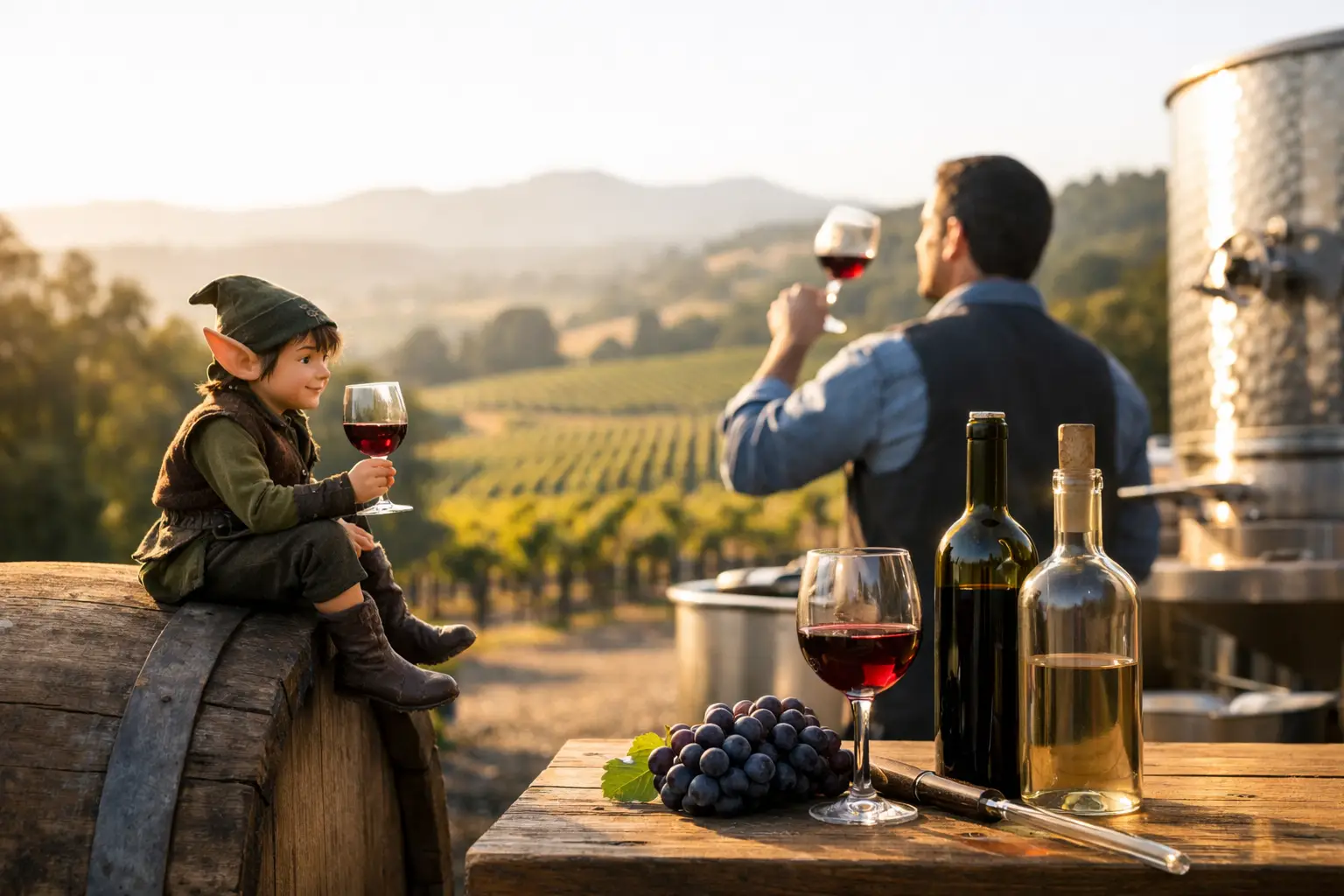
The nickname “Wine Elf” suggests charm, mystery, and perhaps a little mischief. It also captures something essential about Tchelistcheff’s presence. Small in stature, animated in conversation, and formidable in judgment, he brought an almost theatrical intensity to the cellar. Yet the magic associated with his name rested on discipline.
His early life gave him little reason to expect a career in American wine. Born in Moscow in 1901, Tchelistcheff came of age as Russia was convulsed by revolution and civil war. He served in the White Russian army and survived circumstances that might easily have ended his story. Miraculously rescued from a brutal historical moment, he eventually made his way to France, where he pursued scientific training in viticulture and enology.
That education mattered. Wine had long been made in California, but its modern identity had not yet been secured by a shared culture of exacting technical practice. Tchelistcheff brought European knowledge without treating California as a lesser imitation of Europe. He recognized that the state’s vineyards could produce wines of distinction on their own terms, provided growers and winemakers learned to protect what the vineyards offered.
In 1938, he was recruited to join Beaulieu Vineyard in Rutherford. The appointment would become one of the defining partnerships in American wine history.
Science in service of place
Tchelistcheff’s methods were rigorous, but his philosophy was not mechanical. He cared about cleanliness in the winery, temperature control during fermentation, careful aging, and the health of the vineyard. These practices sound familiar now because his generation helped make them foundational. At the time, they represented a decisive move away from inconsistency and toward a more intentional expression of quality.
His work at Beaulieu Vineyard helped establish a standard for Cabernet Sauvignon that could stand alongside serious wines from established European regions. The celebrated Private Reserve became more than a flagship bottling. It was evidence that California could create wine with structure, longevity, and unmistakable character.
Tchelistcheff understood that technical precision and romance were not opponents. A sterile approach to wine can miss the point; an undisciplined approach can waste a vineyard’s potential. The best wines require both imagination and restraint. They require someone willing to listen to the fruit, then make the difficult decisions that allow its voice to remain clear.
Andre Tchelistcheff and the culture of mentorship
A legacy can be measured by awards, landmark vintages, and famous labels. Tchelistcheff’s most consequential legacy may be the people he influenced. His counsel traveled far beyond the walls of Beaulieu Vineyard, reaching winemakers, vineyard owners, and emerging producers across California.
He advised, encouraged, corrected, and challenged. Those who sought his counsel did not receive a formula. They encountered a demanding standard: pay attention, respect the vineyard, understand the science, and never let convenience replace judgment. This was mentorship as stewardship.
The Napa Valley that followed was shaped by a network of people who absorbed that standard and carried it into their own work. As wineries multiplied and ambitions expanded, Tchelistcheff helped reinforce a culture in which quality was not an occasional triumph but an obligation. His influence can be felt in the region’s patient relationship with Cabernet, its insistence on vineyard expression, and its willingness to think in decades rather than seasons.
That influence also explains why his story belongs to more than wine history. It is a story of immigrant achievement in America, but not the simplified version in which talent alone guarantees success. Tchelistcheff brought hard-won expertise, yet he also found collaborators who recognized its value. The partnership between the winemaker and Georges de Latour at Beaulieu Vineyard demonstrated what can happen when entrepreneurial vision meets mastery of craft.
From Napa Valley to the world stage
By the time the Judgment of Paris placed California wines in direct competition with revered French bottles in 1976, the foundations for that moment had been laid over many years. The tasting did not create Napa Valley’s potential. It revealed to a wider public what dedicated vintners had been proving in vineyards and cellars all along.
Tchelistcheff’s role in this transformation was both direct and atmospheric. He helped establish the technical and cultural conditions in which California wines could be judged seriously. He taught an industry to believe that excellence was possible, then to work with enough care to make that belief credible.
Still, history should resist easy triumphalism. Napa’s ascent involved many hands: farmworkers, vineyard managers, proprietors, cellar crews, scientists, families, and winemakers whose names may never appear on a label. It also depended on land that had been cultivated long before Napa became a luxury destination. To honor Tchelistcheff properly is not to reduce that larger history to one hero. It is to recognize how an extraordinary individual can sharpen the ambitions of an entire community.
This distinction matters because the modern wine business can make legend look effortless. A famous vineyard, a sought-after bottle, or a polished tasting room may conceal generations of experimentation and risk. The Wine Elf story returns us to the demanding work beneath the legend: the long harvest days, the arguments over technique, the patience required to wait for a wine to reveal itself.
Why the Wine Elf story still matters
Wine regions are not permanent by default. They are maintained through knowledge, attention, and the willingness of one generation to teach the next. Climate pressures, changing consumer habits, rising costs, and the speed of modern commerce all challenge the old assumptions of the wine world. Under those conditions, Tchelistcheff’s example is not a relic. It is a call for seriousness.
His career argues for craft over shortcuts and for curiosity over complacency. It reminds producers that innovation is most meaningful when it deepens a relationship with place. It invites collectors and visitors to see Napa not merely as a destination, but as a living archive of people who believed American wine could become something enduring.
For readers drawn to consequential lives, the story holds another lesson. History often turns on figures who are not immediately obvious to the public. A winemaker working behind cellar doors may alter a region’s economy, its cultural identity, and its place in the world. Tchelistcheff did precisely that.
Maestro Productions preserves this legacy not as a static biography, but as a cinematic human story of survival, migration, scientific mastery, and transformation. The bottles remain, of course. So do the vineyards. But the deeper inheritance is a standard of care, passed forward each time someone chooses to make wine worthy of the land and the people who came before.