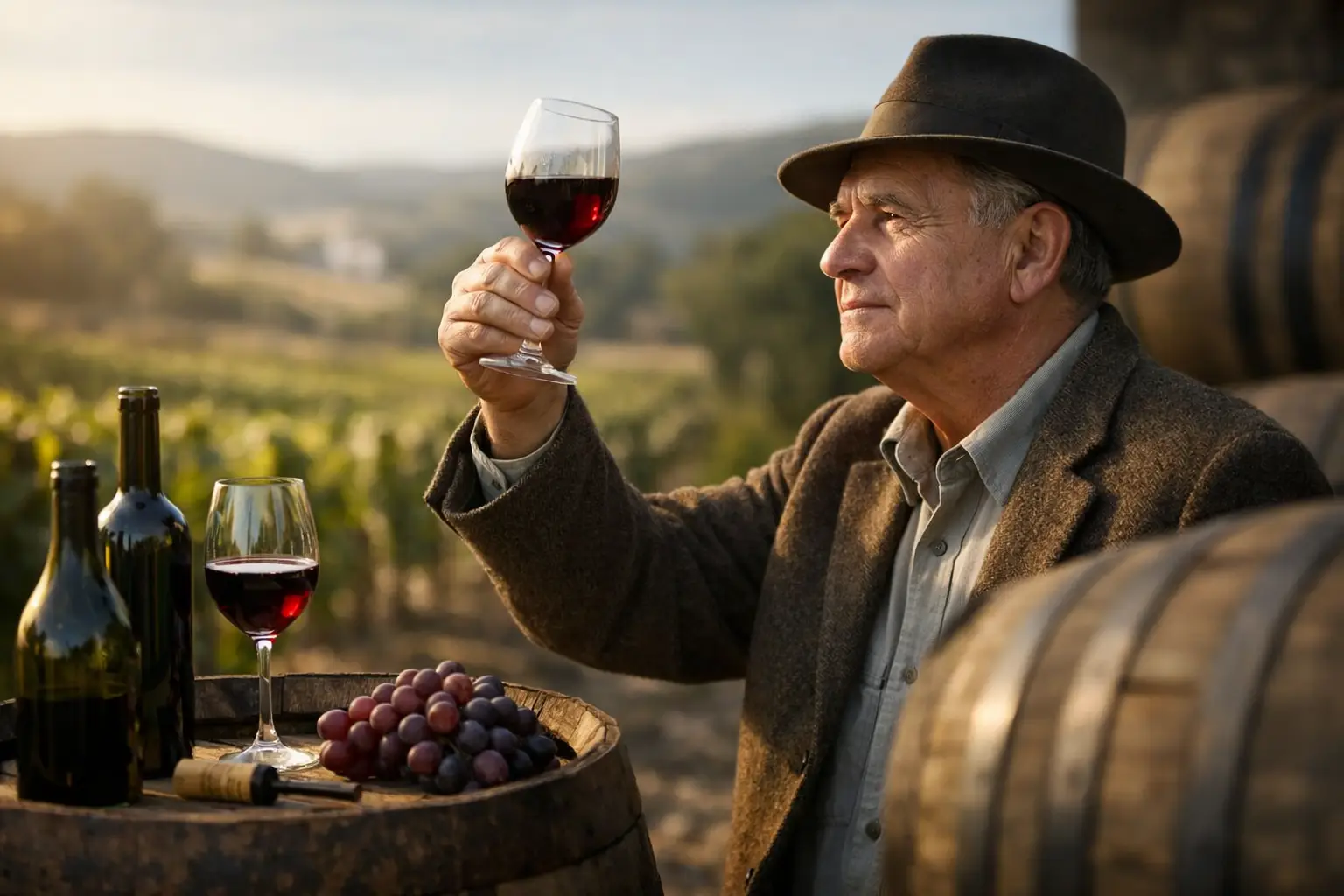
In the cellar at Beaulieu Vineyard, Andre Tchelistcheff treated a grape as both an agricultural gift and a scientific question. That discipline, brought to Napa Valley in 1938, helps explain how Andre Tchelistcheff transformed wine from a promising regional product into a world-class expression of place. His achievement was not a single famous vintage or one secret technique. It was a new standard of care, curiosity, and conviction that California wine deserved to stand beside the great wines of Europe.
For the visitors who see Napa today as a landscape of renowned estates and sought-after bottles, it can be difficult to imagine how uncertain its future once seemed. Tchelistcheff arrived before the valley had established its modern identity. He helped give it one.
A Life Shaped by Upheaval and Study
Tchelistcheff’s authority in the cellar began long before California. Born in Moscow in 1901, he came of age amid the violent rupture of the Russian Revolution. His family’s world was overturned. The years that followed carried him across borders and through hardship, including a period in China, before his path led westward.
His survival story matters because it illuminates the man behind the methods. Tchelistcheff was not simply an imported expert arriving with European credentials. He was a displaced Russian émigré who had endured a century in motion and responded by pursuing mastery. His scientific education in France, including advanced work in fermentation and microbiology, prepared him to see winemaking as a living process rather than an act of luck.
When Georges de Latour, the founder of Beaulieu Vineyard, sought a winemaker with technical rigor, the timing proved historic. Tchelistcheff joined Beaulieu in Rutherford in 1938, when Prohibition had only recently ended and California’s wine industry was still rebuilding its reputation, vineyards, and confidence. The raw materials were there. The system to realize their potential was not yet fully in place.
How Andre Tchelistcheff Transformed Wine in Napa
At Beaulieu, Tchelistcheff brought an exacting philosophy that touched nearly every stage of production. He championed cleaner cellar practices, careful control of fermentation, and a deeper understanding of how temperature affected a wine’s aroma, texture, and stability. These ideas can sound ordinary now because the industry absorbed them. In his era, they helped redraw the limits of what California wineries could achieve.
He also insisted that wine was made first in the vineyard. Site selection, grape maturity, crop levels, and the relationship between variety and place were not background concerns. They were the beginning of quality. His work helped reinforce a principle that later became central to Napa Valley’s identity: great wine is not manufactured from average fruit. It is cultivated through decisions made across an entire growing season.
Tchelistcheff’s influence at Beaulieu found its clearest expression in the Georges de Latour Private Reserve Cabernet Sauvignon. He shaped the wine into a serious, age-worthy Cabernet, using methods that brought structure and longevity without sacrificing grace. His approach to oak aging, including the thoughtful use of French oak, became part of an emerging California vocabulary for fine wine.
Yet it would be too simple to portray him as a lone genius who arrived and remade Napa by force of personality. California’s ascent depended on growers, proprietors, vineyard workers, fellow winemakers, and the changing expectations of American drinkers. Tchelistcheff’s singular contribution was to give that collective ambition a disciplined center. He showed what was possible when a winery treated every detail as consequential.
Science in Service of Character
His work was scientific, but never sterile. Tchelistcheff understood that technical control was valuable only if it preserved a wine’s character. Fermentation management, cellar hygiene, and aging choices were not ends in themselves. They were tools for allowing fruit, soil, climate, and vintage to speak with greater clarity.
That distinction remains relevant. Modern winemaking can lean too far in either direction. Technique without restraint can produce polished but anonymous wines; romanticism without precision can excuse preventable flaws. Tchelistcheff embodied a more demanding middle course. He respected nature enough to study it closely, then acted with the judgment of a craftsman.
His standards extended to white wine as well as red. At a time when warm-climate California could easily produce broad, tired wines, he encouraged practices that protected freshness and aromatic vitality. The cumulative effect was profound: California wines began to present themselves not merely as local beverages, but as wines capable of complexity, balance, and endurance.
The Teacher Behind a Generation
Perhaps Tchelistcheff’s most enduring legacy was his generosity as a mentor. His cellar became a proving ground for future leaders of American wine, and his counsel reached far beyond Beaulieu. He advised and inspired figures associated with wineries that would help define Napa’s next chapter, including Robert Mondavi, Joe Heitz, Mike Grgich, Warren Winiarski, and many others.
His influence was felt in conversations, harvest visits, technical debates, and quiet acts of encouragement. This is the part of his story that resists easy measurement. A vineyard can be mapped. A vintage can be scored. But a teacher’s effect spreads through decisions made decades later by people who learned to ask better questions.
Tchelistcheff helped establish a culture in which California winemakers could pursue excellence without apologizing for their ambition. That mattered deeply in an industry still seeking international recognition. He gave younger vintners permission to believe that Napa Cabernet Sauvignon, and California wine more broadly, could be judged by the highest standards in the world.
The 1976 Judgment of Paris became the public spectacle of that belief. When California wines triumphed in a blind tasting against celebrated French competitors, the result startled the wine establishment and electrified the American public. Tchelistcheff did not make the winning Chateau Montelena Chardonnay or Stag’s Leap Wine Cellars Cabernet Sauvignon, but the moment unfolded within the culture of rigor and possibility he had helped create. Beaulieu’s own Private Reserve had already demonstrated that Napa Cabernet could age with dignity and command serious attention.
A Legacy Larger Than a Bottle
By the time Tchelistcheff died in 1994, he was widely known as the father of modern California winemaking. The title can obscure the living complexity of his legacy. He was a scientist, yes, but also an immigrant whose life carried the marks of exile. He was a cellar master who recognized that wine is an agricultural art. He was a demanding critic who understood that the future of a region depends on what it teaches its successors.
His story also challenges the idea that cultural transformation arrives only through grand public gestures. Some revolutions begin in a laboratory, a vineyard row, or a barrel room. They begin when a person refuses to accept that the current standard is the final one.
For Napa Valley, Tchelistcheff’s real gift was not a formula to imitate. Wine changes with weather, soils, vines, markets, and human taste. What endures is his ethic: observe carefully, respect the fruit, pursue knowledge, and never confuse prestige with permanence. A great region must earn its reputation again with every harvest.
That is why his life continues to belong not only to wine history, but to American cultural history. It is a story of displacement transformed into purpose, expertise transformed into mentorship, and a valley transformed into a global reference point. Maestro Productions carries such legacies forward because the people behind a bottle are often the people who changed an entire landscape.
The next time a Napa Cabernet is opened at a table, consider the unseen chain of knowledge behind it: the vineyard decision, the measured fermentation, the patient barrel aging, and the conviction that California could make wine for the ages. Andre Tchelistcheff’s greatest lesson is still waiting there, in the glass: excellence becomes tradition only when someone has the courage to insist on it.

