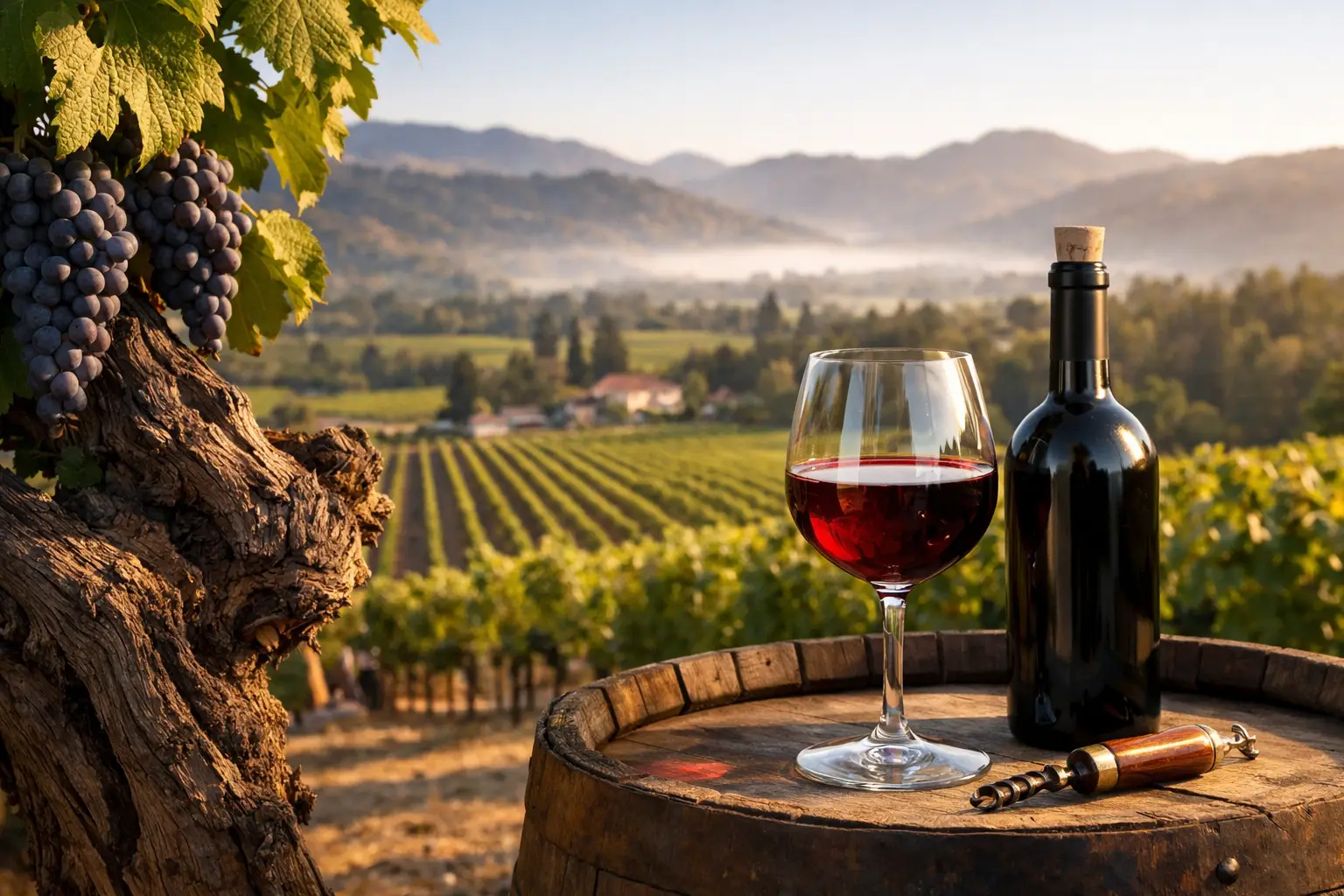
Napa Cabernet history is often told through famous bottles, hillside estates, and auction records. But the more compelling story begins with a fragile agricultural experiment and becomes a drama of ruin, migration, discipline, and reinvention. Napa Valley did not simply inherit greatness. Its winemakers, farmers, and immigrant visionaries built it vintage by vintage, often against forces that could have ended the dream.
Before Napa Cabernet Became an Icon
Long before Cabernet Sauvignon became Napa Valley’s international calling card, the valley was a place of possibility. George C. Yount planted some of its earliest vines in the 1830s, demonstrating that wine grapes could take root in this pocket of Northern California. By 1861, Charles Krug had established what is widely recognized as Napa’s first commercial winery, bringing European winemaking ambition to a young American landscape.
The late nineteenth century brought an influx of growers and entrepreneurs who saw promise in Napa’s varied soils, dry summers, cool nights, and mountain-influenced microclimates. Gustave Niebaum founded Inglenook in 1879, cultivating a serious estate model inspired by Europe’s great chateaus. His work helped establish a conviction that would later define Napa Cabernet: exceptional wine begins not merely in a cellar, but with the exact place where a vine grows.
A Region Interrupted
That early promise was nearly erased. Phylloxera, the vine-destroying pest that devastated vineyards around the world, struck California. Then Prohibition arrived in 1920, delivering a deeper wound. Many vineyards were uprooted or converted to other crops. Some wineries survived by producing sacramental wine, grape juice, or fruit products, but the culture of fine winemaking could not flourish under a national ban.
When Prohibition ended in 1933, Napa’s recovery was uncertain. The valley had vineyards, weather, and a small group of determined families, but it lacked the technical confidence and sustained investment needed to compete with the established wines of France and Italy. The great Napa Cabernet era was still waiting for its central architect.
Napa Cabernet History and André Tchelistcheff
That architect arrived from a world marked by upheaval. André Tchelistcheff was born in Moscow, trained in agricultural science, and displaced by revolution and war. After fleeing Russia, he continued his education in France, where he absorbed modern ideas about microbiology, fermentation, sanitation, and the relationship between vineyard and cellar. His survival was extraordinary. His impact on American wine would be greater still.
In 1938, Tchelistcheff came to Napa Valley to join Beaulieu Vineyard, then led by Georges de Latour. The Russian-born winemaker entered a region with serious potential but inconsistent methods. He brought an exacting scientific sensibility without losing respect for tradition. At Beaulieu, he helped create a model for California Cabernet that combined ripe fruit with structure, longevity, and restraint.
Science in Service of Character
Tchelistcheff’s contribution was not one secret technique or a single celebrated vintage. It was a philosophy of care. He emphasized cleanliness in the cellar, temperature control during fermentation, thoughtful aging, and rigorous attention to vineyard health. He championed the use of small French oak barrels when many California producers favored larger, more neutral vessels. He also understood that a great Cabernet had to be built for time, not just immediate pleasure.
The result was Beaulieu Vineyard Private Reserve, a wine that announced a new level of American seriousness. It was not designed to imitate Bordeaux bottle for bottle. Rather, it showed that Napa’s sunshine, soils, and growing conditions could produce Cabernet Sauvignon with its own voice: generous but balanced, powerful but composed, and capable of aging with dignity.
Tchelistcheff became known as the father of modern California winemaking because his influence traveled far beyond Beaulieu. He advised and mentored a generation of figures who would shape the valley’s future, including Warren Winiarski of Stag’s Leap Wine Cellars and Mike Grgich, later celebrated for his work at Chateau Montelena. His presence gave Napa more than technical expertise. It gave the region confidence in its own destiny.
The Estates That Carried the Story Forward
By the 1960s, Napa was beginning to attract a new wave of independent-minded vintners. Robert Mondavi opened his namesake winery in 1966, making a public case for fine wine as an American cultural pursuit. Joe Heitz’s Martha’s Vineyard Cabernet, first made from the 1966 vintage, helped establish the idea that a specific vineyard site could yield a wine of singular identity. These wines invited drinkers to think beyond grape variety and producer toward place.
Napa Cabernet’s ascent was not inevitable. The region’s producers faced skepticism at home and abroad, along with the practical challenge of creating wines that could stand beside Europe’s best. Cabernet also proved demanding. It needed the right site, disciplined farming, patient élevage, and a willingness to avoid chasing easy ripeness at the expense of balance. In cooler areas and difficult vintages, Merlot, Cabernet Franc, and other Bordeaux varieties often played essential supporting roles.
Paris, 1976
The turning point came on May 24, 1976, at a blind tasting in Paris organized by British wine merchant Steven Spurrier. French judges evaluated California and French wines, expecting the old hierarchy to hold. Instead, a 1973 Stag’s Leap Wine Cellars S.L.V. Cabernet Sauvignon placed first among the red wines.
The Judgment of Paris became a global headline because it delivered an astonishing result in the most public possible setting. Yet its deeper meaning was not that Napa had defeated France once and for all. A single tasting cannot settle the value of entire regions. Its importance was that it shattered a limiting assumption: great wine was not the exclusive inheritance of the Old World.
For Napa, the moment validated decades of patient work. It gave collectors, restaurateurs, critics, and growers permission to see California Cabernet as a serious participant in the world conversation about wine. It also placed extraordinary pressure on the valley. International attention brought investment and prestige, but it also brought escalating land values, commercial expectations, and the risk of treating a living agricultural tradition as a luxury brand alone.
Why Napa Cabernet Still Matters
Napa Valley earned official recognition as an American Viticultural Area in 1981, but its most meaningful distinctions remain geographic rather than bureaucratic. The valley floor, the Rutherford Bench, Oakville, Stags Leap District, Howell Mountain, Mount Veeder, and Coombsville each tell a different Cabernet story. One may offer supple fruit and perfume; another may bring firmer tannin, cooler acidity, or the dark mineral gravity associated with mountain-grown fruit.
That diversity is part of Napa’s strength, and it complicates any easy definition of a Napa Cabernet. Some producers prize opulence and concentration. Others pursue freshness, moderate alcohol, and earlier harvests. Both approaches can produce memorable wine when they remain faithful to site and vintage. The enduring question is not whether a Cabernet is large or restrained. It is whether it carries enough balance, detail, and inner life to outlast the moment.
The Wine Elf story of André Tchelistcheff returns us to the human stakes behind that question. Napa’s modern identity was shaped by a man miraculously rescued from political catastrophe, who brought European scientific rigor to an American frontier and transformed the work of those around him. His legacy is a reminder that wine history is never only about vineyards. It is also about the people who recognize possibility before the rest of the world can see it.
For anyone opening a Napa Cabernet, the most rewarding next step is to ask where it was grown, who made it, and what earlier hands made that bottle possible. Let the wine sit in the glass for a few minutes. Its history has been waiting far longer.

