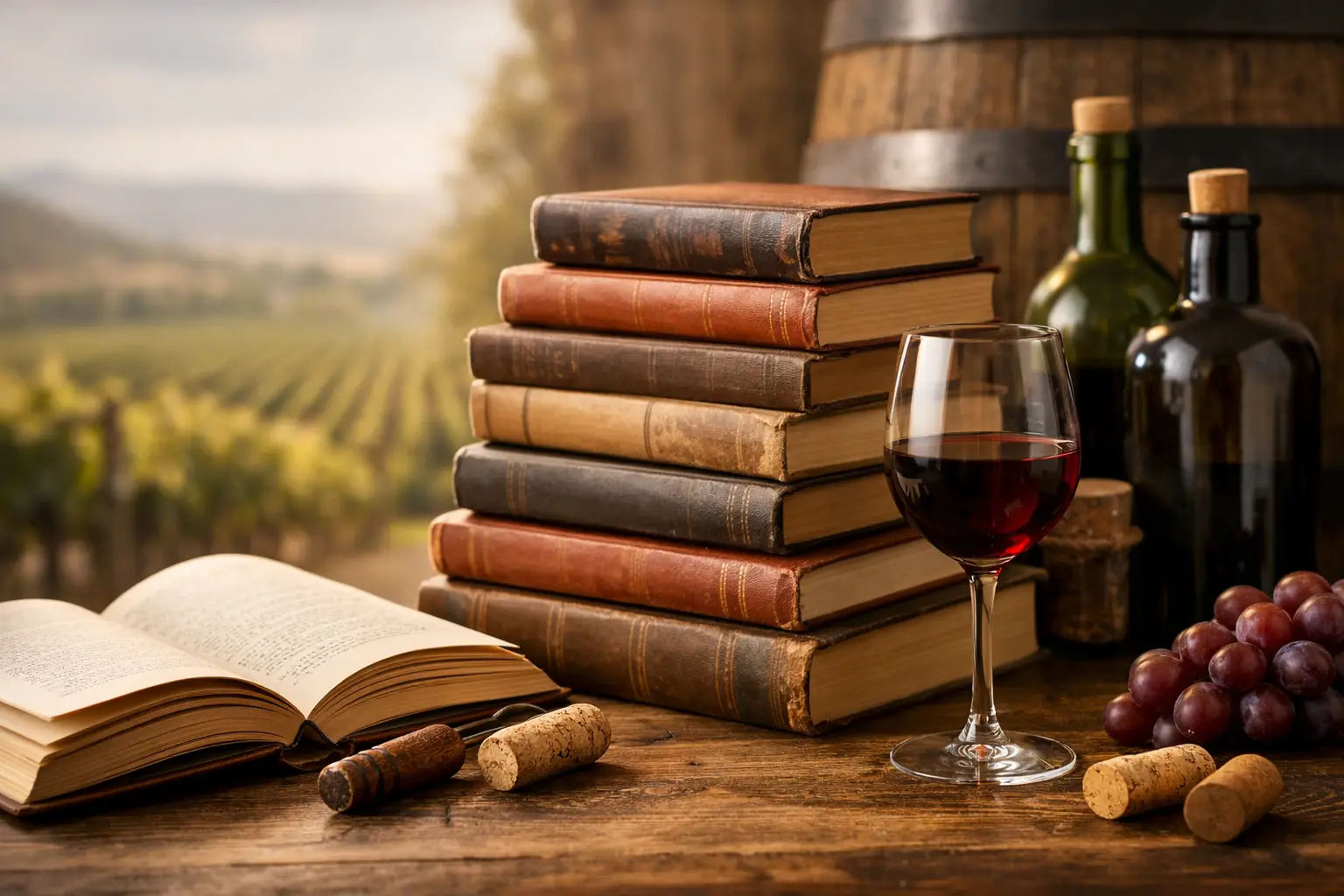
A bottle can carry the memory of a place, but it rarely explains how that place came to matter. The best books on wine history restore the missing drama: vineyards rebuilt after war, immigrants arriving with scientific rigor, families wagering everything on an unproven valley, and critics helping turn a regional craft into a global language.
For readers drawn to Napa Valley, the Judgment of Paris, and the human forces behind American wine, the strongest books do more than catalogue grapes and vintages. They reveal wine as a record of migration, ambition, agriculture, commerce, and survival. This is not a rigid ranking. The right starting point depends on whether you want the sweep of centuries, the texture of a particular region, or the story of a singular figure whose work changed the course of wine.
The Best Books on Wine History for the Big Picture
The Story of Wine by Hugh Johnson
Hugh Johnson writes with the assurance of someone guiding a reader through a great old library, then pausing at the windows to point out the living landscape beyond. The Story of Wine is among the most inviting broad histories of the subject, following wine from ancient Mediterranean civilizations through monasteries, merchant routes, imperial expansion, and the modern marketplace.
Its particular strength is scale. Johnson makes clear that wine was never merely a luxury drink. It has served as ritual, medicine, currency, political instrument, and expression of local identity. Readers seeking a graceful, panoramic first book will find it here. Those who want footnote-heavy academic analysis may want a more specialized companion, but few writers convey wine’s long cultural arc with this much warmth and authority.
A Short History of Wine by Rod Phillips
Rod Phillips brings a historian’s discipline to a subject often treated as pure romance. His concise account is especially useful for readers who want a dependable framework before moving into individual countries, eras, or personalities. Phillips addresses how religion, conquest, technology, trade, taxation, and changing tastes influenced what people planted and what they drank.
The title promises brevity, not superficiality. This is an excellent corrective to the notion that wine history belongs only to grand estates and famous labels. It shows how regulation, labor, disease, and ordinary consumption shaped the wine world as decisively as aristocratic patronage did.
Inventing Wine by Paul Lukacs
Paul Lukacs asks a deceptively simple question: when did wine become the culturally exalted beverage we recognize today? His answer moves beyond the usual chronology of grapes and regions. He examines the creation of wine’s prestige, from religious significance and elite consumption to the rise of connoisseurship and modern ideas of terroir.
This is a book for readers who enjoy the history behind the vocabulary. Lukacs explains why wine acquired a different social standing from beer or spirits, and why the language of place, authenticity, and craftsmanship became so powerful. It is less a travelogue than an argument, and that is precisely its value.
Books That Reveal Wine as a Human Drama
Wine and War by Don and Petie Kladstrup
If one book demonstrates why wine history can feel cinematic, it is Wine and War. Don and Petie Kladstrup recount the peril faced by French winemakers, cellar workers, and collectors during the German occupation of France in World War II. Behind familiar names and celebrated cellars lie stories of resistance, collaboration, confiscation, deception, and preservation.
The book does not romanticize every figure it encounters. Its power comes from the moral pressure of the period: what does it mean to protect a legacy when an occupying force can seize not only a cellar’s contents but its future? For readers interested in cultural memory, it makes wine tangible as an inheritance worth defending.
Adventures on the Wine Route by Kermit Lynch
Kermit Lynch’s classic is not a conventional history, yet it belongs on any serious wine-history shelf. His journeys through France in the late twentieth century capture a moment when small growers, traditional methods, and regional character were being pushed aside by industrial logic and international sameness.
Lynch writes as an importer, observer, and advocate. His accounts illuminate the people behind wines that American consumers were only beginning to understand. Read it for its voice, certainly, but also for its record of a decisive shift in how American drinkers encountered European wine. It reminds us that importers and merchants can become cultural translators, altering a nation’s palate one relationship at a time.
The Wine Elf: The Life and Times of Andre Tchelistcheff
The story of Andre Tchelistcheff belongs beside the great accounts of American reinvention. Miraculously rescued from revolutionary Russia, trained in the science of wine, and eventually brought to Napa Valley, Tchelistcheff became a giant among his peers. At Beaulieu Vineyard and through decades of mentorship, he helped replace uncertainty with discipline, elevating standards for vineyard practice, cellar hygiene, fermentation, aging, and the confidence to imagine California on the world stage.
Maestro Productions’ Wine Elf is essential for readers who want wine history anchored in a life of consequence. Tchelistcheff’s journey joins immigration, scientific mastery, postwar optimism, and California’s ascent. His legacy also offers a necessary reminder: regions do not become great by accident. They are shaped by teachers who give their knowledge away and by communities willing to build on it.
The Essential History of American Wine
The Wines of America by Leon D. Adams
Leon D. Adams wrote with the conviction that American wine deserved to be understood on its own terms. The Wines of America helped many readers see beyond the assumption that serious wine was exclusively European. It surveys the nation’s regions, producers, regulations, and evolving ambitions during a period when California was gathering momentum.
Some details naturally reflect its era, which is part of the book’s historical interest. Read Adams not simply for current recommendations, but to witness the argument for American wine as it was being made. The book captures the early confidence of an industry preparing to command international attention.
A History of Wine in America: From the Beginnings to Prohibition by Thomas Pinney
Thomas Pinney’s work is indispensable for readers who want the foundations rather than the legend. This volume follows American wine from colonial experimentation through the nineteenth century, showing how climate, native grapes, immigration, commercial pressures, and temperance politics complicated every effort to establish a lasting industry.
It is more scholarly than casual, and it rewards patience. Pinney is especially good on the fact that American wine was never a simple transplant of Europe. The country’s native vines, diseases, geography, and laws forced growers and winemakers to invent a distinct path.
A History of Wine in America: From Prohibition to the Present by Thomas Pinney
The companion volume carries the story into the era that made contemporary American wine possible. Prohibition devastated vineyards, knowledge, and markets, but it did not extinguish the desire to begin again. Pinney traces the slow rebuilding of an industry that would eventually produce internationally respected wines and regions of enduring influence.
For Napa-focused readers, this is vital context. The valley’s later acclaim can appear inevitable when viewed through famous estates and auction records. Pinney restores the uncertainty – the fragile post-Repeal years, the pioneers, the investment, and the long work required before California could challenge old assumptions.
Judgment, Napa, and the Moment California Was Seen
Judgment of Paris by George M. Taber
George M. Taber was present at the 1976 Paris tasting, and his account remains the defining narrative of the event that startled the wine establishment. The victory of California wines over revered French labels was not a magical overnight transformation. It was a public revelation of work that had been accumulating for decades in vineyards and cellars.
Taber understands the stakes without turning the tasting into a fairy tale. He introduces the winemakers, organizers, journalists, and skeptical gatekeepers who made the moment possible. Anyone curious about why a single blind tasting still carries such force should start here.
Napa: The Story of an American Eden by James Conaway
James Conaway’s Napa book is expansive, observant, and unafraid of tension. It traces the valley’s evolution through land, capital, personalities, agriculture, fame, and conflict. Napa’s greatness emerges not as a polished brand promise but as a contested achievement, dependent on vision while vulnerable to the pressures that accompany success.
That complexity makes it especially rewarding for visitors and collectors. The valley is more meaningful when its celebrated wines are understood alongside the people who cultivated it, the rivalries that sharpened it, and the conservation questions that still define its future.
The World Atlas of Wine by Hugh Johnson and Jancis Robinson
An atlas may sound like a reference tool rather than a history book, but this landmark work teaches historical thinking through geography. Its maps show why rivers, slopes, soils, borders, weather patterns, and transportation routes matter. Wine history happened in physical places, and this book keeps those places in view.
Use it beside any of the narrative works above. A chapter about Bordeaux, Burgundy, Napa, or the Mosel becomes richer when you can see the terrain that shaped the choices of growers across generations.
Choose the Book That Changes How You Taste
A broad history is the right opening for the curious reader. A regional account is better for someone planning a Napa visit or building a cellar with intention. Biography offers something different again: the chance to see how one disciplined, courageous life can redirect an entire industry.
Read slowly, with a bottle that has a story of its own. The next time you raise a glass, ask not only what is in it, but whose knowledge, risk, and perseverance made that moment possible.

