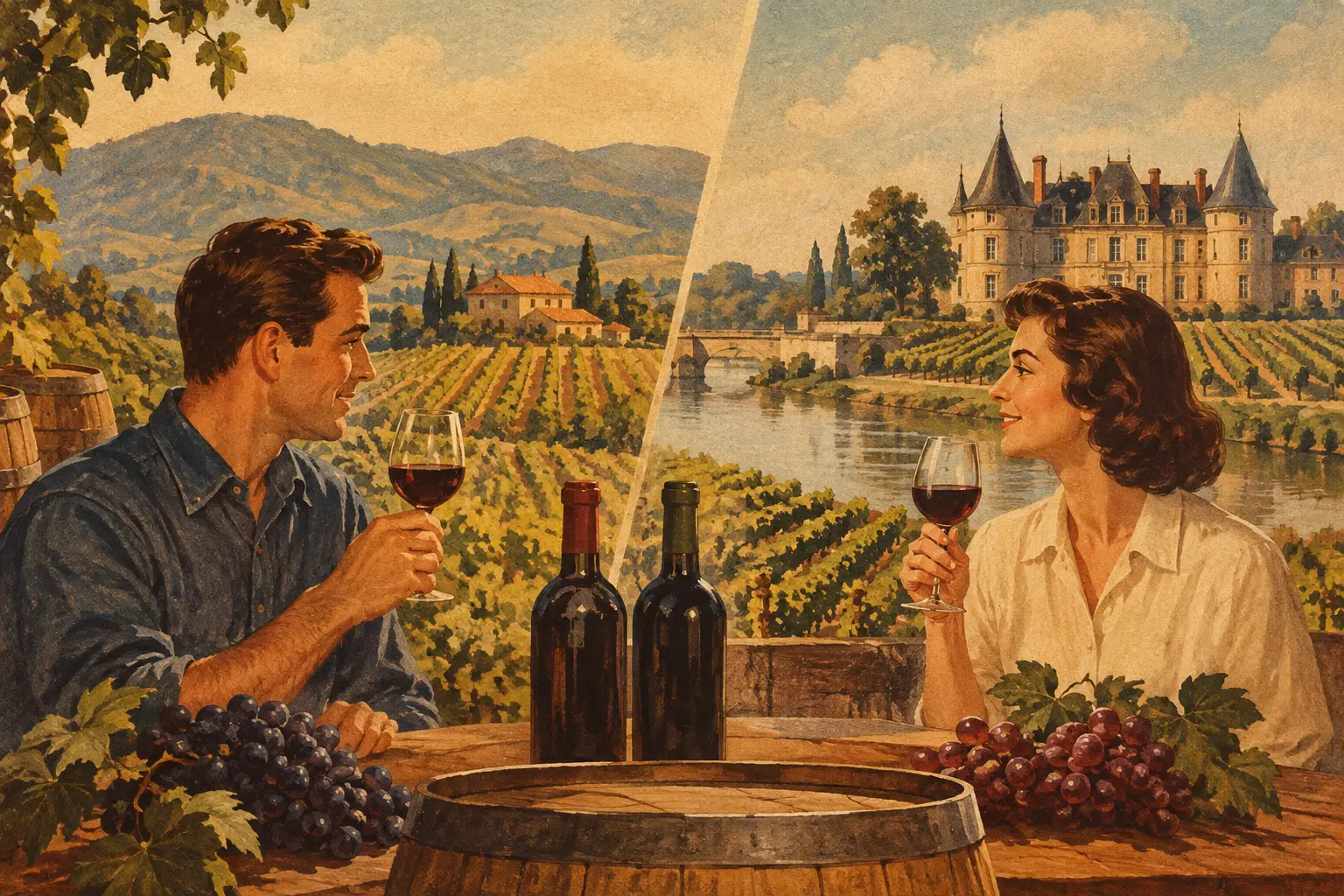
In the great conversation of Napa Valley versus Bordeaux winemaking, the most revealing question is not which region is superior. It is how one young American valley earned the confidence to stand beside a French institution whose vineyards, chateaux, and classifications had shaped the idea of fine wine for centuries. The answer lies in soil and weather, certainly, but also in a human drama of migration, scientific rigor, risk, and belief.
Bordeaux gave the world a language for Cabernet Sauvignon, Merlot, cellar aging, and age-worthy blends. Napa Valley took that language, learned its grammar, then spoke with an unmistakably Californian accent. Its rise was not inevitable. It was built by growers, families, scientists, and immigrant winemakers who saw more potential in the valley than much of the wine world was prepared to recognize.
Napa Valley Versus Bordeaux Winemaking: Two Models of Place
Bordeaux is not a single wine landscape. It is a broad Atlantic region shaped by the Gironde estuary and its rivers, with varied soils, climates, and traditions. On the Left Bank, gravel soils and Cabernet Sauvignon often define the leading blends of the Medoc and Graves. On the Right Bank, Merlot and Cabernet Franc find profound expression in clay and limestone around Saint-Emilion and Pomerol. The regional identity is powerful, but its finest wines emerge from a complex map of individual communes, estates, vineyard parcels, and inherited knowledge.
Napa is geographically smaller and more concentrated, yet its diversity can be startling. Cool Carneros sits close to San Pablo Bay, while mountain vineyards rise above the fog line and the floor of the valley can grow intensely warm in summer. Volcanic slopes, ancient seabed deposits, gravelly benches, and alluvial fans give Napa vintners a remarkable range of sites within a short drive.
The most immediate difference is climate. Bordeaux faces a maritime growing season marked by rain, cloud cover, and the occasional anxiety of a difficult harvest. Great vintages can be magnificent, but consistency is never guaranteed. Napa’s dry, sunny summers and long growing season give growers more reliable ripening conditions, particularly for Cabernet Sauvignon.
That advantage has a trade-off. Bordeaux’s cooler conditions can preserve acidity and restraint, producing wines whose architecture gradually reveals itself over decades. Napa’s warmth can bring generous fruit, fuller body, and a more immediate sense of abundance. Yet a Napa wine with excessive ripeness can lose tension, just as a rain-challenged Bordeaux can struggle to reach complete maturity. Neither path is automatic. The finest wines in either region are exercises in balance.
Tradition, Classification, and Freedom
Bordeaux winemaking is inseparable from a deeply established culture of appellations, classifications, and chateau identity. A bottle may carry the authority of a famous estate, but it also bears the expectations of its place. Blend composition, vineyard practice, and market position exist within a system developed over generations. That framework can preserve standards and continuity. It can also make change deliberate and slow.
Napa developed under different conditions. Its American Viticultural Areas identify places such as Oakville, Rutherford, Stags Leap District, and Howell Mountain, but they do not dictate the same degree of stylistic tradition. Napa producers have had greater latitude to experiment with vineyard density, canopy management, fermentation vessels, oak regimens, and varietal expression.
This freedom helped California advance quickly, though it occasionally invited excess. In some eras, the pursuit of concentration, new oak, and high ripeness created wines of striking power that did not always carry the restraint collectors seek with age. Today, many Napa winemakers are refining that inheritance. They are picking with greater precision, protecting freshness, relying on site-specific farming, and allowing alcohol, tannin, and fruit to settle into proportion.
Bordeaux has evolved as well. Better sorting, cleaner cellars, more attentive vineyard work, and a clearer understanding of individual parcels have changed the region’s wines. The old contrast between traditional France and modern California is no longer sufficient. Both regions now hold tradition and innovation in active tension.
The Man Who Helped Napa Speak With Authority
Andre Tchelistcheff stands at the center of Napa’s transformation because he understood that ambition required discipline. Miraculously rescued from the upheaval that followed the Russian Revolution, he crossed continents carrying scientific training, hard-won resilience, and an unusually exacting vision of what California wine could become.
When Tchelistcheff arrived at Beaulieu Vineyard in 1938, Napa had promise but had not yet secured international stature. Prohibition had damaged the American wine industry, and much of the country’s fine-wine future remained uncertain. He approached the work with the conviction that great wine was made first in the vineyard, then protected through precise cellar practice.
His influence reached from fermentation and sanitation to barrel aging, varietal selection, harvest decisions, and the patient study of Napa’s growing conditions. He championed techniques that helped California produce wines of greater purity, structure, and longevity. More importantly, he trained and inspired generations of vintners. His cellar became a classroom, and his standards became part of Napa’s institutional memory.
Tchelistcheff did not make Napa into Bordeaux. That was never the point. He helped Napa recognize its own greatness while insisting that California measure itself against the world’s highest standards. In that sense, he was a giant among his peers: an immigrant master who reinvented American winemaking without asking it to imitate Europe.
Judgment, Recognition, and What It Changed
The 1976 Judgment of Paris remains the most famous public turning point in the Napa-Bordeaux relationship. In a blind tasting organized in Paris, a Napa Cabernet Sauvignon and a Napa Chardonnay prevailed against celebrated French wines. The event did not settle a permanent contest, nor did it erase Bordeaux’s immense achievements. It did something more consequential: it made dismissal of California impossible.
For American producers, the result was a declaration of arrival. For collectors and critics, it expanded the map of fine wine. For Napa, it affirmed work that had been underway for decades, including the scientific and cultural foundation laid by figures such as Tchelistcheff.
The lasting significance of the Judgment of Paris is often misunderstood. It was not merely a story about winning. It was a story about standards becoming transferable. Excellence was no longer assumed to belong to one old-world geography. It could be cultivated wherever talent, place, patience, and rigorous craft came together.
Why the Difference Still Matters
For a collector, Bordeaux and Napa answer different desires. Bordeaux often rewards patience, study, and the pleasure of watching a wine evolve from reserve to complexity. Napa can offer that same potential, especially from disciplined producers and exceptional sites, while also delivering an earlier generosity and unmistakable Californian presence.
For visitors, Bordeaux offers the grandeur of a wine civilization shaped across centuries. Napa offers a more intimate view of a living industry, where vineyard, cellar, restaurant, and hospitality culture sit close together. One is not more authentic than the other. Their authenticity comes from different histories.
For vintners, the comparison remains productive when it is treated as a conversation rather than a scorecard. Bordeaux reminds Napa that restraint, longevity, and continuity matter. Napa reminds Bordeaux that innovation, confidence, and reinvention can honor a tradition rather than threaten it.
The story is also a reminder that regions do not create their reputations alone. People do. They preserve inherited knowledge, challenge accepted limits, and pass their standards to the next generation. In telling Andre Tchelistcheff’s story, Wine Elf honors that living chain of mentorship and mastery.
The next time a Napa Cabernet or Bordeaux blend is poured, resist the urge to declare a winner too quickly. Ask instead what the wine carries: a climate, a vineyard, a cellar philosophy, and a history of people determined to make something that would outlast them. That question makes every serious bottle more meaningful.

