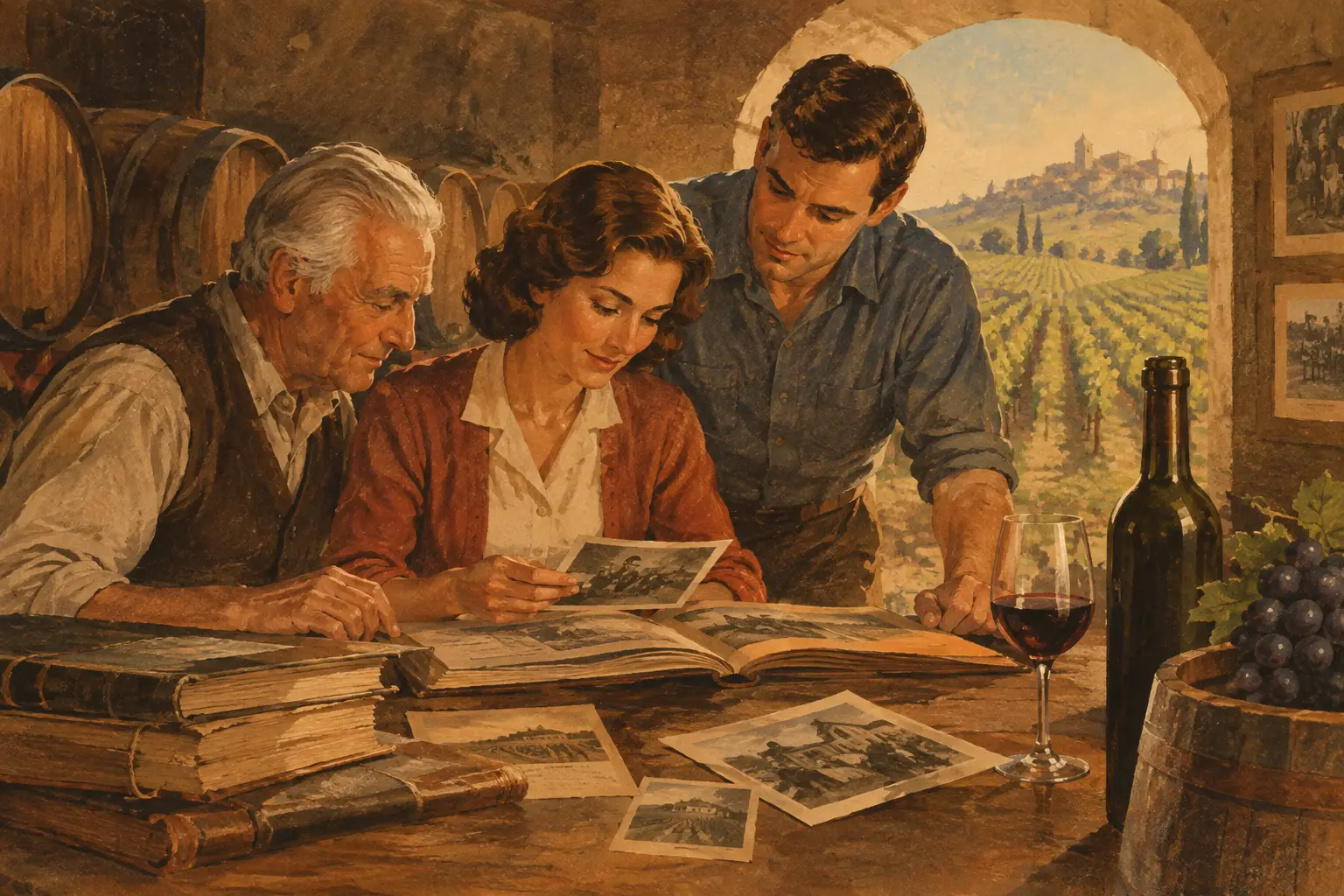
A winery’s oldest vineyard block may be carefully tended, its reserve bottles protected in a cool cellar, and its founding photographs framed in the tasting room. Yet the story that gives those objects meaning can still disappear. Documenting winery histories is the work of preserving more than dates, awards, and varietals. It captures the decisions made under pressure, the families who crossed borders or took improbable risks, and the mentors whose standards changed an entire region.
For American wine, this work carries particular urgency. Napa Valley’s ascent was not inevitable. Neither was the international recognition that followed the Judgment of Paris, nor the transformation of California vineyards through scientific rigor, patient experimentation, and the conviction of people who saw greatness before the world did. A bottle can outlast its maker, but only a well-told record can explain what that maker achieved.
Why Documenting Winery Histories Matters
Wine is an agricultural product, but its history is never only agricultural. It is shaped by weather, migration, finance, war, inheritance, land use, technology, and taste. A winery history that reduces this complexity to a polished timeline may look respectable, but it leaves the most consequential questions unanswered: Who was willing to begin? What did they risk? Which practices were resisted before they became standard? What nearly ended the enterprise?
The finest historical records make room for both achievement and uncertainty. They do not turn founders into flawless monuments. Instead, they reveal character through evidence: a handwritten note from a difficult harvest, a letter seeking investment, a cellar log that records a decisive trial, or the recollection of a vineyard worker who watched a young winemaker learn the land.
That depth has practical value as well as cultural value. Winery guests increasingly want to understand the place in their glass. Collectors want provenance. Journalists, filmmakers, scholars, and hospitality teams need a reliable account of what came before. A carefully documented history gives a winery a durable foundation for education, visitor experiences, books, exhibitions, and screen storytelling. It also protects the record when founders retire, longtime employees move on, or families face a generational transition.
Start Before the Witnesses Are Gone
The most irreplaceable archive is often the living one. A retired cellar master may remember why a particular barrel program began. A grower may know the story behind a vineyard name that appears nowhere in the official files. A family member may possess a box of correspondence that explains the years when the winery nearly changed hands.
These accounts should be gathered early, recorded carefully, and treated with respect. An interview is not simply a promotional conversation. It is a historical source. Ask people to describe what they saw, heard, chose, feared, and believed at the time, rather than asking them to recite a corporate origin story. Specific questions produce specific memory: What was the first harvest like? Who argued for the new method? Which vintage tested the team? When did the winery first sense that it had earned a place beyond its own valley?
Memory can be imperfect, particularly when decades have passed. That does not make oral history less valuable. It means it should be paired with contemporaneous records. If one person recalls that a pivotal Cabernet was made in a certain year, check production notes, invoices, press clippings, labels, and photographs. The goal is not to flatten human memory into a spreadsheet. It is to let testimony and evidence illuminate one another.
Record the people behind the label
Founders deserve attention, but they are rarely the whole story. Vineyard crews, laboratory directors, tasting-room leaders, brokers, restaurateurs, distributors, architects, and neighboring growers may all have shaped a winery’s identity. The history becomes more truthful when it recognizes the many hands involved.
This is especially vital in the story of California wine, where immigrant ambition and cross-cultural exchange have been central to the region’s character. Andre Tchelistcheff, the Russian-born winemaker whose scientific discipline and mentorship helped reinvent American winemaking, is one towering example. His influence cannot be understood merely as a list of technical innovations. It lies in the people he taught, challenged, and inspired across generations.
Build a Chronology, Then Look for the Drama
Every serious winery archive needs a chronology. Begin with the land: prior ownership, planting decisions, water access, appellation changes, and the physical development of the estate. Add the business milestones, first releases, pivotal vintages, acquisitions, partnerships, leadership changes, awards, and major setbacks. Include the wider events that affected the winery, from economic downturns and fires to prohibition-era legacies or shifts in American dining culture.
But chronology is the scaffolding, not the finished story. Once the facts are in order, look for turning points. A great narrative often hinges on a moment when the future was unclear: a family choosing to replant rather than sell, a winemaker defending an unconventional idea, a vineyard surviving a devastating season, or an unknown California bottle earning recognition on an international stage.
Those moments give a history movement. They show that legacy was built through choices, not bestowed by reputation. They also keep the account from becoming a parade of accolades. Awards matter, but they are most meaningful when readers understand the years of labor and conviction that made them possible.
Preserve the Evidence, Not Just the Highlights
A useful archive contains celebrated material and ordinary material. Store high-resolution copies of photographs, labels, harvest reports, vineyard maps, tasting notes, correspondence, sales materials, clippings, and audio or video interviews. Identify each item with a date, location, creator, and short explanation of its relevance. A beautiful image without context eventually becomes a mystery.
Digital preservation is essential, but it should not create false confidence. Files require organization, backups, clear naming conventions, and periodic review as formats change. Physical originals deserve stable storage and thoughtful handling. If an artifact is fragile or valuable, a professional archivist can advise on preservation and access.
Resist the temptation to save only what makes the winery look triumphant. A rejected label design, an early marketing brochure, or notes from a difficult vintage may later become the detail that makes the larger story feel alive. Historical credibility is earned through texture.
Documenting Winery Histories for More Than a Tasting Room
A preserved history should be able to travel. The same research may inform a tasting-room script, a commemorative book, staff education, a museum collaboration, a documentary treatment, or a feature-length narrative project. Each format asks for something different, but each depends on the same disciplined source material.
This is where historical stewardship becomes an act of imagination. A tasting room may need a concise, welcoming version of the founding story. A book can linger over the years of apprenticeship and struggle. Film and television seek scenes, stakes, visual detail, and characters whose inner lives meet a larger historical moment. The research should be deep enough to support all of them without forcing the story into a single promotional shape.
At Maestro Productions, the Wine Elf story demonstrates what becomes possible when wine history is treated as a living cultural legacy. The life of Tchelistcheff contains survival, displacement, intellectual rigor, mentorship, and the remaking of a nation’s wine identity. Such material belongs not only in an archive box, but in the public imagination.
Let the Record Remain Human
The temptation in brand history is to make every chapter sound preordained. Yet audiences recognize the difference between a slogan and a story. They respond to human stakes: the uncertainty before a first harvest, the tension between tradition and innovation, the private cost of building something intended to last.
A winery does not need a famous name or a century of uninterrupted success to possess a story worth preserving. It needs truthful material, attentive listening, and the willingness to see its own past as part of a larger American narrative. The vineyard may supply the setting, but people create the legacy.
Begin with one conversation, one labeled photograph, one box of records brought down from a shelf. What is preserved now may one day help a visitor, a descendant, or a filmmaker understand not merely how a wine was made, but why it mattered.

