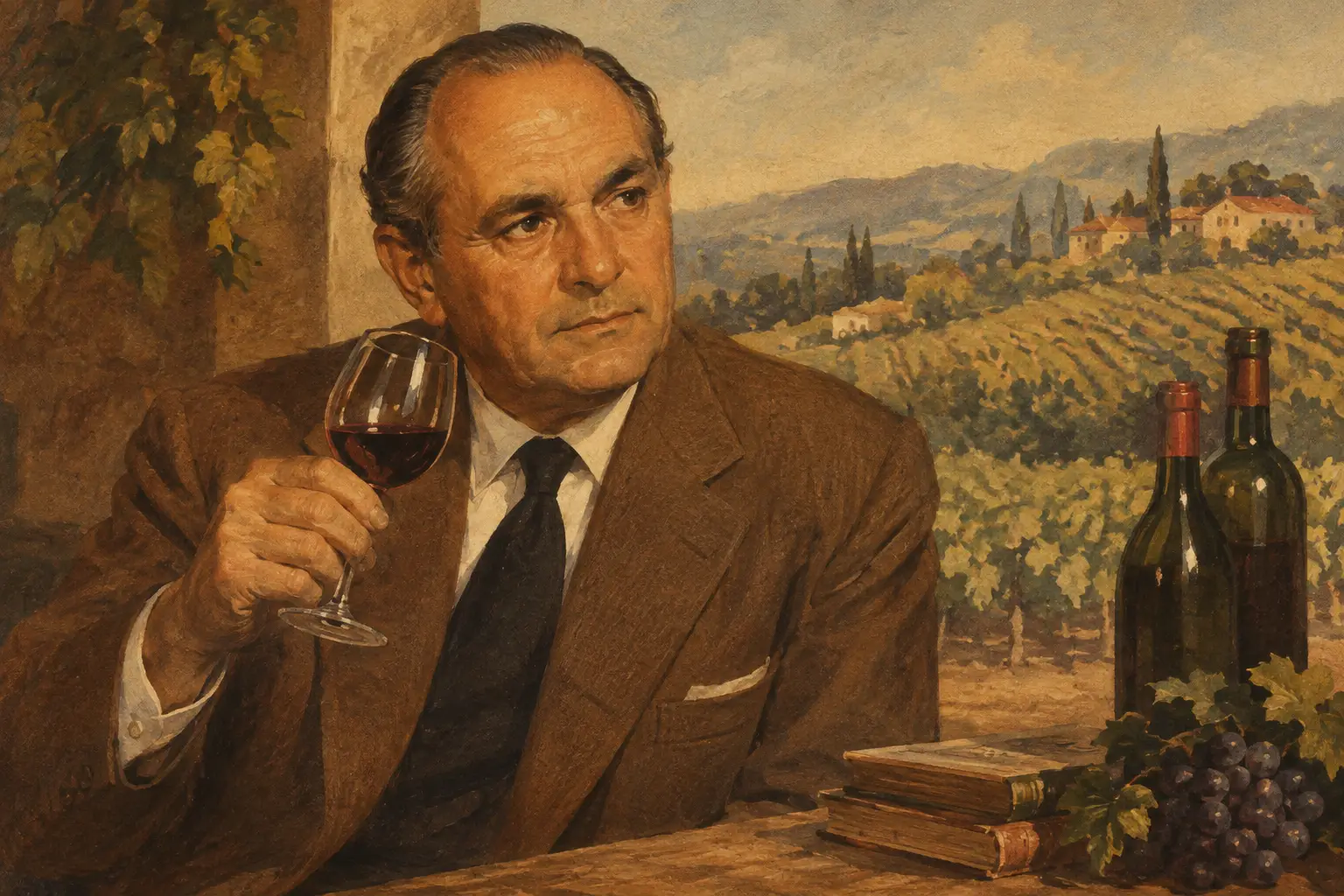
A winemaker can leave behind bottles. Andre Tchelistcheff left behind a way of seeing. To ask what made Andre Tchelistcheff influential is to ask how Napa Valley became more than a beautiful agricultural valley – how it became a place capable of producing wines the world could not dismiss.
His story carries the force of a historical drama: a Russian-born survivor of revolution and war, scientifically trained in France, arriving in California on the eve of another global conflict. Yet the enduring power of Tchelistcheff’s life lies not only in its cinematic turns. At Beaulieu Vineyard and far beyond it, he brought disciplined observation, technical rigor, aesthetic conviction, and a fierce generosity toward younger winemakers. He did not merely improve wine. He helped create the professional culture that allowed modern California wine to exist.
A survivor whose education crossed borders
Andre Tchelistcheff was born in Moscow in 1901, into an era that would soon be shattered by revolution. His early life was marked by displacement, danger, and loss. He escaped the turmoil that overtook Russia and eventually made his way to France, where his future as a winemaker began to take shape.
France gave him more than a new homeland. It gave him a vocabulary for precision. He studied agricultural science and microbiology, absorbing a European understanding that great wine is neither accident nor ornament. It is the result of judgment at every stage: the condition of the vineyard, the health of the fruit, the behavior of yeast, the timing of fermentation, the use of oak, and the patience to let a wine become itself.
This scientific grounding distinguished him from many California winemakers of the period. Before World War II, much of the state’s wine industry was still recovering from Prohibition, which had damaged vineyards, markets, expertise, and public confidence. California had land, sunshine, and ambition. It did not yet have a widely shared standard for fine wine.
Tchelistcheff arrived with the rare ability to connect laboratory knowledge to sensory judgment. He could speak about acidity and bacteria without losing sight of aroma, texture, and grace. That combination made him not simply a technician, but an artist of consequence.
Beaulieu Vineyard became his proving ground
In 1938, Georges de Latour recruited Tchelistcheff to become winemaker at Beaulieu Vineyard in Rutherford. The appointment changed the course of American wine. De Latour had the vision and commercial courage to build a serious estate; Tchelistcheff brought the methods required to fulfill that promise.
At Beaulieu, he raised expectations from vine to cellar. He emphasized cleaner winemaking, careful sanitation, temperature control, thoughtful fermentation practices, and maturation in small French oak barrels. These choices can sound familiar now because they became central to premium winemaking. At the time, they represented a clear break from casual habits and compromised standards.
His approach was never reducible to a checklist. Tchelistcheff understood that technology could protect quality, but it could not substitute for taste. He pursued wines with structure and aging potential, wines that could carry the character of Napa Valley without imitating Europe. His great work at Beaulieu, especially the wines that came to be associated with the Georges de Latour Private Reserve label, showed that California Cabernet Sauvignon could be serious, layered, and long-lived.
That achievement mattered commercially, but it mattered culturally even more. A lasting fine wine invites comparison. It asks collectors to cellar it, restaurateurs to pour it, critics to assess it, and skeptics to revise their assumptions. Beaulieu’s success helped prove that Napa Valley belonged in that conversation.
He treated the cellar as a place of inquiry
Tchelistcheff’s influence is often described through famous techniques, including malolactic fermentation, a process that can soften a wine’s sharp malic acidity and add textural complexity. But his greater contribution was his insistence on understanding causes rather than merely reacting to symptoms.
When a wine seemed unbalanced, unstable, or dull, he looked for the reason. Was the fruit harvested at the right moment? Was the fermentation healthy? Was the wine exposed to too much air? Was the barrel choice adding dimension or obscuring it? This habit of inquiry elevated the role of the winemaker in California from caretaker to informed interpreter.
That distinction still matters. Modern wineries possess tools Tchelistcheff could scarcely have imagined, from advanced vineyard mapping to precise laboratory analysis. Yet no instrument can answer the central question he kept before him: what will best reveal the vineyard in this particular vintage? His legacy reminds winemakers that data is invaluable, but it must serve discernment.
What made Andre Tchelistcheff influential beyond Beaulieu
A great vintner’s influence can be measured by the wines bearing his name. A giant among his peers is measured by the people who carry his standards into places he never owned. Tchelistcheff became known as the dean of American winemakers because his counsel traveled widely through Napa Valley and the larger California wine community.
He advised, encouraged, and challenged generations of vintners. Winemakers who would shape the next chapter of California wine sought his perspective because it was exacting without being narrow. He understood that each vineyard and each producer faced different conditions. His advice was rooted in principles, not dogma.
This was particularly important as Napa expanded in the postwar decades. New estates needed more than investment and optimism. They needed practical knowledge: how to select sites, manage grapes, build cellars, and avoid the errors that can consume years of work. Tchelistcheff offered both expertise and an example of intellectual seriousness.
His mentorship helped establish a chain of transmission. Knowledge moved from cellar conversations and tasting benches into new wineries, new vineyards, and new families. That human network is one reason his influence cannot be confined to a single estate or vintage. California wine rose through a community of ambitious figures, but Tchelistcheff was among the essential teachers who helped that community mature.
His influence made the Judgment of Paris possible
The 1976 Judgment of Paris did not happen because of one man. The historic tasting, in which California wines surpassed celebrated French wines in a blind competition, reflected the labor of growers, owners, winemakers, and visionaries across decades. Still, it is difficult to imagine that moment without the standards Tchelistcheff helped establish.
By the time California wines shocked the international establishment in Paris, the state had developed a deeper bench of technical talent and a stronger belief in its own potential. Tchelistcheff had spent nearly four decades demonstrating that California could pursue excellence with discipline rather than apology.
The Judgment of Paris altered global perception, but its roots were in the quieter work of preparation: better vineyards, cleaner cellars, more rigorous tasting, and the confidence to make wines intended for the world’s table. Tchelistcheff belonged to that foundation. He helped build the stage before others stepped into its brightest light.
A philosophy of place, not imitation
There is a temptation to describe Tchelistcheff as someone who brought Old World methods to the New World. That is true, but incomplete. His achievement was not imitation. He understood that California’s climate, soils, light, and growing conditions demanded their own expression.
The trade-off was real. European tradition offered valuable discipline, yet copying European styles too literally could erase what was distinctive about Napa fruit. Tchelistcheff’s work showed that respect for tradition and belief in local identity could coexist. Fine wine did not have to resemble Bordeaux or Burgundy to deserve seriousness. It had to be balanced, honest, and made with intention.
That conviction helped define the aspiration of Napa Valley. The region could honor the accumulated wisdom of Europe while building an American tradition of its own – bold enough to experiment, rigorous enough to endure.
Why his legacy remains alive
Andre Tchelistcheff died in 1994, but his presence remains tangible wherever California wine is discussed as an art, a science, and a historical achievement. His name is invoked because he represents more than technical advancement. He represents resilience transformed into mastery.
For wine lovers, his story changes the experience of opening a mature Napa Cabernet. Behind the color, aroma, and finish stands a larger inheritance: an immigrant’s hard-won education, a vintner’s patience, and a generation’s decision to believe California could make wines for the ages.
For wineries and cultural institutions, preserving that inheritance is not nostalgia. It is a way of keeping craft connected to memory. The story of Tchelistcheff invites us to look more closely at the people who made American wine possible – and to give the next generation something worthy to carry forward.

