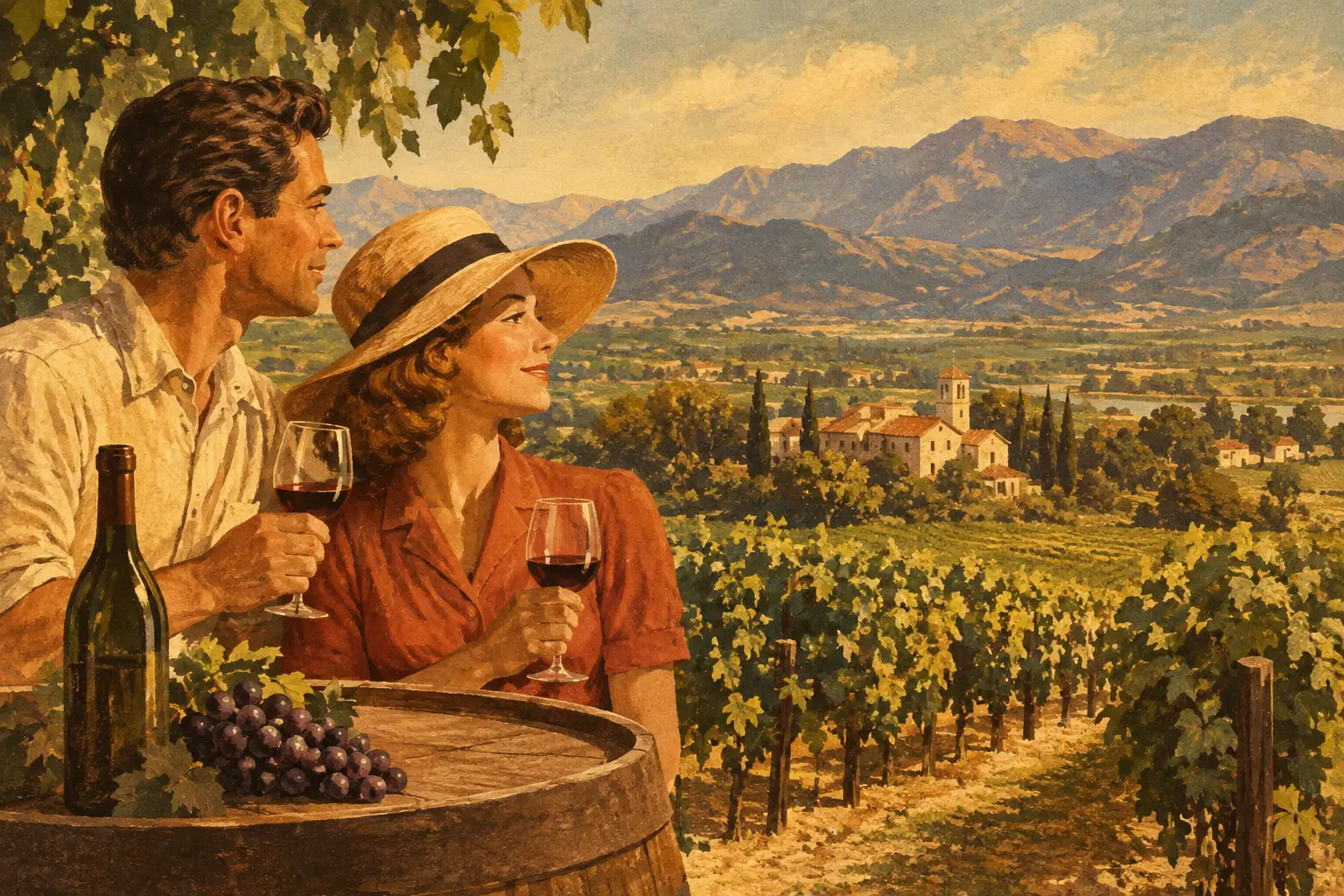
A great bottle can preserve a year, a place, and the judgment of the people who made it. This California wine history guide begins with that human truth: the state’s ascent was never inevitable. It was shaped by missionaries and immigrants, ruined by disease and Prohibition, revived by stubborn families, and transformed by a Russian-born scientist who saw world-class possibility in Napa Valley.
California did not simply become a wine region. It fought its way into the company of the world’s great vineyards. Its history is a story of land and capital, certainly, but also of exile, mentorship, risk, and an enduring belief that American wine could be more than a local curiosity.
Before Napa Had a Name
Wine grapes arrived in California with the Spanish missions in the late eighteenth century. Beginning in 1769, missionaries planted the hardy Mission grape to make sacramental wine and brandy. The wines were rarely celebrated for finesse, but the vines established an enduring fact: California’s soils and sun could sustain viticulture.
The Gold Rush changed the scale of the ambition. As San Francisco exploded with newcomers after 1848, farmers, merchants, and European immigrants recognized a market for wine. Hungarian-born Agoston Haraszthy became one of the era’s great evangelists, bringing attention to Sonoma’s potential and advocating for better European varieties. His legacy has been debated and occasionally romanticized, yet his larger contribution remains clear: he helped make serious viticulture an American aspiration.
By the late nineteenth century, vineyards stretched through Napa, Sonoma, and the Central Valley. Charles Krug established Napa Valley’s first commercial winery in 1861. Gustave Niebaum built Inglenook into an estate of unusual rigor and stature. In 1889, Georges de Latour and his wife Fernande acquired the property that would become Beaulieu Vineyard. These were not yet the foundations of a guaranteed golden age. They were early acts of confidence in a region still defining itself.
California Wine History Guide to Survival
The first California wine boom met the same forces that humbled vineyards across the world. Phylloxera, a tiny root-feeding pest, devastated many plantings. Growers learned that European vinifera vines needed to be grafted onto resistant American rootstocks, a technical solution that revealed how much patience and scientific knowledge winegrowing requires.
Then came Prohibition. From 1920 to 1933, the American wine industry was dismantled with startling speed. Some vineyards survived by selling grapes for home winemaking. Others produced sacramental wine or converted their land to different crops. Many wineries simply vanished.
Repeal did not return California to its former position overnight. The country emerged from Prohibition with damaged vineyards, weakened distribution, and a public accustomed to sweeter, simpler wines. The Great Depression added another obstacle. Yet within the ruins were vineyards, family knowledge, and a handful of estates prepared to begin again.
That distinction matters. Wine history is often told as a smooth march toward prestige. It is better understood as a sequence of recoveries. Every celebrated vintage rests on earlier periods when the industry might easily have disappeared.
André Tchelistcheff Reinvents the Standard
In 1938, Beaulieu Vineyard hired André Tchelistcheff, a decision that would alter the course of California wine. Born in Moscow, Tchelistcheff survived the chaos that followed the Russian Revolution, found refuge abroad, and trained in viticulture and enology in France. He arrived in Napa carrying European scientific discipline, practical intuition, and the hard-won resilience of a man whose life had already been overturned by history.
At Beaulieu, he became a giant among his peers. Tchelistcheff did not merely make better wine. He helped establish a new philosophy of how American wine should be made. Cleanliness in the cellar, temperature control during fermentation, careful aging, improved vineyard practices, and exacting standards for fruit were not glamorous ideas. They were revolutionary because they made quality repeatable.
His influence can be felt in Beaulieu Vineyard’s Private Reserve Cabernet Sauvignon, first made from the 1940 vintage and later revered as a Napa benchmark. The wine demonstrated that California Cabernet could possess longevity, structure, and distinction without imitating Europe in a superficial way. It had to speak clearly of its own valley.
Tchelistcheff also understood that talent cannot remain isolated. He taught, advised, challenged, and encouraged generations of growers and winemakers. Among those touched by his example were Mike Grgich and Warren Winiarski, figures whose later achievements would help carry California wine onto the international stage. His legacy was not a single technique or label. It was a culture of seriousness.
The Judgment That Changed the World’s View
By the 1960s and 1970s, a new generation of California wineries was taking shape. Robert Mondavi’s winery, founded in 1966, made a public case for varietal wines, estate identity, and a more confident American wine culture. Small producers began treating vineyard location as destiny rather than as a detail on a label.
Then, in 1976, came the Judgment of Paris. At a blind tasting organized in Paris, French judges ranked California wines above esteemed French examples in both Chardonnay and Cabernet Sauvignon. Chateau Montelena’s 1973 Chardonnay and Stag’s Leap Wine Cellars’ 1973 S.L.V. Cabernet Sauvignon delivered the shock heard around the wine world.
The event did not mean California had surpassed France in every category, nor did it settle a permanent hierarchy. One tasting cannot do that. Its importance was cultural and psychological. California had proven it could stand at the same table, under the same scrutiny, and command respect.
The Judgment of Paris also illuminated Tchelistcheff’s longer influence. Mike Grgich, who made the winning Chateau Montelena Chardonnay, had worked at Beaulieu under Tchelistcheff. Warren Winiarski, founder and winemaker of Stag’s Leap Wine Cellars, had likewise absorbed lessons from the Beaulieu orbit. A historic victory in Paris had roots in Napa mentorship.
Prestige Brings New Pressures
California’s success created a more complicated landscape. Napa Valley became a global destination, a collector’s benchmark, and a symbol of American luxury. The establishment of the Napa Valley American Viticultural Area in 1981 gave formal recognition to the identity producers had spent decades building. Sub-appellations later made the conversation more precise, directing attention to places such as Rutherford, Stags Leap District, Oakville, and Carneros.
But prestige carries costs. Vineyard land became extraordinarily expensive. Smaller producers faced fierce pressure. The phylloxera crisis of the late twentieth century required widespread replanting, bringing hardship but also an opportunity to reconsider rootstocks, clones, spacing, and site selection. More recently, drought, heat, wildfire, labor constraints, and water management have tested the old assumptions behind California abundance.
There is no single answer to these pressures. Earlier harvests may preserve freshness in a warmer season, but they can alter the shape and character of a wine. Irrigation can protect a vineyard during drought, yet water is never a casual resource in California. Replanting can improve quality, but it asks growers to absorb years without a full crop. The future of California wine will depend on clear-eyed adaptation rather than nostalgia alone.
A Legacy Worth Carrying Forward
The most meaningful way to experience California wine is to see the people behind the label: the immigrant who crossed continents with scientific knowledge intact, the family that kept vines alive through prohibition, the grower who recognized greatness in an uncelebrated hillside, the mentor who insisted that the next generation aim higher.
For Napa visitors, collectors, and wine professionals, this history adds dimension to every cellar door and every bottle opened at the table. A Cabernet is no longer only a Cabernet. It can be a record of European training translated to American soil, of a valley rebuilt after adversity, and of standards passed from one determined hand to another.
The California wine story remains unfinished. Its next chapter belongs to those willing to protect the land, honor the craft, and preserve the remarkable human stories that made this place matter.

