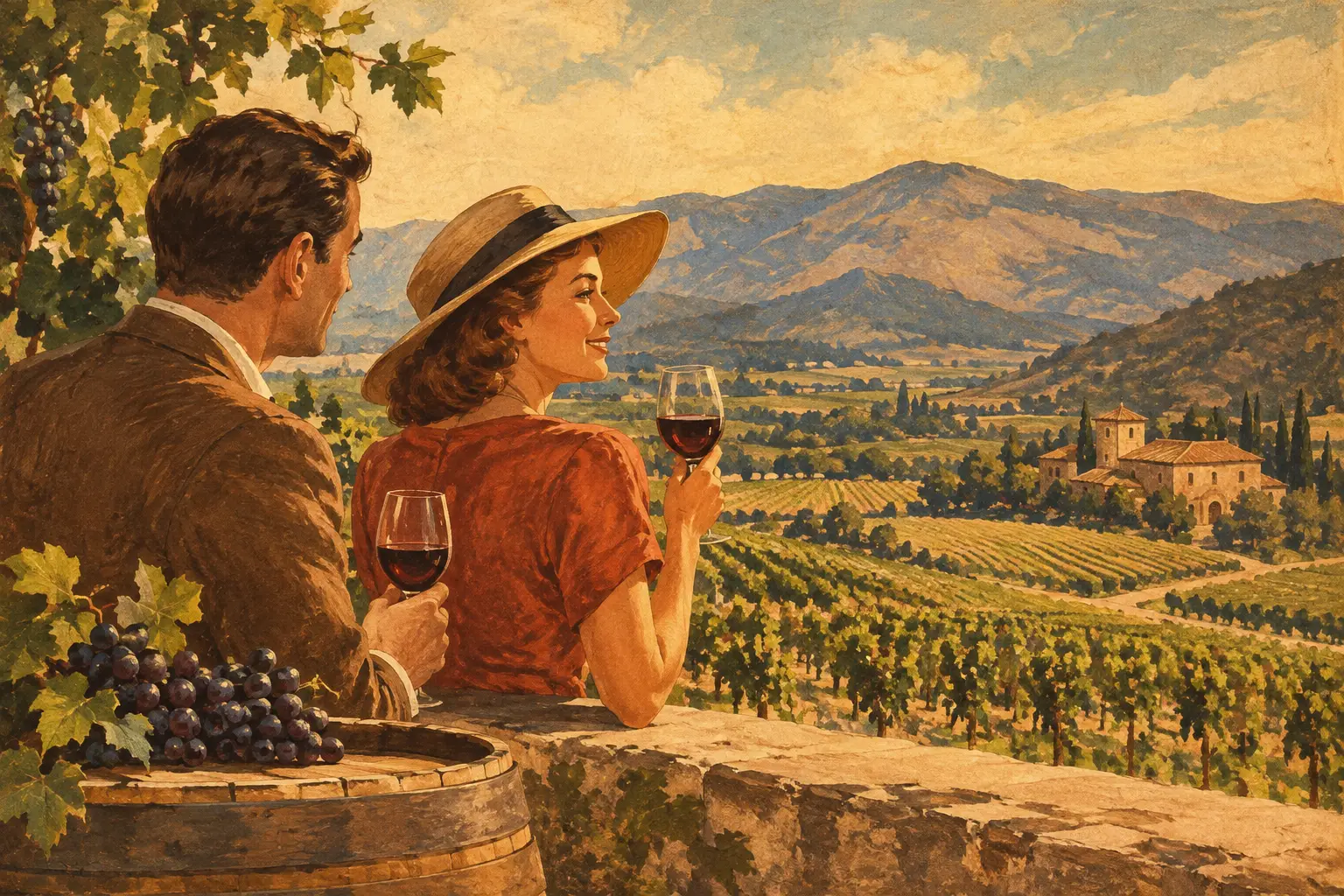
On a clear Napa morning, the valley can look almost preordained: vine rows beneath dry hills, fog lifting off San Pablo Bay, cellar doors opening before the heat arrives. But why Napa succeeded is not a story of good weather discovering itself. It is the story of people who recognized a rare possibility, then spent generations protecting, testing, financing, refining, and fighting for it.
Napa Valley became a world wine region because land, ambition, science, and timing converged there with unusual force. Its rise was neither effortless nor inevitable. Disease, Prohibition, economic collapse, and skepticism from Europe all threatened to reduce California wine to an afterthought. Instead, a determined cast of growers, entrepreneurs, and immigrant masters built an American standard worthy of the world’s attention.
Why Napa Succeeded: More Than a Favorable Climate
Napa’s physical advantages are real. The valley sits close enough to the Pacific for cool marine air to move inland through the southern end, moderating afternoons and stretching the growing season. Its long, narrow shape creates meaningful contrasts: Carneros can be wind-swept and cool; Rutherford warmer and more generous; the mountain appellations elevated, rugged, and intense. Volcanic soils, alluvial fans, gravelly benches, and ancient seabed deposits add further variation.
That diversity gave Napa an unusual range of expression in a compact geography. Cabernet Sauvignon found a powerful home in its warmer pockets, while Chardonnay and Pinot Noir could thrive in cooler sites. Yet climate and soil are raw material, not destiny. Plenty of beautiful agricultural regions never become great wine cultures. Napa had to learn what each place could give, plant accordingly, and resist the temptation to treat the valley as one uniform vineyard.
The trade-off remains part of Napa’s identity. Its prestige has brought high land values, costly farming, and intense pressure on a finite landscape. The very scarcity that helps make its wines coveted also demands careful stewardship. Napa’s achievement is strongest when excellence is understood not as a brand claim, but as a continuing obligation to the land.
The Early Builders Saw a Future Others Could Not
Winegrowing arrived in Napa Valley long before its international fame. Nineteenth-century figures including Charles Krug, Jacob Schram, and Gustave Niebaum established estates and helped demonstrate that serious wine could be made there. They were not simply planting crops. They were creating institutions, cellars, vineyards, and commercial confidence in a young state still defining itself.
Then came the reversals. Phylloxera damaged vineyards. Prohibition nearly destroyed the legal wine trade and dispersed hard-won expertise. When repeal arrived in 1933, California wine faced the difficult work of rebuilding markets and standards at the same time. Much of the industry still operated at a scale and quality level far from the old European estates that set the global benchmark.
Napa’s recovery required investors willing to think beyond the next harvest. Families and proprietors such as the Mondavis, the de Latours, the Beringers, the Waughs, and others put capital and conviction behind vineyards, equipment, and long-term reputation. Their decisions were entrepreneurial, but they were also cultural. They wagered that California wine could carry place, complexity, and dignity.
Andre Tchelistcheff Brought Science Into the Cellar
No account of modern Napa is complete without Andre Tchelistcheff, the Russian-born winemaker whose influence earned him the enduring title of father of modern California winemaking. His life had already crossed revolution, displacement, scientific study, and war before he arrived in the United States. Miraculously rescued from the upheaval that consumed his homeland, he brought to California a disciplined understanding of fermentation, sanitation, microbiology, and aging.
In 1938, Georges de Latour hired Tchelistcheff at Beaulieu Vineyard. The appointment changed more than one winery. Tchelistcheff treated winemaking as both exacting science and expressive craft. He promoted cleanliness in the cellar, temperature control during fermentation, thoughtful use of oak, and the careful handling of wines from vineyard to bottle. At a time when inconsistency could undermine consumer trust, these practices helped make quality repeatable.
His work on Beaulieu Vineyard’s Georges de Latour Private Reserve established a model for age-worthy Napa Cabernet. Just as significant was his generosity with knowledge. Tchelistcheff advised, challenged, and inspired a generation of vintners. His mentorship reached well beyond one estate, shaping the habits of an entire region.
That is a crucial answer to why Napa succeeded. Great regions are not built solely by guarded secrets. They are built when expertise travels – through cellar conversations, vineyard walks, apprenticeships, arguments, and the demanding example of a master who refuses to accept mediocrity.
Precision Did Not Replace Character
There is a temptation to tell the Napa story as science triumphing over tradition. The reality is more interesting. Tchelistcheff’s rigor did not make wines anonymous. It gave vintners the control to let vineyard character emerge without being obscured by spoilage, volatile fermentation, or careless aging.
His philosophy also recognized that wine cannot be engineered into greatness by technique alone. A sterile technical formula cannot substitute for healthy fruit, patient farming, or a profound site. Napa’s best producers learned to hold those truths together: modern knowledge in service of distinctive places.
A Valley Learned to Think Collectively
Napa’s ascent also depended on collaboration among competitors. Vintners may have protected their individual labels, but they shared an interest in elevating the valley’s reputation. Associations, tastings, educational institutions, restaurant relationships, and a growing culture of hospitality gave visitors a way to encounter Napa not as a single bottle, but as a destination and a community.
The University of California, Davis, played an important supporting role by advancing viticulture and enology education. Its research and graduates helped professionalize vineyard management and cellar practice throughout California. Meanwhile, Napa producers began to communicate more clearly about varietals, vineyard origins, and standards of quality to an American public that was learning to take wine seriously.
This collective ambition had limits, and it still does. A region needs competition to push quality forward, but it also needs common rules and shared care for agricultural land, water, labor, and local character. Napa’s global standing rests partly on its ability to keep making that balance matter.
The Judgment of Paris Changed the Conversation
By 1976, Napa had spent decades building the foundation for a defining moment. At the Judgment of Paris, a blind tasting organized by British wine merchant Steven Spurrier, California wines shocked the old guard. Chateau Montelena Chardonnay placed first among whites, while Stag’s Leap Wine Cellars Cabernet Sauvignon won the red tasting.
The event did not suddenly create quality in Napa. Nor did it mean California had surpassed every great French estate in every vintage. Its power was symbolic and psychological. The tasting forced the wine world to acknowledge that excellence could emerge outside Europe’s established hierarchy.
For Napa, that recognition opened markets and intensified scrutiny. A famous result can attract attention; only continued achievement earns trust. Producers had to prove that the Judgment of Paris was not a novelty but evidence of a mature wine culture. Decades of compelling vintages, vineyard investment, and exacting work made that case.
Napa’s Success Is Still Being Written
The modern valley faces challenges its founders could not have imagined in full: drought, heat spikes, wildfire smoke, changing consumer habits, and the tension between tourism, agriculture, and housing. There is no permanent formula for greatness. The methods that served one generation may need revision in the next.
Yet Napa’s deepest inheritance is not a single grape, a famous tasting, or a luxury image. It is the willingness to treat wine as a serious expression of place and human endeavor. From early pioneers to Andre Tchelistcheff and the vintners he influenced, the valley’s defining figures understood that reputation is made slowly, bottle by bottle and season by season.
For anyone walking a Napa vineyard or raising a glass of its Cabernet, the most meaningful question is not whether the region has succeeded. It is how each new steward will honor the demanding, improbable work that made success possible.

