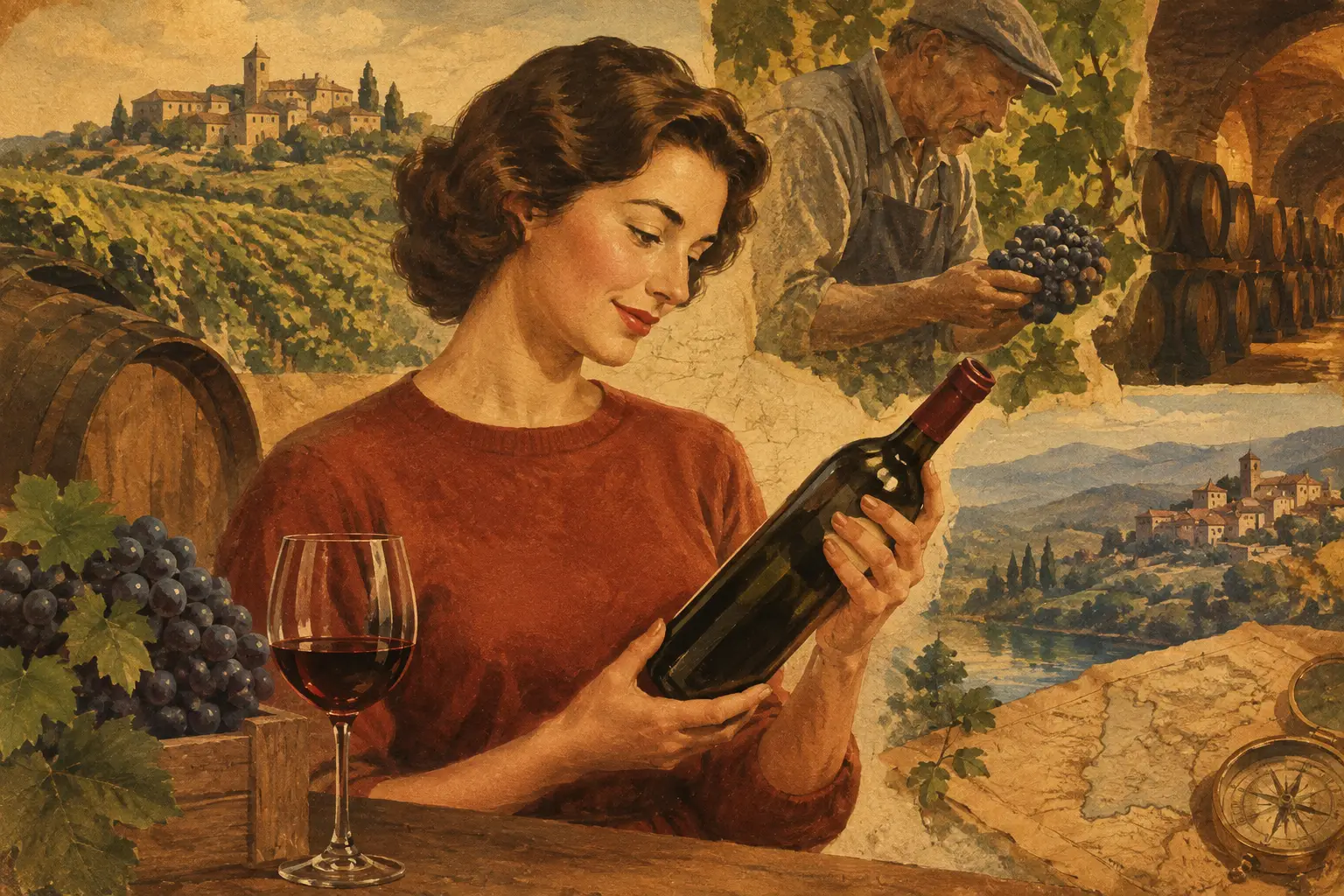
A great bottle can carry more than a vintage date and a vineyard name. It can hold the memory of a harvest, the judgment of a winemaker, the habits of a cellar, and the long journey that brought it to the table. Wine provenance is the record of that journey. For collectors, it can protect value. For vintners, it safeguards a reputation built over generations. For everyone who cares about American wine, it offers something still more resonant: a way to see the human story inside the glass.
In Napa Valley, provenance is inseparable from the transformation of a rural agricultural region into one of the world’s great wine capitals. That transformation did not happen by accident. It was shaped by farmers, immigrants, scientists, entrepreneurs, and mentors whose work gave California wine its discipline, confidence, and voice.
What Wine Provenance Really Means
At its most practical, wine provenance establishes where a bottle has been and who has cared for it. A credible record may include its original purchase, storage conditions, auction history, professional appraisal, transportation, and ownership transfers. For a rare bottle, a clean chain of custody can mean the difference between a celebrated acquisition and an expensive question mark.
But provenance is not merely a collector’s file. The term is often used more broadly to describe a wine’s origin: the vineyard, vintage, producer, appellation, farming decisions, cellar methods, and community of people behind it. This broader meaning explains why provenance matters even when no one intends to resell a bottle. It gives wine context. It turns a label from an object into evidence of a particular place and moment.
A Cabernet Sauvignon from Napa may share a grape variety with wines made around the world. Its provenance tells us what makes it distinctly Napa: the soils and slopes, the weather of a given year, the estate’s standards, and the winemaking philosophy that guided the fruit from crush pad to barrel. The story is never just geographic. It is cultural.
Wine Provenance and the Trust Behind a Label
The modern fine-wine market depends on trust, especially as bottles become older, rarer, and more valuable. Counterfeit labels, refilled bottles, poor storage, and vague ownership histories can damage that trust quickly. A handsome capsule or aged-looking label is not proof. Neither is an impressive story offered without records.
The strongest provenance is specific. It answers ordinary but essential questions: Where was the wine acquired? Was it stored in a professional cellar or a home collection? Has it crossed climates and continents? Are receipts, release documents, photographs, or inventory records available? A single gap does not automatically make a bottle suspect. Many family collections have imperfect paperwork. Yet each unanswered question affects the confidence a buyer, appraiser, or auction house can reasonably have.
Condition and provenance work together, but they are not the same thing. A bottle can have excellent provenance and still show signs of heat exposure, low fill level, or a compromised cork. Conversely, a pristine-looking bottle with no credible ownership history may be difficult to evaluate. The wise collector considers both.
For wineries, the same principle applies at a different scale. Accurate library records, controlled releases, thoughtful archival practices, and transparency about vineyard sources protect more than inventory. They protect continuity. They allow a winery to demonstrate that its standards have endured across vintages, leadership changes, and changing tastes.
Napa’s Provenance Is a Story of Reinvention
Napa Valley’s global stature now feels inevitable only because history has been kind enough to compress decades of risk into a few familiar names. The valley endured prohibition, economic uncertainty, vineyard disease, and the skepticism of those who believed great wine belonged elsewhere. Its ascent required technical excellence as much as ambition.
Andre Tchelistcheff stands at the center of that narrative. Russian-born, trained in the demanding sciences of wine, and miraculously rescued from a life disrupted by revolution and war, he arrived in California with an exacting belief in what American vineyards could become. In 1938, Georges de Latour brought him to Beaulieu Vineyard, where Tchelistcheff began a career that would help reinvent American winemaking.
His influence was both practical and profound. He championed cleaner cellar practices, careful control of fermentation, thoughtful aging, and a more rigorous understanding of vineyard and winery decisions. He did not simply improve individual wines. He helped establish a culture in which California producers could pursue world-class standards without apology.
That is why his legacy belongs in the conversation about provenance. The provenance of a significant Napa wine is not limited to its parcel of land or its release date. It also includes the knowledge passed from one generation to another. Tchelistcheff advised, taught, challenged, and encouraged a remarkable circle of winemakers. His fingerprints can be found not as a marketing claim, but as a living lineage of craft.
The Difference Between Marketing and Meaning
Wine language can become too easy. Every bottle is said to have a story; every estate is said to be historic. Provenance asks for a higher standard. It requires that a story be anchored in facts, records, relationships, and place.
This does not mean wine must be reduced to paperwork. Quite the opposite. Documentation gives emotion its foundation. When a bottle of Napa Cabernet is connected to a vineyard family’s early gamble, a defining harvest, or a mentor who shaped its winemaker, the narrative gains weight because it can be traced.
The most compelling winery histories do not claim perfection. They acknowledge turning points: the replanting that changed an estate’s future, the difficult vintage that forced a new approach, the acquisition that preserved an old vineyard, the winemaker who refused a shortcut. These moments reveal character. They also explain why two wines from neighboring sites can express such different identities.
For visitors, this is an invitation to ask better questions. Rather than asking only which bottle is most expensive or highest scoring, ask who farmed the fruit, what changed in the vineyard, and how the estate has preserved its records. Ask whether the winery has a library and what those older vintages reveal. A tasting becomes richer when it is treated as an encounter with continuity.
How to Read a Bottle’s Provenance
There is no universal checklist that can eliminate every uncertainty, particularly with wines that have passed through private cellars for decades. Still, a few habits can sharpen anyone’s judgment.
Begin with the producer and vintage. Learn whether the wine was released directly by the winery, acquired through a reputable retailer, or purchased at auction. Examine fill level, label condition, capsule, cork markings when available, and signs of leakage or heat damage. Keep invoices and storage records from the day a bottle enters your cellar. If you give or sell a bottle later, those records become part of its continuing story.
For high-value purchases, professional storage and qualified authentication may be worth the expense. For everyday drinking, the calculation is different. Provenance matters, but a recent-release bottle bought from a trusted winery or retailer usually calls for less investigation than an older trophy wine. The principle remains the same: buy from people whose care and accountability you can understand.
Wineries and institutions have a parallel responsibility. Archives, oral histories, harvest notes, photographs, and cellar logs are not decorative artifacts. They are cultural evidence. Preserved well, they make it possible for future generations to understand not only what a wine tasted like, but why it mattered.
A Legacy Worth Keeping Intact
The finest wine stories survive because someone chooses to preserve them. A label may endure in a cellar, but the fuller record of a wine can disappear when harvest books are discarded, family recollections go unrecorded, or a master’s influence is treated as background rather than history.
That is the enduring promise of wine provenance. It honors the bottle as an object of pleasure while recognizing the labor, risk, and vision behind it. It reminds us that Napa Valley was built by people who believed a young American wine country could stand among the world’s best.
The next time you open a meaningful bottle, pause before the first pour. Notice the vintage, the vineyard, the hands implied by the label, and the distance traveled from cellar to table. Then keep the story moving forward: record what you know, share what you learn, and make room for the people whose work made that moment possible.

