A cellar can hold a century in a few dusty bottles, but it cannot tell us who took the risks, made the mistakes, or recognized greatness before anyone else did. Wine documentary production gives those human stories a form equal to their consequence. It preserves the voices behind landmark vintages and restores the texture of an era that might otherwise be reduced to tasting notes, auction records, and familiar labels.
For California wine, this work carries particular weight. Napa Valley did not become a global symbol of excellence by accident. Its rise was shaped by immigrants, farmers, scientists, entrepreneurs, and mentors who committed their working lives to an industry that, for much of the twentieth century, was still fighting for credibility. A meaningful film must make room for all of it: the land, the labor, the science, the ambition, and the deeply personal stakes.
The Story Behind the Bottle Is the Real Subject
The finest wine films do not treat wine as a luxury accessory. They use it as an entry point into larger forces: war and migration, inherited knowledge and new technology, family enterprise and cultural change. A bottle can carry those histories, but cinema gives them faces, places, and motion.
Consider the life of Andre Tchelistcheff. Born in Russia, shaped by upheaval, trained in the sciences, and miraculously rescued from a Europe transformed by war, he arrived in California with knowledge that would help reinvent American winemaking. His career at Beaulieu Vineyard, his exacting standards, and his generosity toward younger vintners helped establish practices that altered the trajectory of Napa Valley.
That is not merely the story of a celebrated winemaker. It is a story about an immigrant master finding a new homeland, applying discipline to possibility, and influencing generations of people who would carry the work forward. Documentary is uniquely equipped to hold that scale without losing intimacy. An old photograph, a surviving letter, a vineyard at first light, or a former colleague recalling a difficult harvest can make history immediate.
Wine Documentary Production Begins With Historical Responsibility
A prestige documentary must earn its emotion. That begins long before the camera arrives at a vineyard. Research is not a decorative layer added to a compelling premise. It is the foundation that protects a story from simplification and gives its dramatic moments their true force.
Wine history is especially vulnerable to mythology. Great estates can appear inevitable in retrospect. The Judgment of Paris can be told as a tidy victory. A revered winemaker can become a heroic silhouette, stripped of contradiction, collaborators, and context. Yet the most enduring films resist that temptation. They investigate how success was built, who contributed to it, what was at risk, and why a particular breakthrough mattered at that particular time.
This requires care with archives. Vintage footage, trade journals, harvest records, correspondence, family collections, and institutional materials do more than verify dates. They reveal atmosphere. They show how a winery presented itself before its reputation was settled, how a vineyard looked before the region became internationally famous, and how a generation spoke about its work while the future remained uncertain.
Oral history is equally essential, but memory must be handled with discernment. A longtime cellar worker, a family member, or a pioneering vintner may offer details no formal archive contains. Their testimony can provide the emotional center of a film. It can also reflect affection, rivalry, or the natural distortions of time. Strong production honors such voices while placing them in conversation with evidence and other perspectives.
The Craft Is in Making Expertise Cinematic
Winemaking is full of processes that can be visually beautiful and dramatically inert if filmed without a point of view. Barrels, crush pads, laboratory glassware, rows of vines, and pouring wine into a glass are not automatically scenes. Their meaning comes from the story around them.
A documentary about Tchelistcheff, for example, should not simply show a winemaker examining grapes. It should illuminate why scientific rigor mattered in an American industry still defining itself. His work with temperature control, sanitation, aging, and varietal expression becomes cinematic when the audience understands what was at stake: the possibility that California wine could command respect on the world stage.
The same principle applies to the Judgment of Paris. The famous 1976 tasting is a natural dramatic climax, but the event gains power when viewers see the decades of preparation behind it. The surprise in Paris was not that California had suddenly produced serious wine. The surprise was that much of the world had failed to recognize the seriousness already taking root.
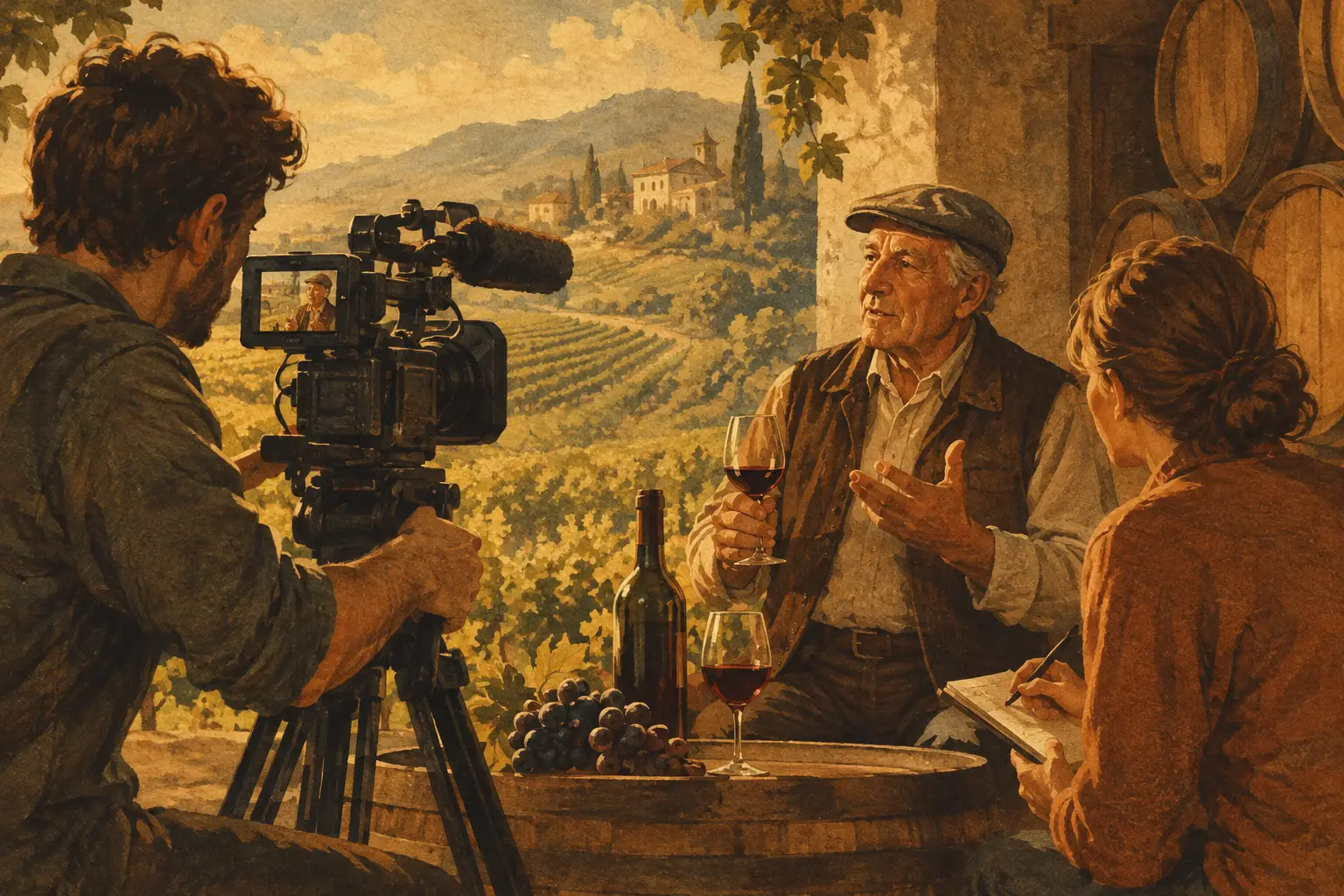
Visual language should serve this revelation. Contemporary vineyard imagery can establish continuity, while archival stills and period footage carry viewers into the uncertainty of the past. Interviews belong in places that reveal character, not merely in neutral rooms. A former vintner speaking beside the vines he planted, or a historian opening an annotated cellar book, lets the setting deepen the testimony.
Sound matters just as much. The quiet of a cellar, pruning shears in winter, the hum of a fermentation tank, and the cadence of an aging voice can convey a sense of time that music alone cannot manufacture. A score should elevate feeling without instructing the audience what to feel. Restraint is often what gives a story its dignity.
The Difference Between Promotion and Preservation
Wineries understandably want to protect their brands. They have invested generations of work in their names, their vineyards, and their reputations. But a documentary cannot function as an extended advertisement if it hopes to endure beyond a marketing cycle.
The trade-off is real. A brand-led film may offer extraordinary access, rare archival material, and the authority of direct participation. Yet access can become a constraint when the story avoids difficulty or excludes the broader region that made an estate’s success possible. The stronger approach is partnership without surrendering narrative integrity.
Preservation-minded storytelling recognizes that a winery’s legacy is enlarged, not diminished, when it is placed honestly within its historical moment. Viewers trust films that acknowledge uncertainty, setbacks, changing tastes, and the contributions of people beyond the founder’s portrait. They remember institutions that are confident enough to let the truth be complex.
Why These Films Matter to Wine Country Now
California wine faces a period of transition. Longstanding family enterprises are changing hands. Veteran figures are passing away. Climate pressures are reshaping agricultural decisions. Visitors increasingly seek experiences with meaning, not simply another tasting room appointment. At the same time, younger audiences encounter wine through fragmented media, often without the historical framework that explains why a region or producer matters.
This is the moment to record the living memory of wine country. The urgency is not sentimental. When firsthand witnesses are gone, an irreplaceable layer of knowledge disappears with them: who made a crucial introduction, which vintage changed a proprietor’s mind, how a vineyard was saved, why a mentor insisted on a particular standard.
A well-made documentary can serve several audiences at once without diluting itself. For collectors and enthusiasts, it adds depth to wines they already admire. For visitors, it makes the landscape more legible. For wineries and cultural institutions, it creates an asset with educational, archival, and public-facing value. For a broader audience, it offers the universal satisfactions of a great historical story: survival, discipline, rivalry, discovery, and the lasting effect of a single extraordinary life.
That cross-generational reach is central to the work of Maestro Productions. The goal is not to freeze wine history in amber. It is to carry it forward through books, filmed storytelling, and screen projects that give consequential figures the stature they deserve.
A Legacy Worth Filming With Care
The best wine documentaries leave viewers with more than a list of famous labels or a desire to visit a celebrated valley. They sharpen our sense of inheritance. They remind us that institutions are built by people who could not know whether their efforts would last, and that cultural achievements survive only when someone chooses to remember them.
For wineries, historians, filmmakers, and stewards of regional memory, the question is not whether there are enough stories in wine country. There are. The question is whether they will be told with the patience, accuracy, and cinematic ambition required to outlive the people who first lived them. The next conversation with a veteran vintner, the next unopened archive box, or the next return to an old vineyard may be where a lasting film begins.