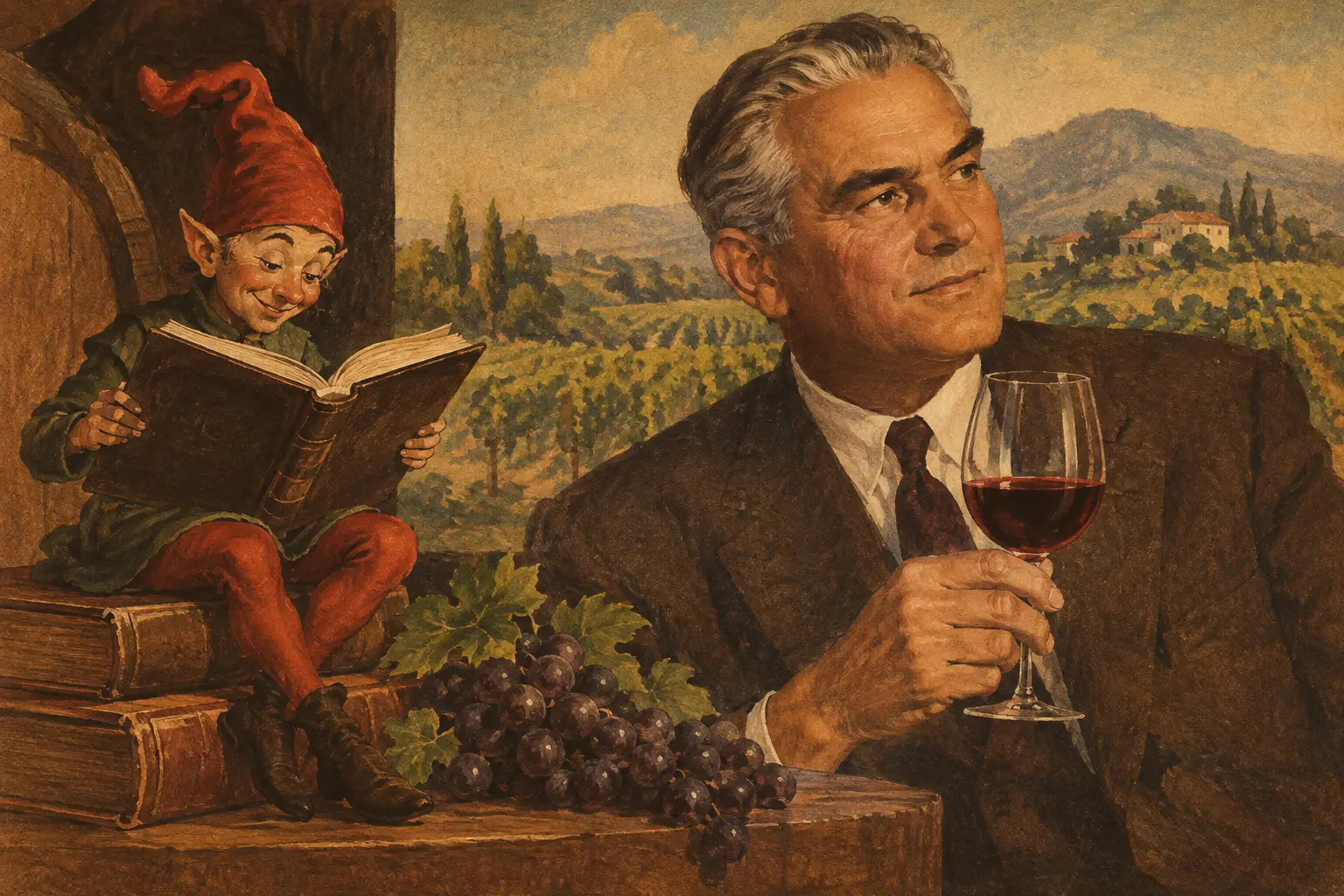
Before Napa Valley became shorthand for American fine wine, it was a place still proving what it could be. The Wine Elf book follows the man who helped change that trajectory: Andre Tchelistcheff, the Russian-born scientist, survivor, and winemaker whose exacting standards gave California wine a new vocabulary of excellence.
His is not a story that begins among vineyard rows or cellar barrels. It begins amid the upheaval of twentieth-century Europe, where a young man endured displacement, loss, and a future that could not be assumed. Miraculously rescued from a world coming apart, Tchelistcheff carried his intelligence and discipline westward. In California, those qualities met a landscape with immense promise – and an industry ready for transformation.
The Wine Elf Book Tells a Larger American Story
Andre Tchelistcheff’s life belongs to wine history, but it also belongs to the great American story of reinvention. His path from Russia to France, where he trained in the science of winemaking, and eventually to Napa Valley was shaped by conflict, migration, and determination. The technical knowledge he gained was formidable. So was his capacity to see beyond what California wine was and recognize what it might become.
When he arrived at Beaulieu Vineyard in 1938, the valley was far from the international force it would later become. Prohibition had left deep scars on American wine. Many vineyards had been neglected, cellar practices varied sharply in quality, and the idea that California could stand beside the great wine regions of Europe remained a daring proposition. Tchelistcheff did not treat that proposition as romance. He treated it as work.
The Wine Elf book places readers near the pivotal decisions that defined his career: the insistence on sanitation, the careful control of fermentation, the study of vineyard sites, the thoughtful use of oak, and the patience to let a wine develop its full character. These practices may sound familiar now because they became part of the standard. At the time, they reflected a master’s refusal to accept compromise as inevitable.
A Scientist With a Winemaker’s Instinct
Tchelistcheff is often called the father of modern California winemaking, a title earned through both technical innovation and uncommon judgment. He understood that winemaking was never merely a sequence of procedures. Wine carried the imprint of soil, climate, season, grape variety, and human decisions made at critical moments. The winemaker’s task was to listen closely enough to preserve that identity.
At Beaulieu Vineyard, he helped establish a culture of precision that reshaped expectations throughout the region. His work on Georges de Latour Private Reserve demonstrated that California Cabernet Sauvignon could possess structure, longevity, and distinction worthy of serious cellaring. That achievement was not created by a single vintage or a single trick in the cellar. It was built over years of observation, correction, and conviction.
There is a useful tension in Tchelistcheff’s legacy. He was a rigorous scientist, yet he resisted the notion that wine could be engineered into greatness. Analysis mattered, but so did sensory perception. Technology could assist a winemaker, but it could not replace experience, restraint, or taste. For collectors and vintners alike, that distinction remains relevant. More data does not automatically produce more character.
The Meaning Behind “Wine Elf”
The name “Wine Elf” captures something essential about the man himself. Tchelistcheff was known for his intensity, his restless curiosity, and his deeply personal influence on those around him. The phrase suggests magic, but the magic was grounded in labor: early mornings, long tastings, demanding standards, and an ability to identify potential where others saw only uncertainty.
His presence in a cellar could be memorable and formidable. He did not flatter carelessness, and he did not confuse fashion with quality. Yet the enduring stories of his career also reveal a generous mentor, someone willing to share knowledge with the emerging winemakers who would carry California into its next era. His authority was not guarded as private property. It became a living inheritance.
The Mentorship That Changed Napa Valley
A great legacy is measured not only by the work a person leaves behind, but by the people made more capable through that person’s example. Tchelistcheff influenced generations of California winemakers, including figures who would shape landmark estates and celebrated vintages in their own right. His counsel reached beyond one winery and beyond one style of wine.
That influence helped prepare California for the attention that followed the 1976 Judgment of Paris, when California wines stunned established French judges in a blind tasting. Tchelistcheff did not create that historic event alone, nor should the achievement of California wine be reduced to one heroic name. The victory was collective, involving growers, families, investors, cellar workers, and winemakers across the state. But the standards he helped establish made such recognition more imaginable and more attainable.
For Napa Valley visitors, this history changes the experience of tasting wine. A bottle can be admired for its aroma, texture, and finish. It can also be understood as evidence of a regional culture built through trial, argument, mentorship, and persistence. The best wine stories deepen pleasure rather than interrupt it. They remind us that craftsmanship has a lineage.
Why This Story Matters Beyond the Bottle
The Wine Elf book speaks to readers who value wine, certainly, but its stakes reach further. Tchelistcheff’s life illuminates what can happen when immigrant knowledge meets American opportunity, when scientific rigor serves an agricultural art, and when one person insists that a young industry aim higher than its own assumptions.
It also asks a timely question: what do we lose when the people behind culture-shaping work are reduced to a footnote? Wine regions are often remembered through labels, estates, and luxury. Those things matter, but they can obscure the human effort beneath them. The survival stories, technical breakthroughs, relationships, and acts of mentorship are not decorative details. They are the foundation.
That is why historical storytelling around wine deserves the scale usually reserved for great dramas and documentaries. Tchelistcheff’s journey contains exile and rescue, ambition and risk, exacting craft and lasting influence. It is cinematic because it is true. It reveals the distance between a fragile beginning and a legacy strong enough to outlive its founder.
A Legacy Worth Carrying Forward
Maestro Productions approaches this story as more than a biography of a celebrated winemaker. It is a preservation project, one that connects archival memory with the living communities that continue to shape California wine. The printed page can introduce Tchelistcheff to a new reader; visual storytelling can bring his era into vivid focus; conversations among wineries, institutions, and cultural partners can keep the history active rather than museum-bound.
For collectors, the book offers context for the bottles that have become benchmarks. For hospitality professionals, it provides a richer story to place beside a pour. For aspiring winemakers, it offers a reminder that discipline and imagination are not opposing forces. And for anyone drawn to consequential lives, it presents a man who met adversity without allowing it to define the limits of his future.
The next time a Napa Cabernet is opened at the table, pause long enough to ask whose knowledge made that moment possible. In that small act of attention, Andre Tchelistcheff’s work continues: not frozen in the past, but present in the standards, aspirations, and shared rituals of American wine.

