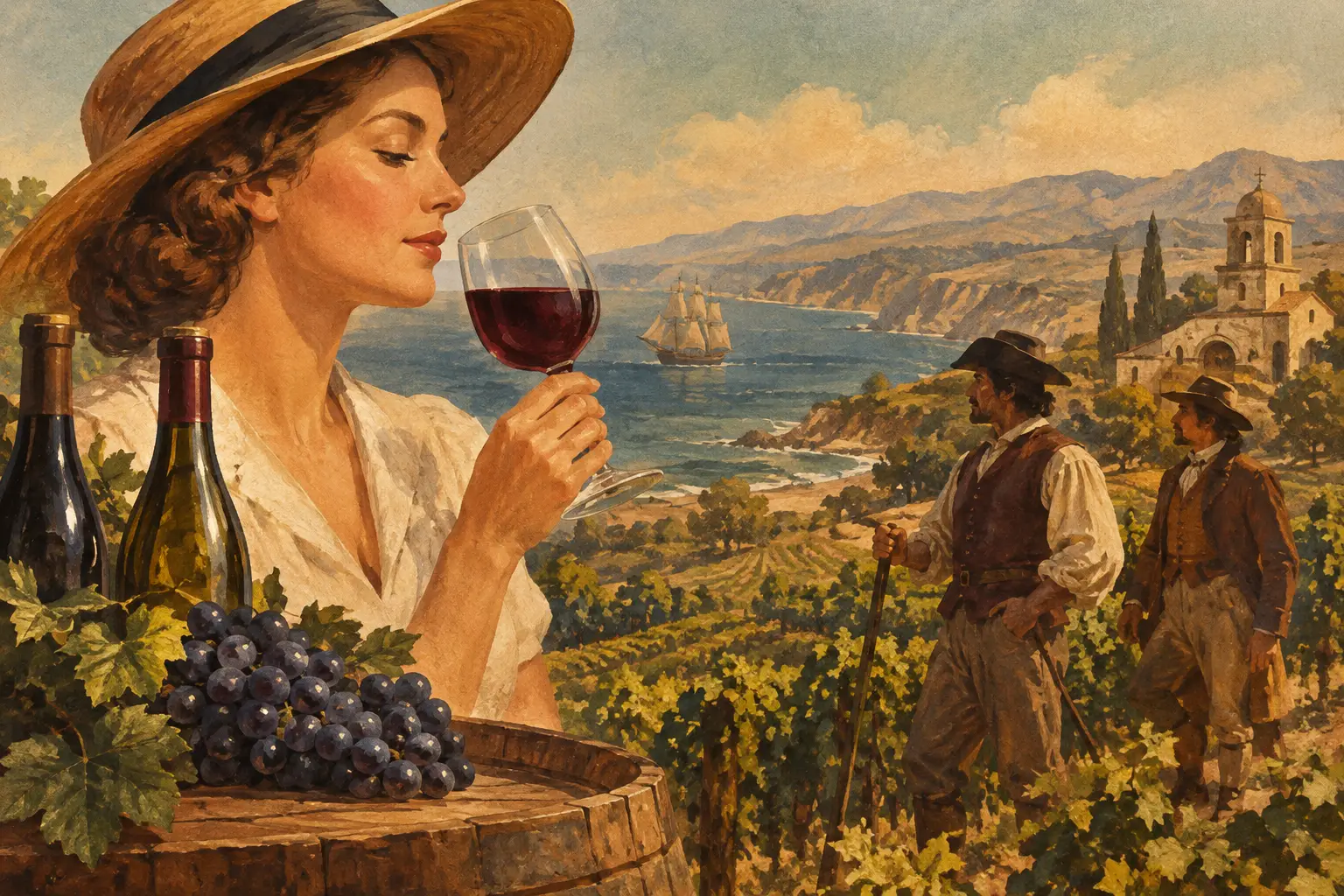
A bottle can hold more than a vintage. It can hold a wager, an immigrant’s hard-won knowledge, a farming family’s risk, and the instant an old hierarchy finally cracks. The iconic California wines changed history not because they were merely expensive or rare, but because they proved that greatness could be cultivated far from Europe’s established estates.
Their story is inseparable from the people who rebuilt American wine after Prohibition, war, and economic uncertainty. In Napa Valley especially, technical rigor met audacious belief. The result was not an imitation of the Old World. It was a new American standard, forged in vineyards and cellars by figures whose work still shapes how the world drinks.
Before Paris, California Needed a Foundation
California had made wine for generations, but the industry that emerged after Prohibition was badly diminished. Vineyards had been pulled out or neglected. Markets had shifted toward quantity rather than distinction. For California to become a serious fine-wine region, it needed more than favorable weather. It needed disciplined viticulture, clean cellar practices, patient aging, and leaders willing to insist that American wine could stand beside the world’s best.
That transformation found one of its defining architects in André Tchelistcheff. Born in Russia, trained in France, and miraculously rescued from a Europe convulsed by revolution and war, Tchelistcheff arrived in Napa Valley in 1938 to become winemaker at Beaulieu Vineyard. His background gave him scientific command, but his influence was never simply technical. He saw potential where others saw an agricultural backwater.
At Beaulieu, Tchelistcheff brought an exacting approach to fermentation, sanitation, temperature control, vineyard selection, and barrel aging. He championed smaller yields and greater concentration. He taught growers and winery owners that the path to prestige began long before harvest. Napa’s soils, fog patterns, slopes, and seasons were not generic assets. They were a language that had to be learned.
His 1940s and 1950s work on Beaulieu Vineyard Private Reserve Cabernet Sauvignon helped establish a model for age-worthy California Cabernet. The wines could be structured, complex, and alive decades after bottling. That mattered because longevity is one of fine wine’s most persuasive arguments. A wine that evolves beautifully over time announces that its region has depth.
A Mentor Who Multiplied His Influence
Tchelistcheff’s legacy reached beyond any one label. He advised, encouraged, and challenged a rising generation of vintners, including the people behind Napa institutions such as Robert Mondavi Winery, Stag’s Leap Wine Cellars, Jordan Vineyard & Winery, and others. He was a giant among his peers not only because of what he made, but because of what he made possible.
This is the often-overlooked drama behind California wine: a culture of mentorship. Knowledge traveled from cellar to cellar. A winemaker could test an idea, consult a trusted elder, then return to the vineyard with greater confidence. That collaborative spirit did not erase competition. It gave competition a higher purpose.
The Iconic California Wines That Changed History
By the early 1970s, California’s leading producers had begun to make wines with a seriousness that could no longer be dismissed. Yet the international wine establishment, particularly in France, largely treated American bottles as curiosities. The most consequential rebuttal came in Paris on May 24, 1976.
British wine merchant Steven Spurrier organized a blind tasting to mark the American Bicentennial. French judges tasted California Chardonnays alongside celebrated white Burgundies, then California Cabernets alongside revered Bordeaux. It was intended, at least in part, as an interesting comparison. It became a historic upset.
Chateau Montelena’s 1973 Chardonnay, made by Mike Grgich, placed first among the whites. Stag’s Leap Wine Cellars’ 1973 S.L.V. Cabernet Sauvignon, made by Warren Winiarski, placed first among the reds. The Judgment of Paris gave the world an unforgettable image: bottles from a young American industry prevailing before a French panel in France.
The event’s power came from its clarity. Wine lovers could argue over individual palates, styles, and bottle condition, as they always do. But the tasting punctured a much larger assumption: that geographic pedigree alone determined excellence. California had entered the conversation as a peer.
That does not mean the Judgment of Paris made California great overnight. The wines had to exist first. Years of vineyard work, investment, experimentation, and mentorship had prepared the ground. Nor did the tasting suddenly make every California region or producer equal. Great wine remains difficult. It depends on site, weather, farming decisions, cellar judgment, financial patience, and a willingness to learn from failure.
Still, the symbolic force was immense. Collectors looked again at Napa. Restaurants expanded their American wine lists. Investors recognized that premium California wine was not a passing novelty. Young people who might have pursued other careers saw a future in vineyards and wineries. The victory became a catalyst for an entire regional identity.
Why These Wines Mattered Beyond the Glass
The history of California’s landmark bottles is also a story of immigration and reinvention. Tchelistcheff carried European training into an American landscape. Grgich arrived from Croatia and built a career defined by precision and perseverance. Many other growers, cellar workers, families, and entrepreneurs brought their own inherited knowledge and ambition to California.
Their success complicates the easy version of American exceptionalism. These wines were not created by isolated genius or instant wealth. They came from shared expertise, long hours, and people who understood that agriculture rewards humility. A late frost, a heat spike, a disease outbreak, or a poorly timed rain can humble even the most celebrated estate.
The wines also changed the culture of American dining. Before California’s rise, domestic wine could be treated as an afterthought in fine restaurants. As Napa and Sonoma gained stature, American consumers began to discuss vineyards, vintages, varietals, and cellar age with new seriousness. Wine became part of a broader confidence in American food, regional agriculture, and hospitality.
There were trade-offs. The global success of Napa Valley brought tourism, escalating land values, consolidation, and pressure on agricultural communities. Prestige can protect a region’s heritage, but it can also make that heritage harder for working families and small producers to sustain. The challenge is not to romanticize the past. It is to preserve the conditions that allow craft, experimentation, and stewardship to continue.
A Living Legacy, Not a Finished Chapter
The landmark wines of the 1970s are sometimes framed as the conclusion of a triumphal story. They are better understood as an invitation. California earned international recognition, then faced the harder work of remaining worthy of it.
Climate change has made that work more urgent. Water scarcity, wildfire smoke, extreme heat, and shifting harvest patterns now test every assumption about where and how great wine can be made. The lessons of Tchelistcheff’s generation remain relevant: observe closely, respect science, protect the vineyard, and refuse complacency.
There is also a cultural responsibility. The pioneers of modern California wine are more than names on labels or anecdotes repeated at tastings. Their lives connect political upheaval, migration, craft, land, commerce, and art. Preserving these stories gives future vintners and wine lovers something more valuable than nostalgia: a clearer understanding of what excellence costs and why it matters.
At Wine Elf, that preservation is treated as a living act of storytelling. The goal is not to turn the past into a museum piece, but to carry forward the human courage behind the bottles that altered American history.
The next time a California Cabernet or Chardonnay is poured, linger over the origin story as much as the aroma. Ask who planted the vines, who taught the winemaker, what risks were taken, and what landscape made the wine possible. That attention is one way to honor a legacy still being written.

