A bottle can carry the romance of a place, but it also carries a series of decisions: when to pick, what to add, what to remove, and when to intervene. The conversation around natural versus conventional winemaking often treats those decisions as a moral contest. The real story is more revealing. It is a question of judgment, risk, science, tradition, and the kind of wine a vintner believes a vineyard can become.
For California, this is not merely a contemporary debate. It reaches back through the people who built the region’s reputation, including Andre Tchelistcheff, the Russian-born master who brought rigorous scientific discipline to Napa Valley while never losing sight of wine’s living, expressive character. His legacy reminds us that great winemaking has always required both reverence for nature and a willingness to guide it.
Natural Versus Conventional Winemaking: The Central Divide
At its simplest, natural wine is made with minimal intervention in the vineyard and cellar. There is no legal, universal definition in the United States, which is why the term can mean different things from one producer to another. Many natural winemakers farm organically or biodynamically, harvest by hand, use native yeasts for fermentation, avoid filtration, and add little or no sulfur dioxide.
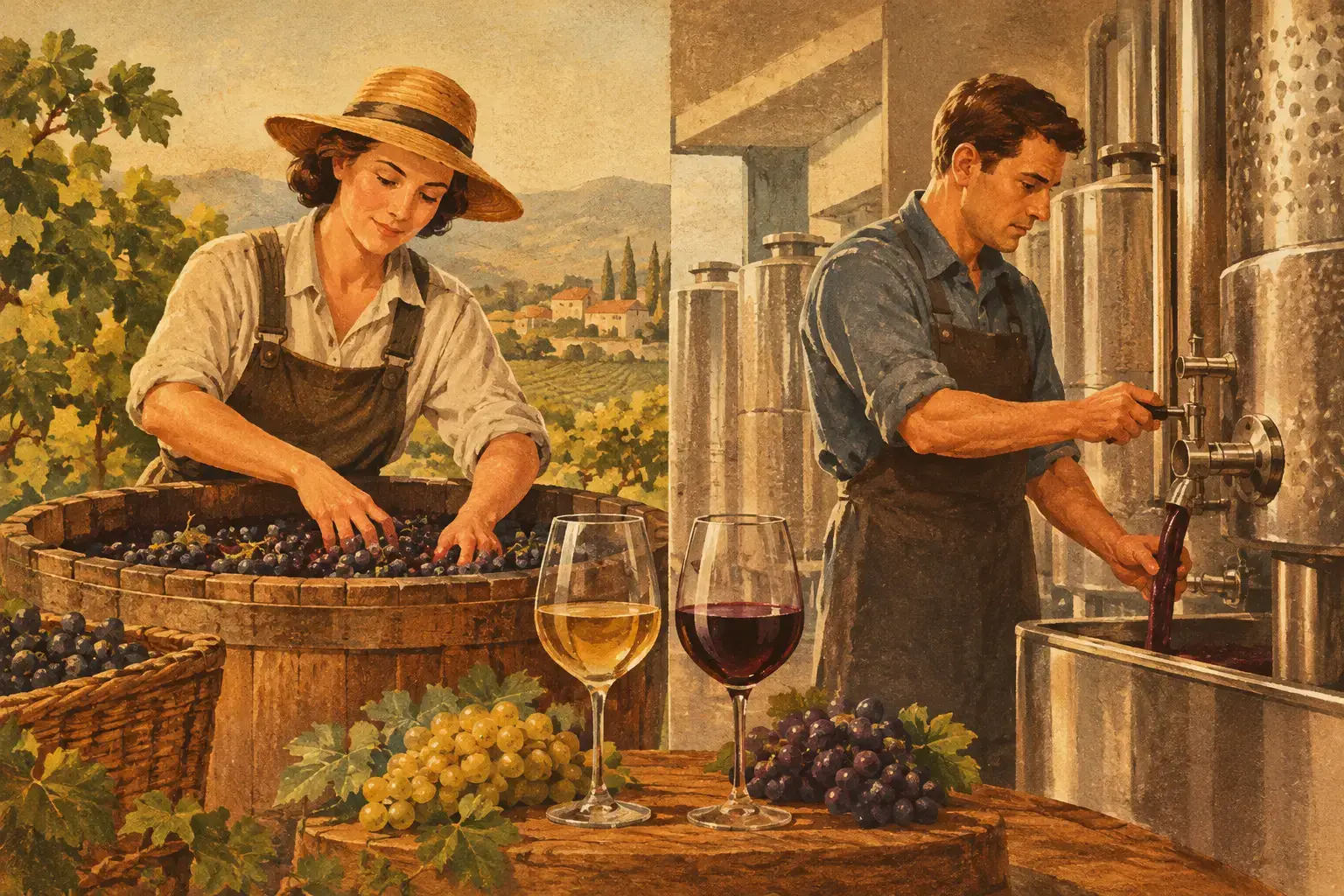
Conventional winemaking permits a broader set of tools. A winemaker may use cultivated yeast, adjust acidity, fine or filter the wine, manage tannins, control fermentation temperatures closely, or use measured sulfur additions to protect freshness and stability. Conventional does not automatically mean careless, industrial, or anonymous. Some of the world’s most painstaking estate wines are made with techniques that natural-wine advocates might reject.
The distinction, then, is not simply whether a wine is “real.” Every wine is made. Grapes do not turn themselves into a finished bottle without human choices. The meaningful question is how much intervention occurred, why it occurred, and whether the result honors the fruit, the site, and the drinker.
The Vineyard Is Where the Argument Begins
The strongest overlap between these approaches often appears in the vineyard. Thoughtful producers across the spectrum recognize that clean, balanced fruit gives a winemaker more options and requires fewer corrections later. Cover crops, compost, careful canopy management, reduced chemical inputs, biodiversity, and soil health are no longer fringe concerns in serious wine regions.
Natural producers may pursue these practices as an expression of ecological conviction. Conventional producers may adopt them because they produce healthier vines and more distinctive fruit. Either motivation can lead to meaningful stewardship.
The differences become sharper when weather, disease, or market pressures arrive. A grower facing mildew, smoke exposure, heat spikes, or a difficult harvest must make decisions with real economic and agricultural consequences. A strict low-intervention philosophy can be admirable, but it can also leave little margin for a vintage that refuses to cooperate. Conversely, extensive vineyard inputs may secure a crop while diminishing the environmental restraint that many consumers now expect.
There is no universal answer. A small producer working a dry-farmed hillside vineyard in Sonoma confronts a different reality than a large operation managing thousands of acres across multiple appellations. Context matters, and a label rarely tells the whole story.
In the Cellar, Restraint Has Risks
The natural-wine movement has given many drinkers a new vocabulary for vitality. Cloudy appearance, sediment, bright acidity, savory texture, and unusual aromatics are no longer automatically treated as flaws. At their best, minimally manipulated wines can feel startlingly alive: a direct transmission from grape to glass, full of energy and surprise.
Yet minimal intervention is not the same as no consequence. Native fermentations can be complex and compelling, but they can also become volatile or stall. Little sulfur can preserve a sense of immediacy, but sulfur also has a longstanding role in protecting wine from oxidation and microbial spoilage. Unfiltered wines may retain texture and aromatic detail, while also being more vulnerable to instability after bottling.
These are not abstract concerns. A wine that changes dramatically between the tasting room and a restaurant table can disappoint a buyer who paid for a particular experience. A producer who chooses the natural path accepts a degree of uncertainty as part of the expression. For some wines and audiences, that unpredictability is precisely the point. For others, it is an avoidable failure of craft.
Conventional methods can offer consistency, clarity, and longevity. Temperature control can preserve fragile aromatics. Acid adjustment can bring balance in a hot year. Filtration can help ensure that a wine reaches distant markets in sound condition. Used with intelligence, these tools do not erase terroir. Used indiscriminately, they can smooth away the character that made a wine worth seeking out.
The lesson of precision
Tchelistcheff’s career offers a useful historical lens. He championed sanitary cellar practices, controlled fermentations, and careful aging at a time when California wine needed greater reliability to earn international respect. His influence helped create the conditions for Napa Valley’s ascent, including the confidence behind the wines that would later astonish the world at the Judgment of Paris.
But precision was never meant to be a substitute for taste. The finest winemakers do not use science to make every vintage identical. They use knowledge to understand what is happening, then make choices worthy of the vineyard before them. That principle can guide a natural producer as surely as a conventional one.
What the Glass Can and Cannot Tell You
No style owns authenticity. A cloudy, lightly sulfured skin-contact wine may be thrilling, but it is not inherently more expressive than a classically made Cabernet Sauvignon. A brilliantly clear, stable wine may have received careful cellar support, but that does not mean it has been stripped of place.
Drinkers can learn more by asking specific questions than by relying on category labels. Was the fruit grown responsibly? Were additions made, and for what purpose? Does the wine taste balanced and sound? Is its character intentional? Does the producer explain its methods with candor?
These questions restore judgment to the conversation. They also make room for pleasure. A lively natural red may be exactly right with a casual meal and friends who welcome the unexpected. A traditionally structured Napa Cabernet, built for decades in the cellar, may be the wine that marks an anniversary or carries a family story forward. The occasion matters. So does the bottle’s ability to fulfill its promise.
A More Generous Way to Choose Wine
The most productive response to natural versus conventional winemaking is curiosity rather than allegiance. Seek wines from producers who can speak clearly about their farming and cellar work. Taste across styles, vintages, and regions. Notice whether a wine has energy, balance, and a sense of origin, not merely whether it conforms to a fashionable term.
For collectors and Napa Valley visitors, this perspective reveals a deeper continuity. California’s great wine history was not built by rejecting either nature or technique. It was built by immigrants, growers, scientists, and visionaries who learned when to intervene and when to listen. Their work transformed an agricultural landscape into a global cultural force.
The next memorable bottle may come from a cellar with almost nothing added, or from one shaped by generations of meticulous technical knowledge. What matters is the integrity of the hand behind it – and whether, when the cork is drawn, the wine gives you a true reason to remember where it came from.