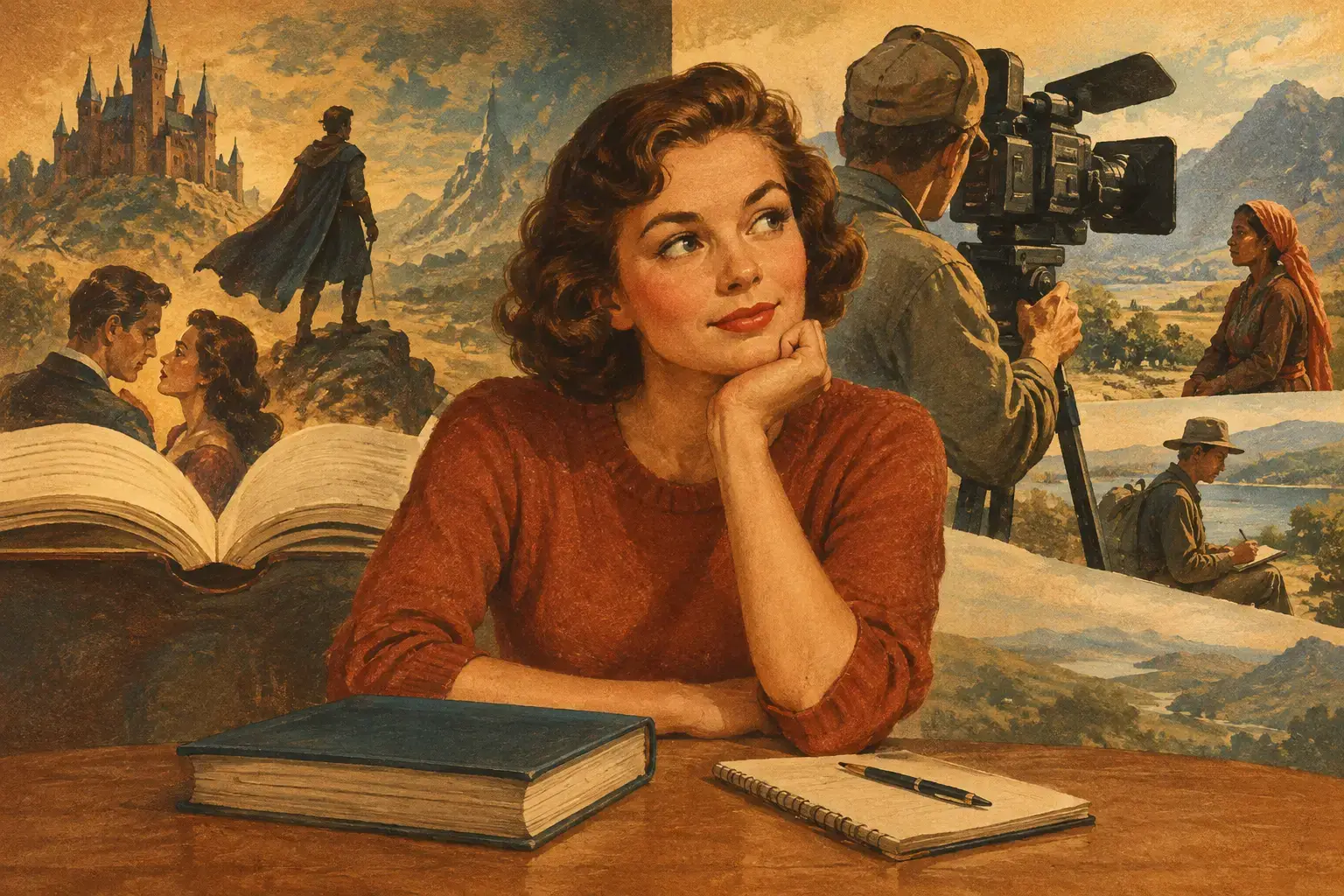
A cellar can hold a century in silence: the label on a dusted bottle, the handwritten notes beside a fermentation tank, the memory of a mentor whose standards outlived him. Book adaptation versus documentary storytelling begins in that silence, with one central question: what must a historical life become when it moves from researched pages to a screen?
For stories rooted in wine, migration, scientific discovery, and American reinvention, the answer is never simply “a film version of a book.” A book and a documentary are distinct acts of preservation. Each can honor a consequential figure. Each can reach audiences the other cannot. Yet each asks its audience to experience truth, memory, and character in a different way.
The story of André Tchelistcheff, the Russian-born winemaker whose work helped reinvent American winemaking, makes the distinction especially clear. His life contains the architecture of great historical narrative: survival through revolution and war, rigorous scientific training, arrival in a new country, and a career that elevated Napa Valley from regional promise to global authority. The facts are powerful. The telling determines how those facts endure.
What a Book Can Preserve That Film Cannot
A book is uniquely suited to the patient accumulation of a life. It can remain with the detail that a screen must often compress: the political upheaval that shaped a young man in Russia, the discipline of enology, the technical decisions made in a cellar, and the network of growers, mentors, and apprentices behind a celebrated vintage.
That depth matters because historical transformation is rarely a single dramatic moment. Modern California wine was not created by one toast, one review, or one famous competition. It emerged through decades of work in vineyards and laboratories, through failures corrected, standards raised, and knowledge passed from one generation to another. Literary nonfiction gives the reader room to understand the chain of cause and effect.
A book also gives interiority a particular authority. Through letters, interviews, archival records, and carefully reconstructed context, it can trace how a subject thinks. It can linger on contradiction. A giant among his peers may still be impatient, private, demanding, or uncertain. Those dimensions do not diminish a legacy. They make it credible.
For wine audiences, that patient approach can illuminate why a technical principle matters. Temperature control, sanitation, oak aging, vineyard selection, and sensory judgment may sound specialized in isolation. Within a biography, they become evidence of a mind at work. The reader sees not only that Tchelistcheff influenced California wine, but how disciplined craft became cultural change.
The trade-off is that books ask for time and imagination. They invite a reader into the archive, but they cannot supply the sound of a harvest crew before dawn or the sight of an elder winemaker moving through a familiar cellar. Their power is cumulative rather than immediate.
What Documentary Storytelling Makes Present
Documentary gives history a body, a voice, and a landscape. A Napa Valley road in early light, the clink of bottles on a bottling line, the grain of a family photograph, and the testimony of someone who learned directly from a master can create a form of presence no paragraph can replicate.
That presence is especially valuable when a legacy lives in people as much as in documents. In documentary storytelling, a former colleague can pause before describing a mentor. A vintner can hold an old tool or open a bottle from a defining year. An archivist can reveal a photograph whose faces suddenly make an era feel near. These moments are not decorative. They make cultural memory tangible.
The medium also excels at placing one life inside a wider historical landscape. A documentary about California wine can move from prewar Europe to postwar America, from a laboratory bench to a vineyard, from Napa’s early ambitions to the global attention surrounding the 1976 Judgment of Paris. Images, music, location, and editing allow viewers to feel the momentum of change as a shared cultural event.
For institutions, wineries, and audiences who may not begin with deep wine knowledge, this accessibility is significant. A well-made documentary can welcome a curious visitor, a hospitality professional, or a younger viewer into a sophisticated story without flattening it. The challenge is not to simplify the history beyond recognition. It is to make complexity emotionally legible.
But documentary has its own limits. Screen time is finite. Interviews are shaped by memory. Archival footage may be scarce, expensive, or unavailable. Every cut carries an interpretive decision: whose recollection leads, which event becomes the turning point, and what nuance is left just outside the frame. A documentary can be deeply researched and still must choose.
Book Adaptation Versus Documentary Storytelling Is Not a Contest
The most useful way to consider book adaptation versus documentary storytelling is not as a competition between superior and inferior forms. It is a question of purpose.
A book may be the foundation when a subject’s record needs to be established with breadth, sourcing, chronology, and intellectual depth. It can create an enduring reference point for collectors, scholars, wine professionals, and readers who want to understand the forces behind a legend. It can preserve names and details that a conventional screen narrative cannot accommodate.
A documentary may be the first encounter when a story needs to travel widely and move people quickly. It can animate a historical figure for viewers who have never read a wine biography, never visited Napa, or never considered how immigrant expertise helped shape American culture. When the goal is public memory, visual storytelling can bring an overlooked legacy into the room.
The strongest historical properties recognize that these roles can reinforce one another. The book establishes the full world. Documentary brings selected moments into vivid focus. A scripted series may then explore the dramatic sweep of a life through performance, while short narrated pieces can introduce individual chapters to new audiences. This is not repetition. It is a considered stewardship of a story across forms.
The Adaptation Question: What Is the Emotional Spine?
Adaptation becomes difficult when a team treats a book as a sequence of scenes waiting to be extracted. Historical books often contain multiple narratives at once: family history, political upheaval, professional apprenticeship, regional development, and cultural influence. A documentary cannot carry all of them at equal weight.
The work is to find the emotional spine without betraying the larger truth. In Tchelistcheff’s case, that spine might be the journey of a man miraculously rescued from a fractured world who brought scientific precision and uncommon conviction to a young American wine industry. Another approach might center on mentorship, following the people who carried his standards forward. A third could frame the story through Napa Valley’s ascent and the moment California wine earned international recognition.
Each approach can be honest. Each creates a different documentary. The decision should follow the intended audience and the available evidence, not merely the most marketable premise.
This is where preservation-minded producers earn trust. They resist the temptation to turn history into a simple triumph narrative. Achievement has texture. Napa’s rise involved labor, capital, risk, competition, and many hands. A great documentary allows a central figure to shine while acknowledging the ecosystem that made lasting change possible.
Evidence, Access, and the Ethics of Memory
Historical storytelling gains power when its confidence is earned. Books can show their research through notes, bibliographies, quotations, and a detailed chronology. Documentary must establish comparable credibility through archival rigor, expert voices, transparent context, and careful use of reenactment when reenactment is necessary.
Access affects both forms. Family archives, winery records, correspondence, vintage photographs, and first-person witnesses can transform a project. So can the absence of them. When evidence is incomplete, responsible storytelling does not invent certainty. It identifies the gap, frames the possibilities, and lets the audience understand what is known.
That discipline is particularly important with revered figures. Reverence should not mean embalming a subject in praise. The goal is to preserve a human legacy with enough specificity that future generations can recognize its scale. The master becomes more compelling when viewers and readers can see the work, the costs, the relationships, and the convictions behind the reputation.
A Legacy Needs More Than One Vessel
For a culture-shaping life, the ideal question is not whether the book should become a documentary. It is what each form can carry forward with integrity. The page can safeguard the full record. The screen can give it breath, place, and public feeling. Together, they can ensure that a legacy is not reduced to a date on a label or a line in a tasting-room script.
Stories such as André Tchelistcheff’s ask more of us than admiration. They ask us to remember how knowledge travels, how immigrants reshape a nation, and how one exacting individual can raise the aspirations of an entire region. Preserve the evidence first. Then choose the form that lets the next generation hear the cellar door open.