A bottle can preserve a vintage, but it cannot preserve the voice of the person who made it. Vineyard oral history carries what ledgers, tasting notes, and polished brand timelines often leave behind: the first frost someone remembers, the difficult harvest that changed a family’s fortunes, the mentor whose exacting standards reshaped a cellar, and the immigrant journey behind a new American tradition.
For Napa Valley and other great wine regions, those recollections are not decorative additions to history. They are part of the record. They explain how a rural agricultural valley became a global symbol of American wine, and why the people who worked its vineyards and cellars deserve to be remembered alongside its labels and landmark vintages.
What Vineyard Oral History Can Preserve
Wine history is often told through milestones: a winery opens, a vineyard is planted, a critic awards a score, a bottle triumphs on an international stage. Those moments matter. Yet the human choices beneath them are usually more complicated, more revealing, and more cinematic.
An oral history captures the texture of those choices. A vineyard manager may recall learning to read a block of Cabernet by its dust, wind, and uneven vigor. A cellar worker may describe the physical reality of night harvests before modern equipment changed the pace of production. A family member may remember a parent mortgaging everything to replant vines after a bad season. None of this is likely to appear in a corporate archive, but each account can illuminate how a region evolved.
The form is especially valuable in wine because expertise has long moved through conversation. Technical knowledge is taught in laboratories and universities, but also in the small, repeated exchanges of working life: a warning about picking too early, a correction at the press, a lesson shared over a barrel sample. These memories reveal the human chain behind a celebrated bottle.
They also restore scale to the story. A famous winery may have one public founder, but it was built by growers, foremen, harvest crews, cooks, mechanics, salespeople, and families who endured uncertainty alongside the visible figures. Oral history does not diminish great leaders. It gives their achievements the full community they required.
The Voices Behind Modern California Wine
Andre Tchelistcheff’s life demonstrates why personal testimony matters. The Russian-born winemaker survived revolution and displacement, pursued scientific training in France, and arrived in the United States with a formidable understanding of fermentation and cellar practice. At Beaulieu Vineyard, he helped establish methods that would alter the standards and ambitions of California wine.
The historical outline is extraordinary on its own. But oral accounts from colleagues, protégés, growers, and friends give the story its force. They recall a master of exacting discipline, a teacher with strong opinions, and a man whose influence extended far beyond the winery where he worked. Such recollections make clear that Tchelistcheff was not merely a technical innovator. He was a giant among his peers whose mentorship helped form a generation.
That distinction matters when telling the larger Napa story. Modern California winemaking did not emerge from one person, one estate, or one celebrated event. It emerged through relationships: European knowledge meeting California fruit, scientific rigor meeting entrepreneurial risk, and experienced mentors challenging younger winemakers to think beyond the next harvest.
The Judgment of Paris became an international turning point because it made the world look at California differently. Yet the achievement was decades in the making. Oral history can trace the patient groundwork – the experiments, setbacks, arguments, and acts of faith – that made that moment possible. It turns a famous result into a living narrative of preparation.
Why These Accounts Must Be Recorded Now
Oral history has a deadline. The people who remember a winery’s formative decades are not permanent custodians of those memories. When they are gone, a region can retain its buildings, photographs, and bottles while losing the context that tells future generations what those objects meant.
This is particularly urgent for mid-century California wine history. Many of the men and women who witnessed postwar expansion, the rise of fine-wine standards, and Napa’s emergence on the world stage carried knowledge that was never formally documented. Some came from families that viewed their labor as ordinary rather than historic. Others worked behind the scenes in an industry accustomed to celebrating owners, critics, and public-facing winemakers.
Recording these voices is an act of cultural preservation, but it is also an act of fairness. It recognizes that history belongs not only to those who signed the labels, but to those who planted, pruned, repaired, fermented, transported, hosted, and taught.
For wineries, the value is practical as well as cultural. A carefully gathered oral-history archive can deepen staff education, inform visitor experiences, guide anniversary projects, and protect institutional memory during changes in ownership or leadership. It can give a brand language that is earned rather than manufactured. The strongest stories do not need embellishment. They need careful listening.
How to Build a Vineyard Oral History That Lasts
A meaningful project begins with purpose. Is the goal to document a founding family, preserve the knowledge of longtime employees, understand a vineyard’s agricultural transformation, or place a winery within the broader history of its region? The answer shapes whom to interview and which questions deserve time.
Begin before the camera or recorder is switched on. Review harvest records, photographs, correspondence, old newsletters, cellar logs, maps, and family collections. These materials do not replace testimony. They help prompt it. A photograph of an early crush pad may bring back a name, a disagreement, or an entire lost routine.
Then make room for memory to move naturally. The best interviews do not rush toward a predetermined quote. Ask a grower to describe the first day they arrived at the property. Ask a retired cellar hand what a difficult vintage smelled like. Ask what people feared, what they argued about, and who taught them the work. Details often emerge after the expected answer has ended.
Accuracy remains essential. Memory can be vivid and imperfect, especially across decades. Dates, names, and claims should be checked against available records, and differing accounts should be preserved rather than forced into artificial agreement. Contradiction is not always a flaw. It can reveal how an event was experienced differently by people with different roles and stakes.
Ethics matter, too. Interviewees should understand how their words may be edited, shared, archived, or adapted for books and screen projects. Sensitive family histories, workplace conflicts, and accounts involving people who cannot respond require judgment. The aim is not to sanitize the past, but to handle it with the rigor and respect that enduring history demands.
From Recorded Memory to a Story People Can Feel
An archive becomes most powerful when it is made accessible without being simplified. A recorded conversation may hold the raw material for a museum installation, a winery exhibit, a documentary sequence, a book chapter, or an educational program. Each format asks different questions of the material, but the original voice remains the anchor.
That is where historical storytelling can become more than nostalgia. A voice describing a first encounter with Tchelistcheff, or a grower recalling the risks of an early planting, can connect audiences to migration, scientific ambition, family sacrifice, and the long work of building American excellence. These are not side stories to wine. They are the story.
Maestro Productions approaches this legacy as living cultural material – history with the emotional scale of cinema and the discipline of serious research. The purpose is not to freeze the past behind glass. It is to preserve it in forms that can still move a reader, visitor, viewer, or young winemaker toward a deeper sense of stewardship.
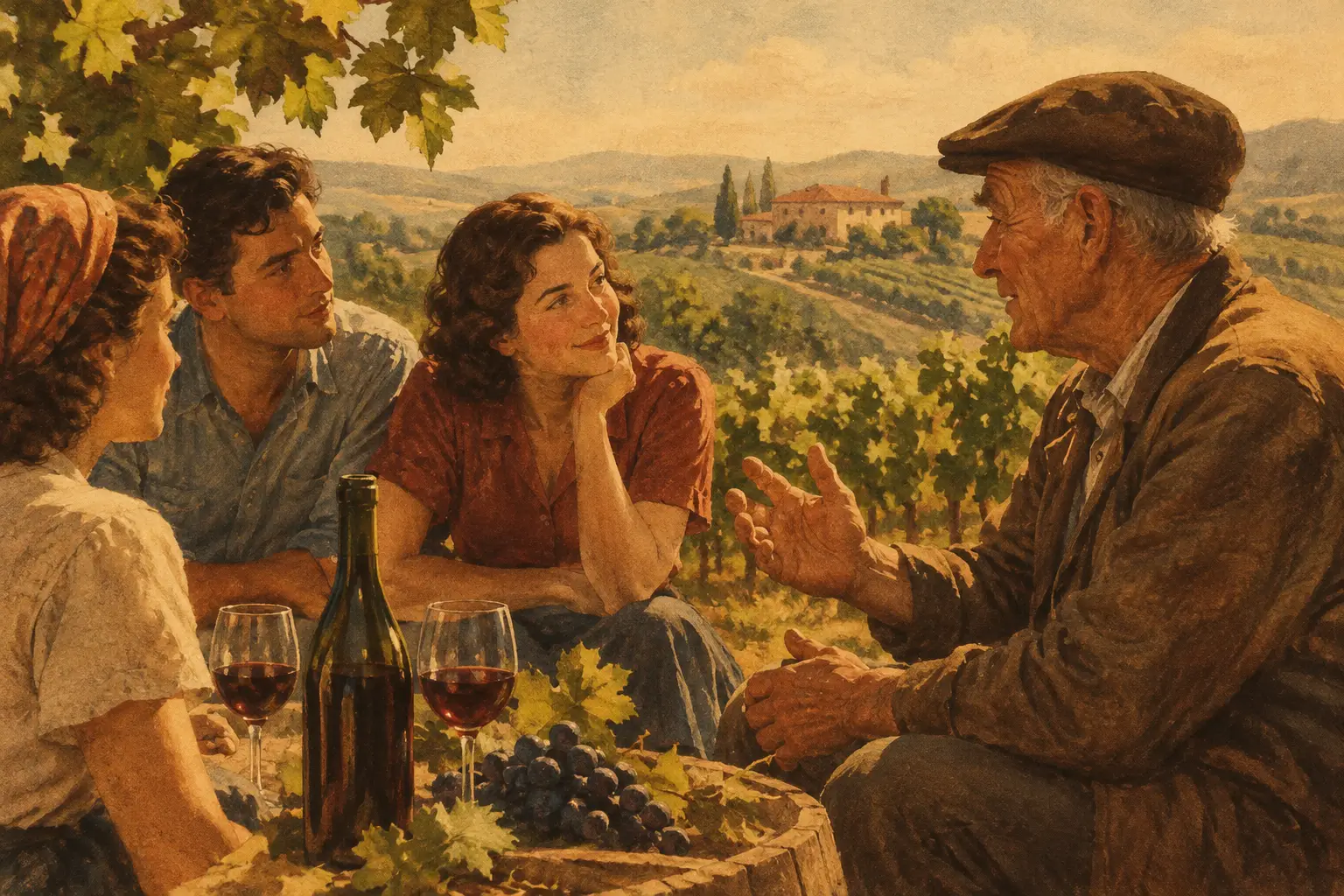
A winery does not have to wait for a centennial celebration to begin. Record the veteran employee who knows why a block was planted where it was. Ask the family elder what the first harvest cost them. Invite the quiet keeper of institutional memory to speak while the details are still close at hand. The next great story of American wine may already be sitting across the table.