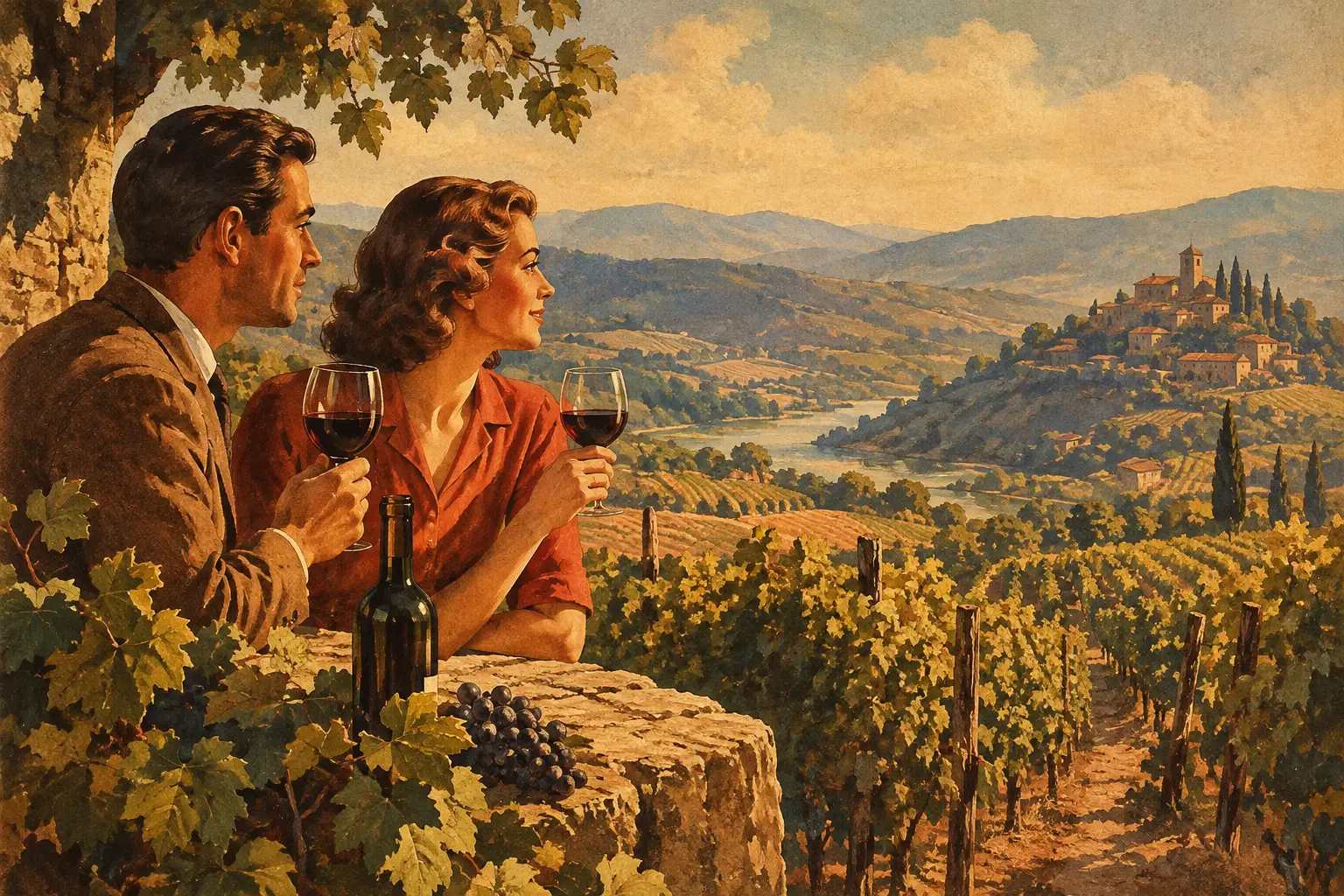
A bottle of Napa Valley Cabernet can carry the heat of an August afternoon, the cooling breath of San Pablo Bay, the resistance of volcanic rock, and the decisions of the people who refused to accept that California wine had a fixed ceiling. That is wine terroir: not a decorative word on a label, but a record of place made visible through taste.
For generations, wine lovers have been taught to look first at a grape variety. Cabernet Sauvignon, Chardonnay, Zinfandel. But grapes are only the beginning of the story. The same Cabernet planted a few miles apart can become something altogether different. One wine may be taut, dark, and mineral-driven; another may be broad, fragrant, and sun-warmed. The distinction is not magic. It is the accumulated force of geography, weather, farming, and human judgment.
In California, that truth became the foundation of a revolution. The rise of Napa Valley was not simply a commercial success story. It was the work of people who learned to read a landscape, respect its limits, and recognize its extraordinary potential.
What Wine Terroir Really Means
Terroir is often translated as “sense of place,” but the phrase deserves more precision. Wine terroir describes the conditions that shape a vineyard and, ultimately, the character of its wine. Soil is part of it, certainly, but soil alone does not explain why a vineyard matters. Elevation, slope, drainage, sunlight, wind, fog, rainfall, temperature shifts, rootstock, vine age, and farming choices all play their part.
Then comes the human hand. A vineyard is not wilderness. Rows are planted, pruned, irrigated or dry-farmed, harvested, and interpreted. A winemaker decides when fruit is ripe enough to pick, how long the juice remains with its skins, whether oak should frame the wine or stay in the background, and whether power should yield to balance. Terroir is therefore not nature untouched by people. It is a conversation between a place and those disciplined enough to listen.
That distinction matters because terroir is sometimes used as shorthand for prestige. A famous appellation may signal quality, but fame is not terroir. A great site must still be cultivated with care. An acclaimed vineyard can lose its voice through careless farming or heavy-handed winemaking. Conversely, a modest site can reveal remarkable character when someone understands what it wants to become.
Napa Valley and the Art of Difference
Napa Valley is compact on a map but vast in its variations. The valley floor, benchlands, mountain slopes, and cooler southern reaches do not speak with one voice. Morning fog can move north from the bay, tempering the heat in places such as Carneros and southern Napa. Higher elevations can bring thinner soils, more intense sunlight, and dramatic shifts between day and night. Gravelly alluvial fans, ancient seabed deposits, and fractured volcanic ground each influence how vines struggle, drain, and ripen.
This complexity explains why Napa cannot be reduced to a single style, even when Cabernet Sauvignon remains its most celebrated grape. Rutherford may offer generous fruit and supple structure. Oakville can deliver concentration and perfume. Stags Leap District is often associated with fine tannins and elegance, while Howell Mountain wines may arrive with mountain-born intensity. These are tendencies, not guarantees. Vintage conditions and producer choices always matter.
The finest wines do not erase these distinctions in pursuit of uniformity. They preserve them. A compelling bottle should feel anchored somewhere real. It should suggest that it could not have been made in exactly the same way anywhere else.
Climate is the Vineyard’s Clock
Of all terroir’s forces, climate may be the most immediately felt. Grapes need sunlight to ripen, but they also need enough coolness to retain acidity, fragrance, and shape. Too much heat can produce fruit that is high in sugar yet short on definition. Too little warmth can leave tannins green and flavors undeveloped.
Napa Valley’s Mediterranean pattern, with dry growing seasons and warm days, offers a powerful advantage. Its cooling influences are equally essential. Nighttime temperature drops slow the vines’ metabolism and help preserve freshness. Coastal fog acts less like a postcard image than a natural regulator, making certain vineyards suitable for varieties that would struggle farther inland.
Climate is also where the future becomes most urgent. Earlier harvests, hotter spikes, drought pressure, wildfire smoke, and erratic rainfall are not abstract concerns for growers. They alter decisions at every stage. The enduring lesson of terroir is not that a region remains unchanged. It is that serious winegrowing requires adaptation without surrendering a place’s identity.
Andre Tchelistcheff and the Discipline of Place
Few figures understood this responsibility more profoundly than Andre Tchelistcheff. Miraculously rescued from the upheaval that followed the Russian Revolution, he carried his scientific training and formidable curiosity across continents before arriving in California in 1938. At Beaulieu Vineyard, he became a giant among his peers and helped reinvent American winemaking.
Tchelistcheff did not manufacture greatness through technique alone. He brought rigor to California at a moment when its finest vineyards needed a translator. He championed careful sanitation, cold fermentation, controlled aging, and a more exacting approach to vineyard and cellar work. Yet his influence was never merely mechanical. He recognized that California could produce wines of distinction because its sites possessed their own character, worthy of study rather than imitation.
His famous mentorship extended far beyond one winery. Generations of vintners absorbed his insistence on balance, cleanliness, patience, and respect for fruit. He helped establish a culture in which American wine could be judged not as a provincial curiosity but as a serious expression of land and craft.
That legacy helped prepare the ground for the 1976 Judgment of Paris, when California wines startled the old guard in a blind tasting against celebrated French competitors. The event was not proof that one nation had defeated another. It was proof that excellence could emerge wherever talent, discipline, and remarkable terroir met.
Why Terroir Cannot Be Reduced to Tasting Notes
Wine language often reaches for a catalog of flavors: blackberry, cedar, violet, lemon curd, wet stone. These descriptions can be useful, but they are not the whole experience. Terroir is less about identifying one isolated taste than recognizing proportion and persistence. Does the wine hold together? Does its texture match its aroma? Does its finish leave an impression of freshness, depth, or tension?
A wine may not announce its origin in an obvious way. In fact, the most forceful signature of place can be structural. A mountain Cabernet may carry tannins that feel firm and granular. A cool-climate Chardonnay may have a line of acidity that seems to pull the wine forward. These qualities are not easily captured by a single adjective, but experienced drinkers recognize them over time.
This is why comparison is so valuable. Taste two wines made from the same grape, in the same vintage, from different Napa subregions. Then taste two vintages from the same producer. Patterns emerge. Weather leaves its mark. Vineyard position matters. So does the winemaker’s willingness to let differences remain visible.
The Preservation of a Living Legacy
Terroir asks us to see wine as more than luxury, status, or collectible scarcity. Every vineyard is part of a larger inheritance. It holds geological history, agricultural labor, immigrant ambition, scientific innovation, family risk, and the accumulated knowledge of those who came before.
For Napa Valley, preserving that inheritance means protecting agricultural land, honoring vineyard workers and growers, documenting the people who changed the region, and approaching innovation with humility. Progress has always been essential to California wine. But progress without memory can flatten what made the place meaningful in the first place.
The next time a bottle is opened, pause before searching for the score or the price. Ask where the vines stood, what season they endured, and whose judgment guided the wine into being. In that moment, wine terroir becomes more than an idea. It becomes a living history, still speaking from the glass.