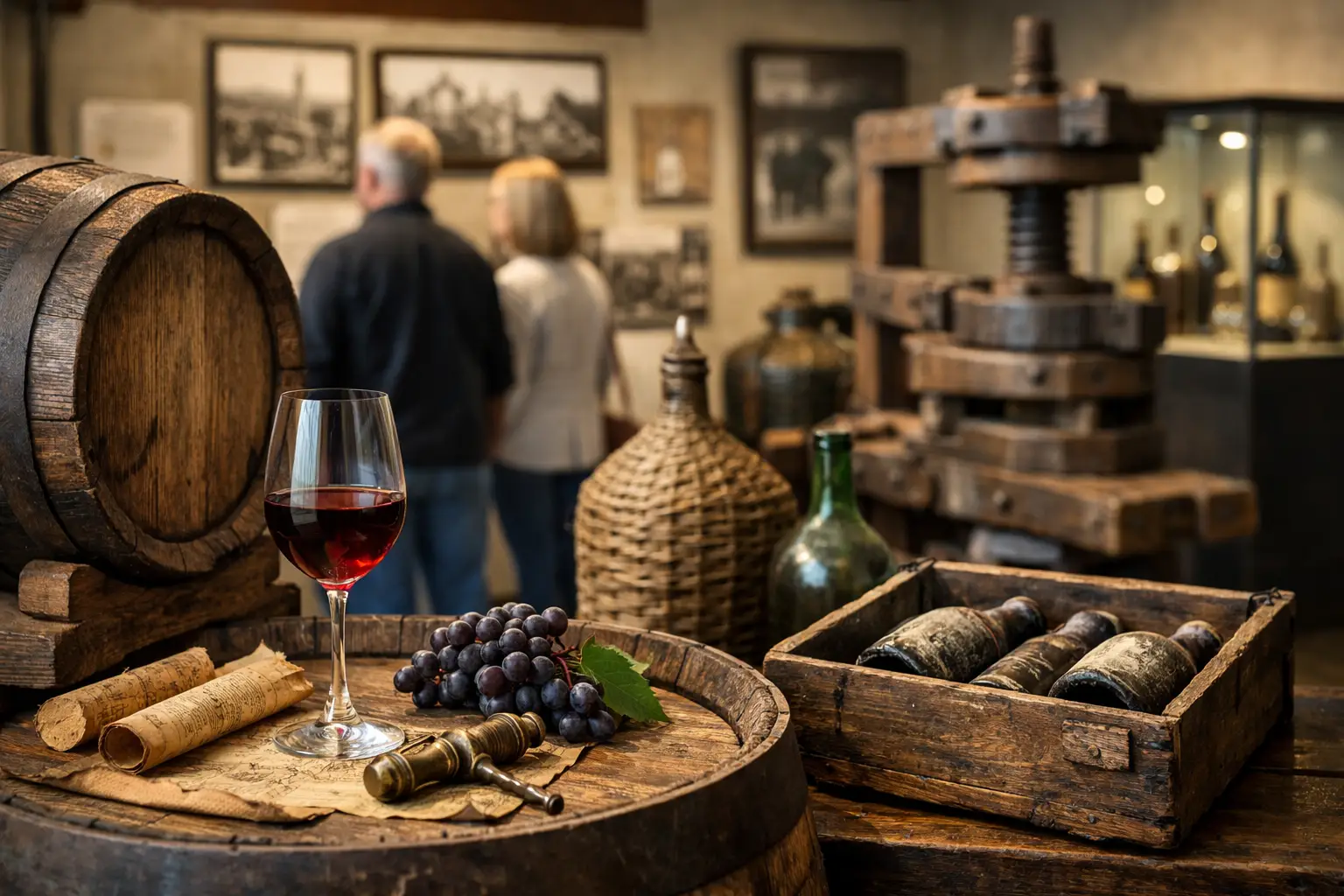
A bottle can carry a vineyard’s name across decades. It cannot, by itself, explain the hands that pruned the vines, the scientist who changed the cellar, the family that held on through prohibition, or the immigrant who arrived with knowledge America had yet to recognize. Wine heritage exhibits give those stories a physical presence. They turn an estate visit from a pleasant tasting into an encounter with the forces that made a region matter.
For California, this is not a minor distinction. The state’s wine culture was shaped by migration, war, agricultural risk, scientific discipline, entrepreneurial nerve, and a long struggle for international respect. Its most influential figures did more than make fine wine. They altered the way Americans thought about land, taste, craftsmanship, and possibility.
Wine Heritage Exhibits Give Place Its Memory
Great wine regions are often described through geography: a valley, a mountain range, a coastal fog line, a particular soil. Those elements are essential, but they are only part of the story. A place becomes a cultural landscape when its people, decisions, setbacks, and achievements are remembered alongside its terrain.
That is the work of wine heritage exhibits. At their best, they gather photographs, correspondence, tools, cellar records, oral histories, vintage maps, labels, and film into a coherent narrative. A weathered notebook may reveal how a winemaker approached fermentation. A family portrait may introduce the people who risked everything on a vineyard when its future was uncertain. A surviving barrel sample, a tasting journal, or a newspaper clipping can show how a local wine earned its first national attention.
These objects are not decorative props. They are evidence. They allow visitors to see that celebrated wines did not emerge fully formed from a beautiful landscape. They were built through judgment, repetition, failure, and unusually persistent belief.
For wineries, the value is practical as well as cultural. A tasting room can offer hospitality; an exhibit can establish identity. The difference matters in a market where many visitors are looking for more than another pour. They want to understand why a producer’s name endures, what a region overcame, and how one generation’s work shaped the next.
The Human Drama Behind Modern California Wine
California wine has no shortage of pivotal characters, but few embody its transformation more fully than Andre Tchelistcheff. Russian-born, rigorously trained, and miraculously rescued from the upheaval of twentieth-century Europe, Tchelistcheff came to Napa Valley carrying scientific knowledge and an exacting view of what American wine could become.
At Beaulieu Vineyard, he brought new precision to winemaking at a time when California’s industry was still defining itself after Prohibition. His work in fermentation, sanitation, aging, vineyard practices, and varietal character helped establish standards that later generations would inherit. He did not simply refine a single winery’s output. He helped reinvent American winemaking.
An exhibit centered on a figure of this stature should resist the temptation to turn him into a distant monument. The deeper story is found in the tensions of his life: displacement and arrival, old-world training and new-world ambition, laboratory rigor and agricultural unpredictability. Visitors should come away with a sense of the man in motion – a master adapting his knowledge to a landscape that would, in time, become globally revered.
That approach also makes room for the people around him. The owners who entrusted him with responsibility, the cellar crews who carried out demanding work, the growers who learned new methods, and the younger winemakers who sought his counsel all belong in the story. Wine is collaborative by nature. Its legends are often singular, but its achievements rarely are.
Beyond the Famous Bottle
The most effective exhibit does not begin and end with trophy wines. It asks what happened before the bottle reached the table. How did a vineyard survive disease, drought, economic pressure, or changing consumer tastes? Which innovations appeared quietly in the cellar long before critics took notice? What did an immigrant winemaker see in California that native-born producers had not yet imagined?
These questions make heritage vivid because they restore uncertainty. The past feels remote when every outcome appears inevitable. It becomes immediate when visitors understand that Napa Valley’s rise was never guaranteed.
The Judgment of Paris offers a powerful example. The 1976 tasting is often told as a triumphant headline: California wines stunned French judges and altered global perceptions. Yet the event gains meaning when placed in context. It was the result of years of disciplined vineyard work, confidence built against skepticism, and mentors who had already raised expectations across the region. The surprise in Paris was not luck. It was the delayed recognition of a transformation already underway.
What a Meaningful Exhibit Requires
Not every winery needs a formal museum, and not every heritage story demands a large permanent installation. A modest display can be deeply moving if it has a clear point of view and real material behind it. The trade-off is between breadth and intimacy. A broad regional exhibit can place one winery in a sweeping historical context; a focused collection can reveal the texture of one family, one vineyard, or one pivotal vintage.
Whatever the scale, the strongest work begins with research rather than design. Archives must be examined carefully. Dates need verification. Family recollections should be honored while distinguished from documented fact. The goal is not to flatten a complicated history into a marketing slogan. It is to shape a truthful story with dramatic force.
Visual presentation matters, too. Wine history should feel alive, not embalmed. Projected footage, narrated audio, enlarged harvest photographs, handwritten letters, and objects with visible use can create a sense of presence. A visitor may forget a timeline, but remember the sound of a winemaker describing frost in the vineyard, or the sight of an old lab instrument used to protect a fragile vintage.
There is also a responsibility to widen the frame. California wine history includes celebrated proprietors and critics, but it also includes farmworkers, cellar workers, coopers, restaurateurs, distributors, educators, and immigrant communities whose labor and knowledge sustained the industry. A heritage exhibit becomes more credible, and more compelling, when it acknowledges the full human ecosystem behind a great wine region.
A Cultural Asset, Not a Decorative Feature
For institutions, wineries, and preservation partners, heritage storytelling can serve several audiences at once. It gives visitors a richer experience. It helps younger generations understand what they have inherited. It creates material for books, documentaries, educational programming, and public conversations. It can also deepen relationships with collectors, hospitality professionals, and cultural travelers who seek authenticity over spectacle.
Yet authenticity does not mean avoiding cinematic storytelling. The opposite is often true. A well-researched historical narrative has natural drama: a survivor reaches a new country; a remote valley builds a reputation; a mentor shapes an entire generation; a bottle from an underestimated region changes the world’s opinion. These are not invented plots. They are the real stakes of American wine.
That is why projects such as Wine Elf matter beyond biography. They preserve a record of expertise that could otherwise dissolve into anecdote. They recognize that Tchelistcheff was not merely a name on a commemorative plaque, but a giant among his peers whose influence remains present in the standards, vineyards, and wines of California.
Let the Visitor Leave With a Question
The best exhibits do not attempt to settle history once and for all. They leave room for curiosity. A visitor who learns how a wine region was made may begin to ask different questions at the table: Who planted these vines? Who taught this cellar its discipline? What risks made this vintage possible? What knowledge deserves to be carried forward?
That curiosity is a form of preservation. When a story is told with care, it does not remain behind glass. It travels home with the visitor, returns in conversation, and finds new life in the next generation of makers and stewards.

