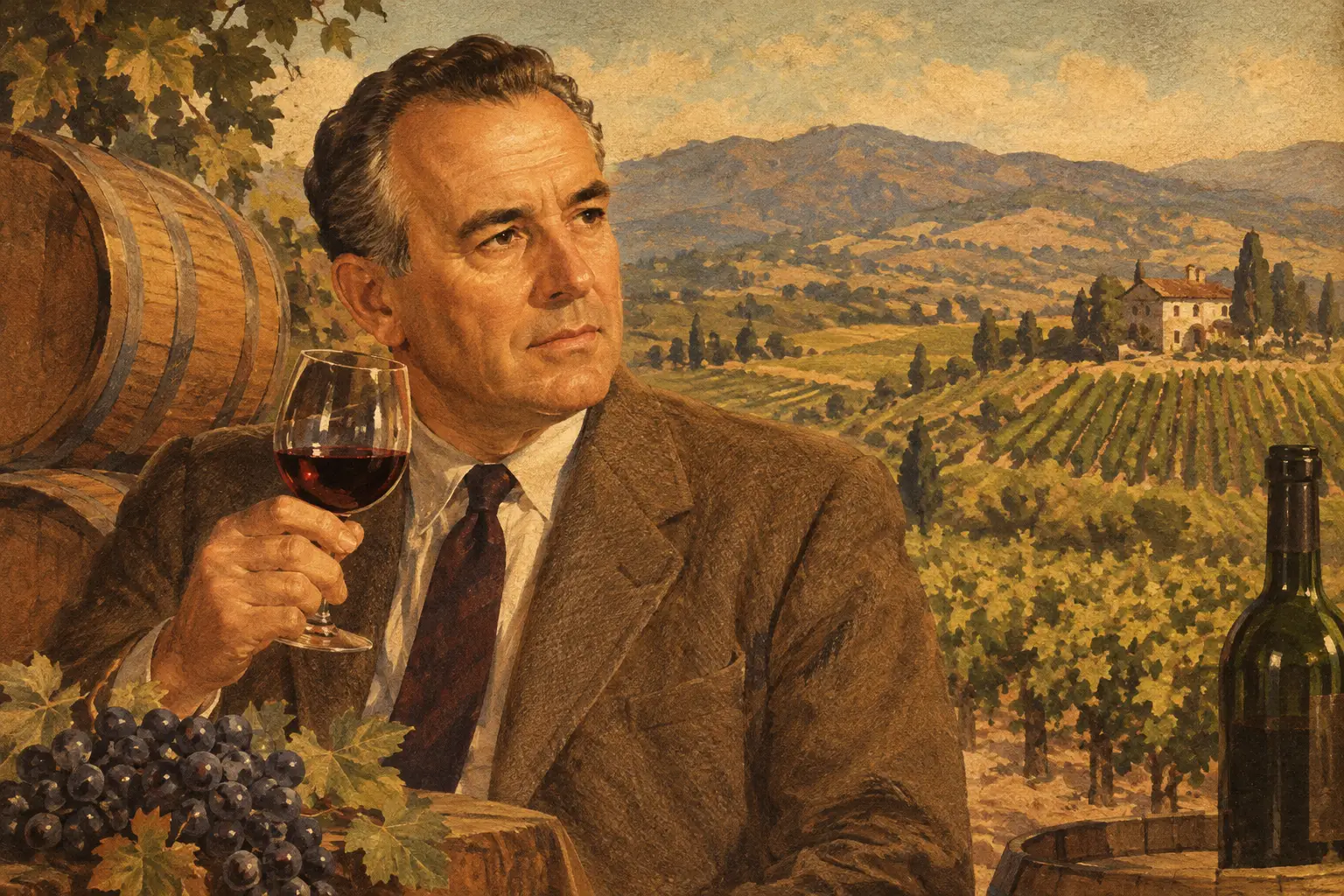
A bottle can preserve more than fruit, place, and time. It can preserve the convictions of the people who made it. To ask who was Tchelistcheff is to ask how Napa Valley found the confidence, discipline, and imagination to stand beside the great wine regions of the world.
André Tchelistcheff was the Russian-born winemaker, scientist, teacher, and indefatigable mentor widely known as the father of modern California winemaking. At Beaulieu Vineyard in Rutherford, beginning in 1938, he brought European technical rigor to an American industry still searching for its identity after Prohibition. His influence reached far beyond one cellar. It shaped how California growers understood vineyards, how wineries handled wine, and how a generation of future leaders came to believe that Napa could make wines of international consequence.
His story is not simply one of professional achievement. It is a story of survival, migration, and the rare ability to turn knowledge into a living legacy.
Who Was Tchelistcheff Before Napa?
André Tchelistcheff was born in Moscow in 1901, into a Russia that would soon be overturned by revolution and civil war. His youth unfolded amid political collapse and personal danger. Like many displaced Russians of his generation, he was forced to build a future far from the country of his birth.
That journey brought him to France, then the unquestioned center of the wine world. There, Tchelistcheff pursued scientific training in agronomy, microbiology, and fermentation. He absorbed the French conviction that great wine begins with exacting work: healthy vineyards, clean cellars, close observation, and respect for the individual character of a site.
This combination made him unusual. He possessed a scientist’s command of microbial life and chemistry, but he never treated wine as an industrial formula. He understood that precision was not the enemy of beauty. It was one of beauty’s necessary conditions.
In the late 1930s, Georges de Latour, the founder of Beaulieu Vineyard, sought someone capable of elevating the estate’s wines. The recommendation came through French wine circles, and Tchelistcheff accepted the opportunity to travel to California. In 1938, he arrived at Beaulieu Vineyard. Napa Valley had gained a master, though few people yet understood the scale of the transformation to come.
The Winemaker Who Reinvented American Standards
When Tchelistcheff began work at Beaulieu, California wine was recovering from the long damage of Prohibition. Many vineyards had been neglected or replanted for quantity. Winery equipment and sanitation varied widely. Fine wine existed, but the systems needed to produce it consistently were still emerging.
Tchelistcheff raised the standard from the ground up. He emphasized vineyard selection, careful harvesting, sanitary cellar practices, temperature control, and thoughtful aging. He championed techniques that are now fundamental to fine winemaking, including cold fermentation for white wines, controlled malolactic fermentation for reds, and aging in French oak barrels.
These practices can sound commonplace because California eventually adopted them so thoroughly. At the time, however, they reflected a new level of intention. Tchelistcheff taught that wine should not be left to chance. A flawed fermentation, an unclean tank, or poorly chosen fruit could compromise a wine before it had the opportunity to speak of its vineyard.
His work on Cabernet Sauvignon became particularly influential. At Beaulieu, he helped establish Georges de Latour Private Reserve as one of California’s benchmark wines. The wine was structured, age-worthy, and distinctly Napa in character. It offered proof that California could produce more than pleasant young wines. It could produce bottles that developed complexity and commanded serious attention over decades.
The achievement involved more than importing European methods. Tchelistcheff understood that Napa was not Bordeaux, Burgundy, or Champagne. California’s sunlight, soils, growing conditions, and agricultural possibilities demanded their own response. His genius was adaptation. He brought deep Old World learning to a New World landscape without insisting that the landscape become something it was not.
A Teacher in the Cellar and Vineyard
Tchelistcheff’s greatest impact may have come through the people who sought his counsel. He was a giant among his peers, but he was also a demanding and generous guide. Winemakers, growers, and winery founders came to him for judgments on vineyard sites, cellar problems, and the direction of their wines.
His circle of influence included figures who would define the next era of Napa Valley. Robert Mondavi respected his counsel. Warren Winiarski, whose Stag’s Leap Wine Cellars Cabernet Sauvignon would triumph at the 1976 Judgment of Paris, worked under Tchelistcheff at Beaulieu. Mike Grgich, another central figure in California wine, was part of the generation shaped by the standards Tchelistcheff helped establish.
Mentorship in wine is rarely a tidy transfer of instructions. It happens through tasting, argument, observation, and repeated attention to small details. Tchelistcheff offered all of these. He could be exacting, even formidable, because he believed the work mattered. Yet his influence did not create a school of identical wines. It encouraged independent winemakers to pursue quality with seriousness and intellectual curiosity.
That distinction matters. Napa Valley’s greatness was not built by one man alone, nor by one formula. It was built by a community of growers, families, investors, cellar workers, and visionaries. Tchelistcheff became one of its defining forces because he helped give that community a shared language of excellence.
The Road to the Judgment of Paris
The 1976 Judgment of Paris did not emerge from nowhere. When California wines defeated celebrated French competitors in a blind tasting, the result shocked much of the wine establishment. But the victory rested on decades of patient work in vineyards and cellars across the state.
Tchelistcheff was not a contestant in that famous tasting, yet his presence was felt in its aftermath. Winiarski’s Stag’s Leap Wine Cellars Cabernet Sauvignon, which won the red wine competition, was made by a vintner trained at Beaulieu under Tchelistcheff. The triumph represented the flowering of a culture he had helped cultivate: one that believed California wines deserved rigorous standards, long-term ambition, and a seat at the global table.
It would be too simple to credit Tchelistcheff with every California milestone. The Judgment of Paris had many authors, including pioneering wineries, courageous investors, gifted growers, and the tasters who challenged received wisdom. Still, his role is essential to the story. He helped lay the technical and cultural foundation on which the moment stood.
Why Tchelistcheff Still Matters
André Tchelistcheff died in 1994, but his legacy remains present wherever California wine is made with disciplined attention to place. His name is often invoked as a symbol of authority, and rightly so. Yet the fuller lesson of his life is more compelling than a title.
He demonstrated that expertise can travel. A man shaped by revolution, exile, and scientific study arrived in a valley still finding its voice and helped it speak with confidence. He showed that tradition is not imitation. It is knowledge tested over time, carried forward by people willing to adapt it to new conditions.
For visitors tasting Cabernet in Rutherford, for collectors opening an aged Napa bottle, and for young vintners deciding how much to intervene in a difficult harvest, Tchelistcheff’s questions remain alive. Is the fruit worthy? Is the cellar disciplined? Does the wine express its place? Will it endure?
Maestro Productions carries this story forward because historical figures such as Tchelistcheff deserve more than a passing mention on a tasting-room wall. Their lives reveal how culture is made: through craft, courage, mentorship, and a belief that the next vintage can be better than the last.
The most meaningful way to honor Tchelistcheff is to taste with greater attention. Behind a great Napa wine stands not only a vineyard and a vintage, but a hard-won inheritance of knowledge, carried forward by hands that still believe excellence is worth pursuing.